
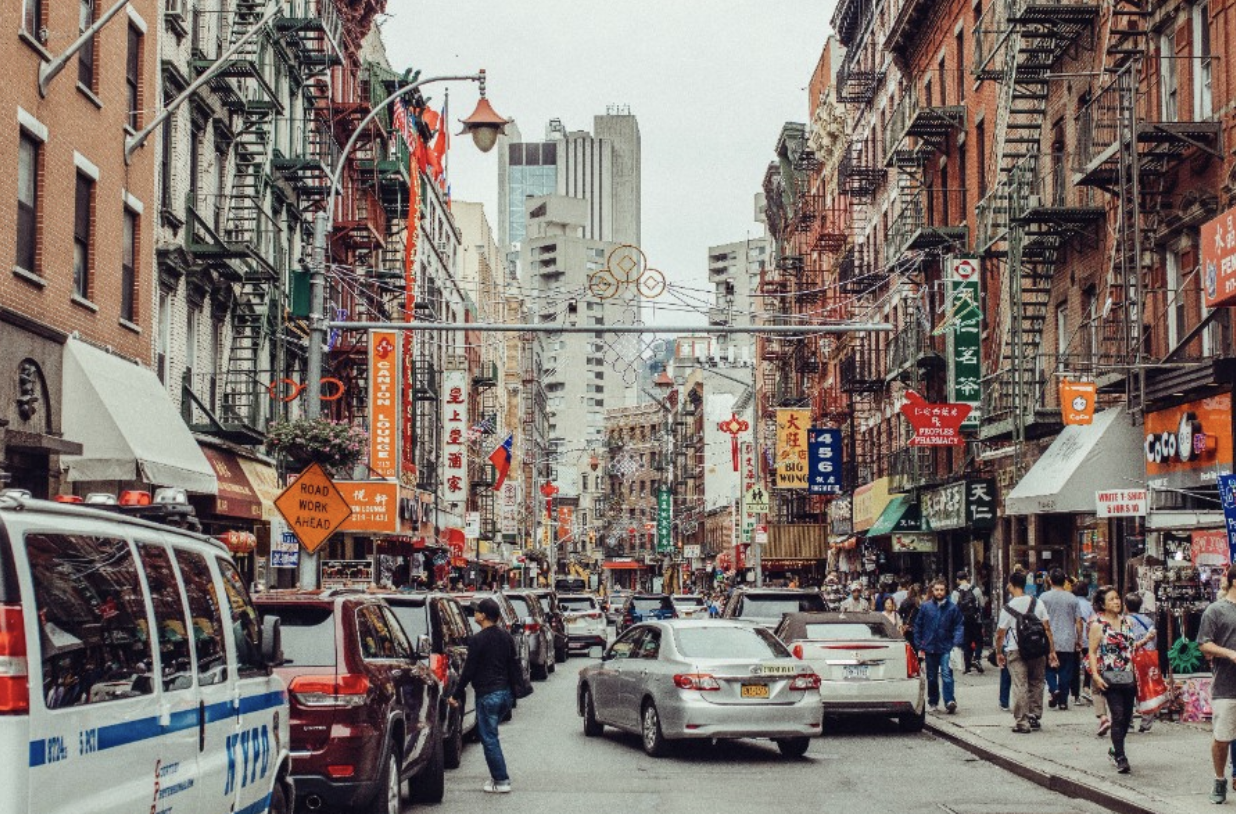
Photo via ExperienceFirst
***
On any given day in lower Manhattan, Canal pulses as one of New York City’s most recognizable scenes: rows of street vendors selling fake designer handbags, wallets, watches, jewelry, and sunglasses while tourists haggle for deals amidst the constant churn of pedestrians trying to navigate the chaos. For decades, Canal Street has been synonymous with knockoff luxury goods in the minds of New Yorkers. However, this street has inevitably become a strong point of tension, as its very existence embodies the stark contradictions that define years of racial, cultural, and economic inequalities in the city.
This past October, that long-standing, but typically subtle, tension erupted into national headlines. As part of a broader string of recent and increasingly aggressive immigration crackdowns unfolding under the Trump administration, federal immigration authorities conducted a raid on Canal Street, targeting vendors accused of selling counterfeit merchandise. Agents from Immigration and Customs Enforcement (ICE) swept through the area, ultimately detaining nine “illegal alien” vendors who allegedly had outstanding criminal records—primarily for nonviolent offenses such as violating local vending laws and the possession of drugs.
Many present that day reported that the operation felt far less precise and noble than government officials claimed. Bystanders described masked agents moving quickly through the crowd, asking vendors for identification and immigration documents, and interrogating them about their citizenship status. Many vendors attempted to flee the scene in fear of the agents, abandoning their stands and merchandise.
Awa Ngam—a vendor at the scene of the raid—described the encounter as discriminatory:
“They asked every African that was here for their status.”
Even the Department of Homeland Security admitted the sweep was highly “targeted.”
At the time, mayoral candidate Zohran Mamdani condemned the raid in a Tweet, calling the agents’ tactics “aggressive and reckless,” and writing that “you don’t make New York safer by attacking New Yorkers.”
He added, “once again, the Trump administration chooses authoritarian theatrics that create fear, not safety…It must stop.”
In the immediate aftermath, Canal Street was left uncharacteristically quiet. The once bustling sidewalks where street vendors normally set up shop were now nearly empty.
Quickly enough, though, vendors were forced to make their return, as for them, selling on Canal Street is a means of survival.
“If we don’t come out to work every day, how are we supposed to live?” one vendor asked after narrowly escaping the raid.
Another vendor framed the reality even more bluntly—“I have to work, do you think the president of the United States is going to pay my rent?”
The raid sparked immediate public protest. Local bystanders converged on the scene, attempting to block federal vehicles and shouting at agents to leave the area. Some of these activists were shoved to the ground, threatened with pepper spray and stun guns, and five were arrested alongside the nine “illegal” vendors and charged with “assaulting federal law enforcement officers” and “obstructing law enforcement by blocking a driveway.”
Advocacy groups quickly pointed out that many of the vendors arrested and questioned during the tense raid were migrants simply trying to earn a living in an economy that offered them few feasible alternatives.
To understand why the raids sent such deep shockwaves through New York City, one must understand the origins of Canal Street itself—for decades, the street has served as a hub of the informal economy. The vendors who inhabit the unofficial marketplace are predominantly migrants, many of whom are undocumented, who rely on the trade as their primary source of income to support their families. In fact, roughly 96% of the street vendors in all of New York were born outside the United States.
For newcomers to the city, vending offers one of the few accessible opportunities for entrepreneurship, as it requires relatively low start-up costs and few legal barriers compared with other industries. Yet despite this accessibility, the street economy exists in constant tension with the “formal” economy that dominates New York and disadvantages immigrants and poor populations from participating in it.
The city continues to place strict caps on vending permits, forcing many vendors to work without proper licensing and pushing them into legal grey zones where they risk heavy fines, confiscation, or arrest simply for trying to work. Fines for illegal vending or counterfeiting can reach up to $1,000, which is hundreds of dollars more than the average vendor can make on a good day.
With most vendors making less than $100 per day, Canal Street is a place where symbols of wealth and luxury circulate through a marketplace sustained by workers who remain far removed from the economic elite.
Yet the counterfeit economy is far from new. Imitation goods have been quietly embedded into New York’s commercial history for centuries. In the 18th century, New Yorkers were purchasing knockoff Chinese porcelain and decorations. The story of Canal Street as a modern marketplace is also deeply tied to New York’s immigration history. Waves of African traders began arriving in the city in the 1980s, initially selling counterfeit watches on Fifth Avenue before being pushed out by complaints from luxury retailers. Over time, those vendors migrated to other neighborhoods—including Harlem and eventually lower Manhattan—adapting their products and markets along the way, until the business eventually expanded into what we see today—counterfeit designer handbags and accessories—around the early 2000s.
Immigrant entrepreneurs repeatedly relocated within the city as policing dictated where they could operate. While New York celebrates itself as a global capital of hustle, diversity, and entrepreneurial grit, the same immigrant labor that fuels this image remains consistently criminalized. In other words, the history of street vending has long reflected an uneasy balance between opportunity and exclusivity.
So, why are the vendors themselves so often blamed and punished?
Part of the answer lies in the politics of urban space.
The street sits at the intersection of rapidly gentrifying neighborhoods, where debates over street vending often reflect deeper tendons over tourism, visibility, identity, and public image. Residents and local business owners frequently complain about crowds of vendors blocking sidewalks, their aggressive sales tactics, and the congestion created by street markets. Some even blame vendors for sanitation issues in the area, speculating that their alleged public urination has caused a lingering stench along the street—some believe such complaints and accusations are racially-motivated.
With immigrant vendors overtaking the area’s reputation, many locals describe Canal’s current condition as unmanageable. However, urban planners diagnose that this attitude is due not only to increased vending, but also to an entire laundry list of structural and design issues in the area—such as narrow sidewalks and heavy traffic—that have left the streets completely dysfunctional and risky for pedestrians—even without the bag-show crowds.
Nevertheless, the image of unruly, non-white counterfeit vendors has become central to public narratives about the street. To some, the vending on Canal Street represents a “civic disgrace” that must be cleaned up to allow for redevelopment and investment.
From this perspective, one must wonder if the ICE raids have become part of a broader initiative towards urban cleansing—the idea that removing the visibility of poor immigrants from highly visible NYC neighborhoods helps structure a sanitized version of the city for tourists, investors, and economic profit.
At the same time, some anti-Canal vendor activists argue that the issue extends beyond urban aesthetics. While much of the public attention around counterfeit products centers on lost revenue and intellectual property theft from luxury brands, anti-counterfeit campaigns also often invoke ethics to condemn those who work and shop on Canal Street. They claim that the cheaply-manufactured, faux-luxury goods sold on Canal are linked to “organized crime lords who profit from these illegal sales” and shady behind-the-scenes production practices that often involve illegal exploitation, child labor, and trafficking.
While such concerns are not entirely unfounded, it is important to acknowledge that these narratives are often driven by false Western assumptions about plagiarism, foreign threats, and criminal networks, particularly in relation to China.
“When we talk about knockoffs,” one scholar explains, “it’s usually from a Western vocabulary that relies on the moralization of intellectual property laws. We associate knockoffs with moral grayness, cheapness, and poor taste. It’s a classically American belief—the conflation of wealth with good morals and poverty with ethical deviance.”
Meanwhile, the seemingly authentic and moral, European-dominated luxury fashion industry itself faces issues concerning labor practices that are far from pristine. The production of high-end goods relies on a complex global supply chain where human rights abuses—including child labor, forced labor, and dangerous working conditions—remain persistent risks. The sourcing of raw materials commonly used in luxury goods, such as diamonds, gemstones, leather, and textiles, often takes place in regions with weak labor protections.
Not to mention, the luxury fashion industry has, for decades, stolen concepts of street style from marginalized communities—particularly black and immigrant communities—while systemically excluding those very groups from their intended customer base. Immigrant vendors are punished for selling counterfeit goods. Still, the entire fashion industry runs on cultural appropriation, exploitation, illusion, and continuously caters to white ideals, yet receives little to no consequence.
This raises a broader question: why is there such an intense ethical emphasis on counterfeit goods, sold by predominantly immigrant workforces, while multinational corporations—who possess the option and monetary resources to do better—face far less overt and discriminatory scrutiny for what are essentially the same labor processes?
Ultimately, the conflicts surrounding Canal Street reveal more than just the sale of fake handbags. They highlight a deeper struggle over authenticity—not only in fashion but in the identity of New York itself.
The city prides itself on the ways its immigrant history has uniquely enhanced its cultural landscape, and prides itself as a place where newcomers can arrive with little and work their way upward through sheer determination and grit. Yet, the immigrant workers, most of whom are simply trying their best to get by in an economy that doesn’t serve them, are treated as the problem.
Enforcement sweeps and police crackdowns have occurred for decades, only for vendors to make their return a mere few days later—constantly driven by the same economic realities that brought them there in the first place.
And so Canal Street remains what it has long been: a place where the illusions of luxury counter the realities of life in a global city. The Fake Gucci bags and Chanel wallets may be the most visibly notable symbols of the area, but the lives behind them—the immigrants chasing opportunity, the shoppers chasing status and the illusion of success, and the officials chasing power and order, are undeniably real.
***
This article was edited by Siera Calderon and Siya Patel.
 Catherine Topps
  Sarah Olivia Sullivan
  Sahir Sadat