
Photo via the Guardian
***
In the year of 2026, modern democracies remain constrained by Enlightenment-style court systems implemented by the largest Western powers. British colonialism imposed its “modern revolutionary” thinking, and all of its former colonial states have just kept the system. It is like a toxic relationship that the colonial state just can’t let go of. The Indigenous people of these colonial states have existed in these lands long before the creation of democracy, and they are leading the charge in decentralizing Western values in democratic systems. Aboriginal peoples use their traditions to assert sovereignty and political autonomy within their stagnant post-colonial governments.
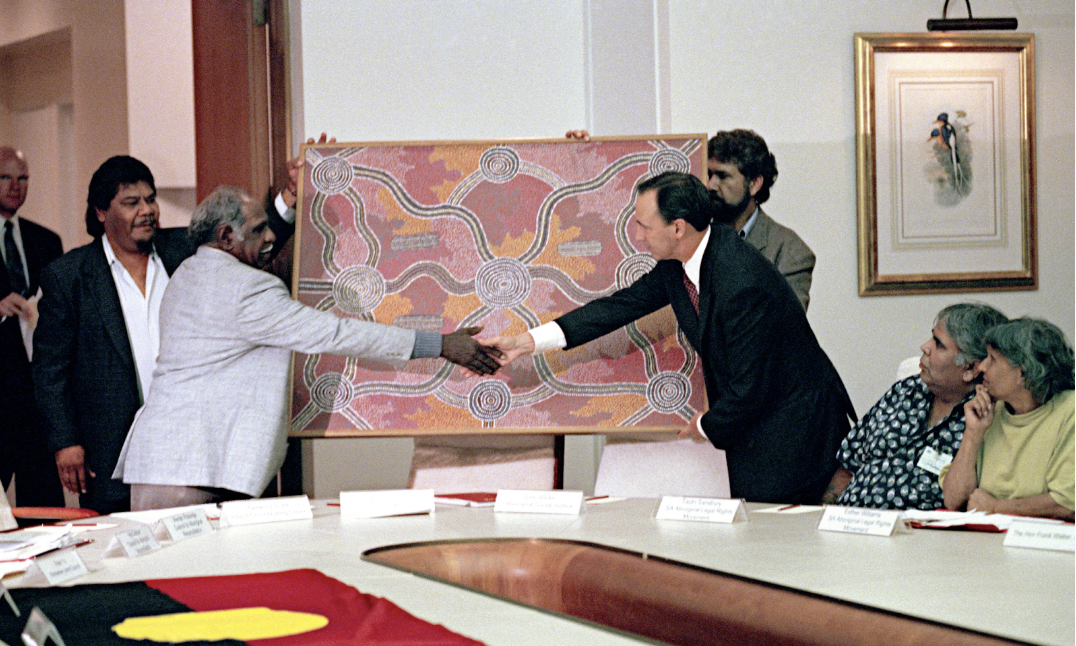
The First Nations Australians have made efforts to decolonize the legal system since the mid-1960s. Their work paved the way for future generations of legal reform, especially in regards to global indigenous representation. According to Aboriginal beliefs, spiritual ancestors traveled across the continent, shaping the land and future interactive binding laws between the people and nature, also known as “The Dreaming,” or creation time. To prove their relationship with Country to their white/English counterparts in a way true to their culture, Aboriginal groups went back to their artwork to advance their self-determination and autonomy against the state. The epics foretold in The Dreaming have been depicted in Aboriginal art, providing historical evidence of indigenous land and property ties.
In a global “watershed moment,” Eddie Mabo won native title in the 1992 High Court Mabo v. Queensland decision, using landscape sketches and maps. The case, battled over half a decade, contested the British colonial doctrine of “land belonging to no one” used to claim indigenous lands. Mabo’s artistic evidence proved to be of great value, as it provided proof of Aboriginal existence in the area far before European introduction, and it has remained a largely homogeneous population with little immigration. He emphasized the importance of a continuing connection between the First Nation peoples and the Murray Island Torres Straight. The native title arising from the Mabo case was an inaugural land right.
Roughly two decades later, the High Court was called upon again to determine the native claim to the Blue Mud Bay region of Eastern Arnhem. The Australian High Court is the highest, most supreme, apex court in the state. In 2008, the Yirrkala Saltwater Collection and the indigenous Yolŋu used traditional carvings and paintings to reflect the kinship relationship between the indigenous artists and the land. These artistic pieces were produced from the bark of tropical forests in Arnhem, and they compelled the argument for the integration of the physical and spiritual planes in these coastal waters– making them sacred sites in law. The physicality represented in the actual pieces of bark, and the spirituality within the land, as ritual sites. These pieces became integral evidence in the case and eventually led to Aboriginal ownership of 80% of the coastline and precedence over fishing industries.
In a truly formidable, trail-blazing fashion, Aboriginal artists reappropriated Western artistic practices and then used their artwork as legal evidence in the Western court system. This era is defined as the Post-Reservation Era: when artistic education and political sovereignty for global indigenous populations coincided. By using traditional Western acrylic and canvas materials, Aboriginal women in the Western deserts of Australia employed distinctly indigenous motifs such as dotting, abstract geometric forms, and cubist strategies to tell their cultural stories. This abstraction is tied to the spiritual relationship between a person and Country. In the 1970s, the Aboriginal Arts Board and Aboriginal Arts and Crafts Pty Ltd encouraged these artists to use their paintings in native title tribunals. Many of the claimants were not English speakers, so they entered the English-speaking democratic system through their art and language to prove their sovereignty. Between 1996 and 1997, the Ngurrara peoples presented acrylic canvases as legal documents for native title in the Great Sandy Desert, yet it wasn’t until 2007 that Justice Gilmore granted the title, citing the canvases as vital evidence.
Art is not limited to physical forms. As the fore-founders of Democracy have proven, costuming works as well, since they loved their powdered wigs and robes! Another form of artistic expression can be seen in the Maori practice of Haka. In November 2024, Hana-Rawhiti Maipi-Clarke, Rawiri Waititi, and Debbie Ngarewa-Packer performed Haka in protest of a proposed law that would regress the advances Maori people have made in New Zealand over the past decades. This proposal was a reinterpretation of the Treaty of Waitangi that reinforced British hegemonic ideals, validating the historical asymmetrical interdependence between the two nations. According to James Lull’s Hegemony, resistance to hegemonic ideals involves the reinvention of institutional standards that differ from the creator’s intention. Haka in the Western courtroom is an act of counter-hegemonic resistance that reinvents legal standards. A performance of Haka consists of expressive movements, facial expressions, and chanting; it is often used to express strong emotions, but the New Zealand Parliament weaponized this protest by enacting the harshest penalties in its modern history: suspension without pay for up to 21 days. The committee stated that Maipi-Clarke, Waititi, and Ngarewa-Packer acted in a “way that could have the effect of intimidating’ other lawmakers.” The government minister, Nicole McKee, reinforced this aggressive characterization, saying, “It’s about grandstanding at the expense of this House and how it operates. It’s about just being arrogant and ignorant about how we do laws in New Zealand.”
The punishments imposed on Maipi-Clarke, Waititi, and Ngarewa-Packer demonstrate this problematic attachment that colonial states still have to British hegemonic values. As seen in their Oceanic neighbor, democracy may have been enforced by colonial powers, but there is no reason it has to remain that way. Democracy and the legal system can be adapted to fit the culture in which they exist. Powdered wigs and written evidence do not need to be the only qualifiers for valid legality. The only ones holding countries and legal systems back are themselves. Change comes from within, and indigenous groups are at the starting line of reformation.
***
This article was edited by Lena Martorana and Sofia Alvarez.
 Jonathan Kho
  Anika Bobeck
  Eve Leeser