
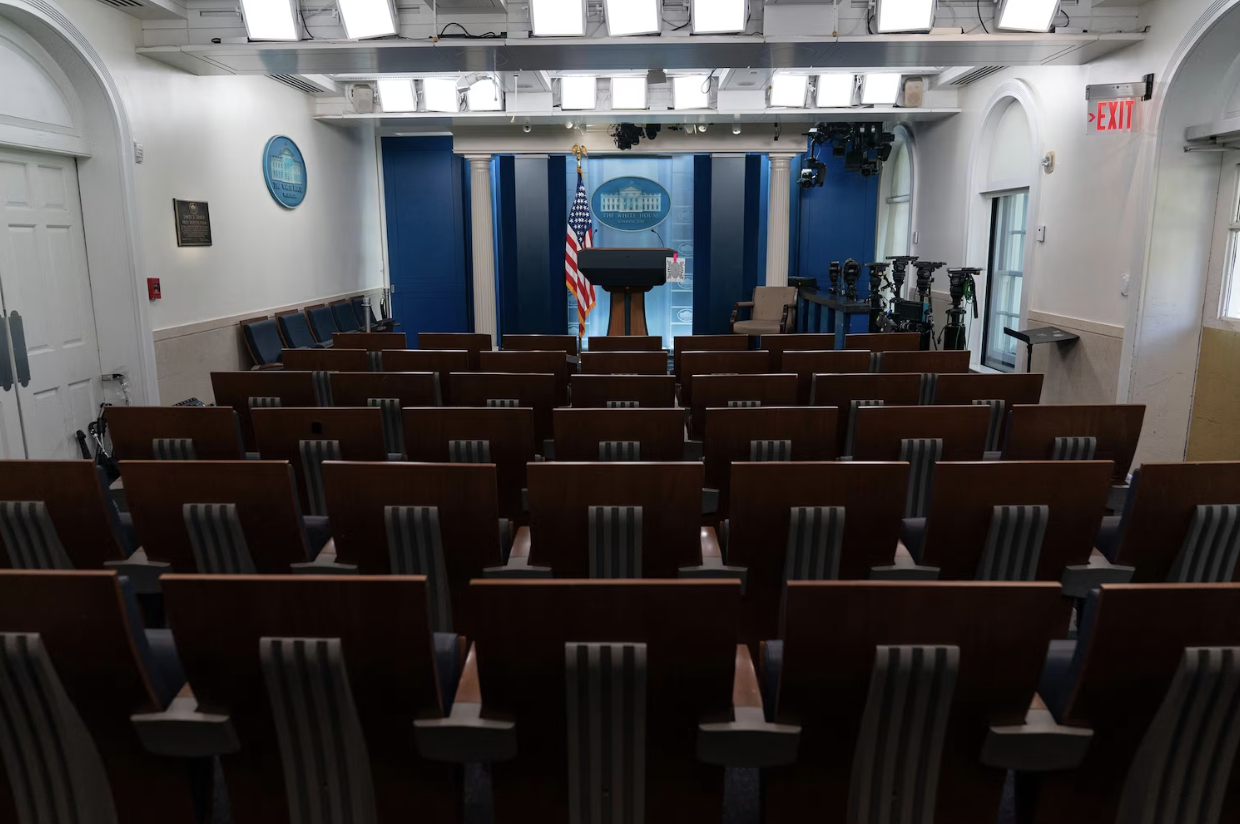
Photo via Jose Luis Magana/AP Photo.
***
President Donald Trump announced on Truth Social, September 18th, that he was “proud to announce that, effective immediately, I am banning Fake News CNN, MS NOW… and Politico… from the White House as a result of their constant ‘reporting’ FAKE NEWS!” The ban included the outlets’ access to White House grounds, including the James S. Brady Press Briefing Room and events on the South Lawn. The following morning, reporters from the three outlets were denied entry to the White House, and their credentials were confiscated or disabled, according to NBC News.
Following this announcement, the White House issued a press release defending the President’s decision titled “White House Access Is a Privilege — Not a Right.” The defense justifies the administration’s actions by claiming that Democrats in the past have gotten away with the same, thereby resembling a toddler caught red-handed who points out that their sibling did it first. Even if previous administrations inappropriately restricted press access, that cannot alone justify the current administration’s actions. The relevant question is not simply whether a precedent exists, but whether the circumstances warrant the administration’s rash actions.
The White House document states, “[In] 2009: The Obama White House branded Fox News as the ‘research arm’ and ‘communications arm’ of the Republican Party, barred it from a round of exclusive Sunday show interviews.” Not only is the ‘they did it first’ argument their justification, but the White House completely twisted what actually happened. The White House claims that Obama barred Fox from exclusive Sunday show interviews in an effort to justify Trump’s ban. However, the White House source states that Obama simply chose not to attend that one interview. Criticizing a news organization and declining to appear on its program is radically different from barring the program entirely. The entire press release has claims like this one – claims that can be easily deconstructed. FactCheck.org’s examination of the White House’s examples likewise found that the comparisons with previous administrations omitted important differences in the circumstances, compressed distinct incidents, and left out important context. It’s quite ironic that the White House banned CNN for being ‘fake news,’ yet releases a defense that is hardly factual itself.
To further the case against the administration, in February 2025, they banned the Associated Press from White House coverage for failing to refer to the Gulf of Mexico as the ‘Gulf of America.’ In April, District Judge Trevor McFadden ruled against the ban of AP from White House grounds, writing, “The Court simply holds that under the First Amendment, if the Government opens its doors to some journalists — be it to the Oval Office, the East Room, or elsewhere — it cannot then shut those doors to other journalists because of their viewpoints.” Yet roughly a year and a half later, the administration again restricted access for news organizations whose reporting it opposed — CNN, MS NOW, and Politico. Perhaps they believed that they’d have better luck this time.
Nonetheless, CNN’s exclusion did not eliminate the network. Its website remained online, its broadcasts continued, and its reporters could still investigate and publish stories. Additionally, CNN, MSNBC, and Politico sued the federal government over the ban, and in support of the three networks, all major media outlets—including Fox News—abstained from White House coverage. On September 24th, “U.S. District Judge Timothy Kelly [temporarily] ordered the White House to ‘immediately return, reinstate, and restore’ the three outlets’ access.”
Given the timely reinstatement of access, what exactly was accomplished?
Perhaps that question rests on an incomplete understanding of censorship. Censorship is often imagined as the direct suppression of information: a newspaper prevented from publishing, a book removed from circulation, or a journalist forbidden from speaking. But censorship can also be understood through the power exercised in the attempt itself. The point may not be to eliminate a critic’s voice, but to demonstrate what can happen when someone speaks out.
This is the distinction at the heart of modern political censorship. It is not necessarily about successfully silencing opposition; it is about demonstrating a willingness to punish it. With news networks being multimedia corporations that operate across television, social media, and print formats, complete silence is nearly impossible. The network’s continued existence does not erase the significance of the attempt to restrict it.
In other words, the administration demonstrated that access to the government could become a point of leverage. Other journalists, observing those consequences, are left to consider whether unfavorable coverage could jeopardize their own access and have further implications for their individual job security.
Censorship is also a tool that carries a powerful message for the administration’s supporters. A quite powerful stigma is usually associated with the White House; it is supposed to be a reliable governing body focused on protecting national interests. For those who believe this is true, censoring a network can severely damage their trust because the censorship was imposed solely by the President.
This is not a one-off case; the administration has made its attack on dissenting voices a pattern. NPR examined a variety of Trump’s attacks on opposing politics, specifically during the first 100 days of his presidency. They looked at his attacks on media coverage, universities, law firms, and rival political opponents. The report concludes with this important statement: “Even the process of investigation can be stressful and scary. Law firms are losing clients, people have lost jobs, and multiple sources said they could not talk with us because speaking out just puts a bigger target on your back.”
The entertainment industry has faced similar tensions. In September 2025, the President successfully took Jimmy Kimmel off the air. The late-night show was suspended by ABC after he made comments about the political reaction to Charlie Kirk’s death. Trump, along with FCC Chairman Brendan Carr, was the ultimate driving force behind the pressure on ABC to suspend Kimmel. After significant pushback from fellow talk show hosts, the late-night show was reinstated about a week after it was cut. Kimmel’s case demonstrates that pressure does not stop at the White House press room; it can extend to anyone whose public criticism threatens those in power.
The danger, then, is not limited to the journalists who lose access, the comedians who lose their platforms, or the organizations that find themselves under scrutiny. It lies in the precedent these actions establish for the relationship between political power and public criticism. When the president’s authority becomes intertwined with the punishment of its critics, the distinction between defending public interest and defending those in power becomes increasingly difficult to maintain. A government should be judged by how it responds to criticism, not by how effectively it can punish it.
***
This article was edited by Cristina Palmieri and Adam Sharqawe.
 Thomas Tisdale
 Caroline Smith
 Samuel Speiser