
Photo via Amazon
***
Try as we might, some wars cannot be won. No matter how noble the cause, power, even with demand, is sometimes too big to fail. It refuses to concede. We lose, but only in defeat do we have an opportunity to pick up the pieces of the devastation we have wrought, honor the martyred, and reform our institutions.
Our institutions may not be worthy of saving, having aided and abetted the crime of crimes, but once they stood for liberal values. The hope is that one day, our institutions– our government, our neighbors’ governments, and the international system– can rise from the depths of their fall and stand once again for the values they were founded on. Values like Truth and Justice– that the layman and the disenfranchised once believed they could seek redress for in the distinguished bodies. Until then, our work begins to prevent more blood from being spilled and falling upon our collective hands.
Unfortunately, truly fighting injustice is a transgressive and costly act. Disrupting entrenched power or oppression marginalizes. The New York Times rued in its obituary to Malcolm X that, “The world he saw through those horn-rimmed glasses of his was distorted and dark. But he made it darker still with his exaltation of fanaticism. Yesterday someone came out of that darkness that he spawned, and killed him.” Martin Luther King Jr. was ostracized at the end of his life, facing an almost 75% disapproval rating for criticizing the Vietnam War and preaching economic justice, launching the “Poor People’s Campaign” in the final year of his life and striking with sanitation workers in his final hour.
That is why so few are willing to make the ultimate sacrifice, to lay down one’s life (whether literally or metaphorically) to protest a pervasive injustice or crime against humanity. Few exist who, to give up on “Truth and Justice,” “however futile the endeavor,” and despite the cost, would be “to relinquish one’s humanity.”
Norman Finkelstein is one of the few.
Norman Finkelstein has sacrificed almost every day of his life since Israel’s 1982 invasion of Lebanon to protest the US-Israeli war machine and to try to prevent the destruction of Gaza and the Palestinian people. He has dedicated his life to exposing the moral decay of Israeli society in the form of the war crimes of its citizen-army, “one of the most criminal armies in the world” (as a UN expert stated matter-of-factly in June 2024), as well as the Israeli pseudoscholarship that has sought to manufacture consent for Israel’s founding, that dispossessed some 700,000-750,000 indigenous Palestinians, and Israel’s collective punishment of the Palestinians (Alan Dershowitz’s The Case for Israel).
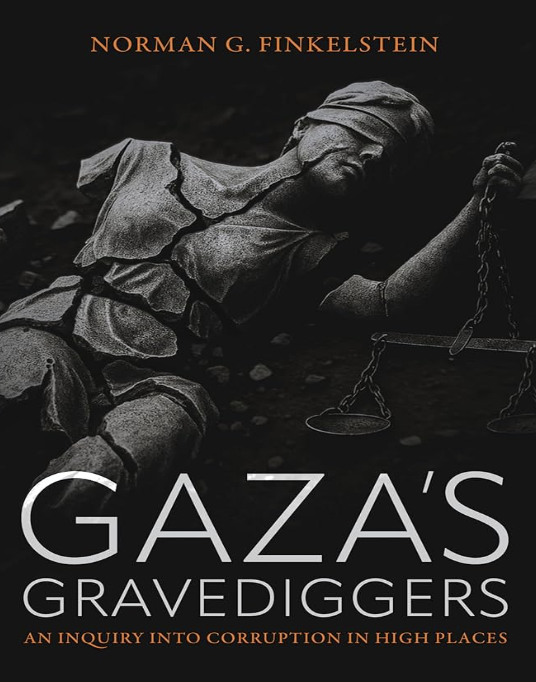
Denied tenure, ignored by the mainstream despite his stature, and even cast out of the movement he is the authority of — radical-chic, pro-Palestinian absolutists — Finkelstein has nonetheless persisted, refusing to retreat “one-thousandth part of one inch,” as one of his heroes, Paul Robeson, once declared. As a result of these hardships, Norman Finkelstein has emerged stronger — more witty, more piercing, and more defiant— than ever, reaching the culmination of his life’s work with Gaza’s Gravediggers: An Inquiry into Corruption in High Places, a masterful forensic accounting of abuse and dereliction of duty that ferociously takes to task those fabricators, deceivers, and propagandists who have aided and abetted Israel’s genocide in Gaza.
Although Gaza’s Gravediggers is admittedly a “challenging read,” scrutinizing “a quartet of critical investigations by international institutions,” Finkelstein’s prose is as convincing and gripping as ever, the rare work that makes international law and the “legalese” it entails wholly accessible. This is in part because of the emotionally charged nature of Gaza’s Gravediggers, Finkelstein’s most moving writing.
Gaza’s Gravediggers drips with reverence for those courageous and capable enough to challenge Israel’s genocide in Gaza. Whether it be the eminent South African jurist John Dugard, the encampment movements that sprung up on college campuses in the spring of 2024, or, most controversially, the Houthis in Yemen who “blocked international shipping lanes in solidarity with the forlorn people of Gaza.” Gaza’s Gravediggers additionally expresses the strongest and most righteous sorrow, horror, and indignation at those who shamelessly betrayed their offices and humanity to enable Israel’s campaign of lies and genocide, the Judge Sebutinde and Joan Donoghue’s of the world.
Finkelstein’s style is, at times, the most polemical it’s ever been, flustering even his most learned and sympathetic reader. However, his copious and rigorous parsing of the evidence is, bar none, the best. Finkelstein convincingly demonstrates each of his claims in meticulous detail, logically dismantling his target’s arguments by examining the ins and outs of the cited and available evidence. Finkelstein exposes his opponent’s arguments as, intentionally or unintentionally, nothing but Israeli hasbara, sustained by ludicrous claims, invention, and flawed methodology — entirely deserving of scathing criticism and censure.
In Gaza Gravediggers first chapter, bluntly entitled “Rape Fantasies,” Finkelstein deconstructs the spurious charge, validated by the UN’s Patten Report, that Hamas committed mass rape as a weapon of war on October 7th. The Report found, in Finkelstein’s analysis, “no material evidence of rape,” despite reviewing over 5,000 photos and 50 hours of footage. Inexplicably, the Report still gave the green light (or institutional support) to the “Hamas rape hoax,” subsequently promulgated by Israel to fuel its genocide in Gaza, in part under the facade of saving its hostages, at risk of rape and sexual violence.
To sustain their determination of “sexual violence,” Patten and company had to stoop so low as to put forward morbidly comedic claims of “coerced intimacy” and desecration of corpses as sexual violence. Finkelstein reveals the Patten Report to be a travesty of international law, focused on giving “voice” to survivors, regardless of their credibility, while relying on tenuous circumstantial evidence and rendering “discrete judgments” beyond its Mission as an investigative body. In this chapter and throughout Gaza’s Gravediggers, Norman Finkelstein successfully recasts the narrative and shows that he is not partisan against Israel; the evidence is partisan against Israel.
In this vein, the second chapter of Gaza’s Gravediggers exposes the UN Pillay Commission’s “laws of war framework,” viewing Israel’s actions in Gaza as “indiscriminate” and “disproportionate,” while obliviously ignoring the intentional targeting of the whole of Gaza for destruction, following the “logic of genocide.” Examples abound of Gaza’s infrastructure, young families, and children being callously murdered by this logic, employed through Israel’s “accurate and measured” sniper fire, piercing children’s skulls in record numbers, and US-supplied 2,000lb bunker buster bombs, with wide lethal radii, being dropped on populated residential neighborhoods and refugee camps.
The subject matter is dark. Finkelstein’s third chapter, “Free Agent or Foreign Agent?,” is the darkest chapter of any of his books, cross-examining in 100 pages the disturbing jurisprudence of the vice president of the International Court of Justice, Judge Julia Sebutinde. The chapter is the first in any of Finkelstein’s works to feature images, effectively highlighting the depravity of Judge Sebutinde’s decision-making.
Finkelstein eviscerates Judge Sebutinde’s credibility as an impartial jurist, bringing to light her illogical, plagiarized dissents and multiple incoherent volte-faces in her jurisprudence. Sebutinde devalues the UN evidence her colleagues rely on while herself writing factually incorrect opinions. Furthermore, and most strikingly, Sebutinde’s sole dissent from every conclusion in the ICJ’s historic July 2024 Advisory Opinion, ruling Israel’s occupation of the Palestinian territories illegal, is shown to be 32 percent plagiarized from sources translated from Hebrew, from PragerU, from Wikipedia, and from fringe Israeli settler legal figures. The chapter emphasizes an urgent need for Sebutinde, in an almost religious enthrallment to Israel, to be immediately dismissed from the International Court of Justice before further harm is done to the cause of Truth and Justice.
Finkelstein’s book is full of even more groundbreaking and poignant content– analogizing October 7th to Nat Turner’s slave rebellion, ruling the UN a “rotting corpse” following its colonial ceding of Gaza to Trump’s “Board of Peace,” and definitively proving that the ICJ found in South Africa v. Israel that Israel was plausibly committing genocide in Gaza (despite Joan Donoghue’s Richard Goldstone-like recantation). Put simply, my writing cannot do Gaza’s Gravediggers justice – it is one of the few books that comes once every decade or so, with the moral clarity and explosive truth-telling warranting study in this millennium and its place in the “whole history of writing.”
Finkelstein rang the bell a decade ago in Gaza’s Gravediggers predecessor, practically warning the world of Israel’s coming “Final Solution” to the “Gazan Question.” The world nonetheless ignored Finkelstein and ignored Gaza’s plight, letting Gaza fall out of the international spotlight and subjecting its population, half of whom are children, to remain destined to languish and die in its besieged 25×5-mile concentration camp. Following October 7th, Finkelstein was propelled back “into the spotlight.” Now, again, he has told the truth about Gaza and the corruption threatening to finish it off. Hopefully, this time, the world listens.
***
This article was edited by Melisa Sezgin and Mia Kirch.
 Thomas Tisdale
 Caroline Smith
 Nathan Wellman