
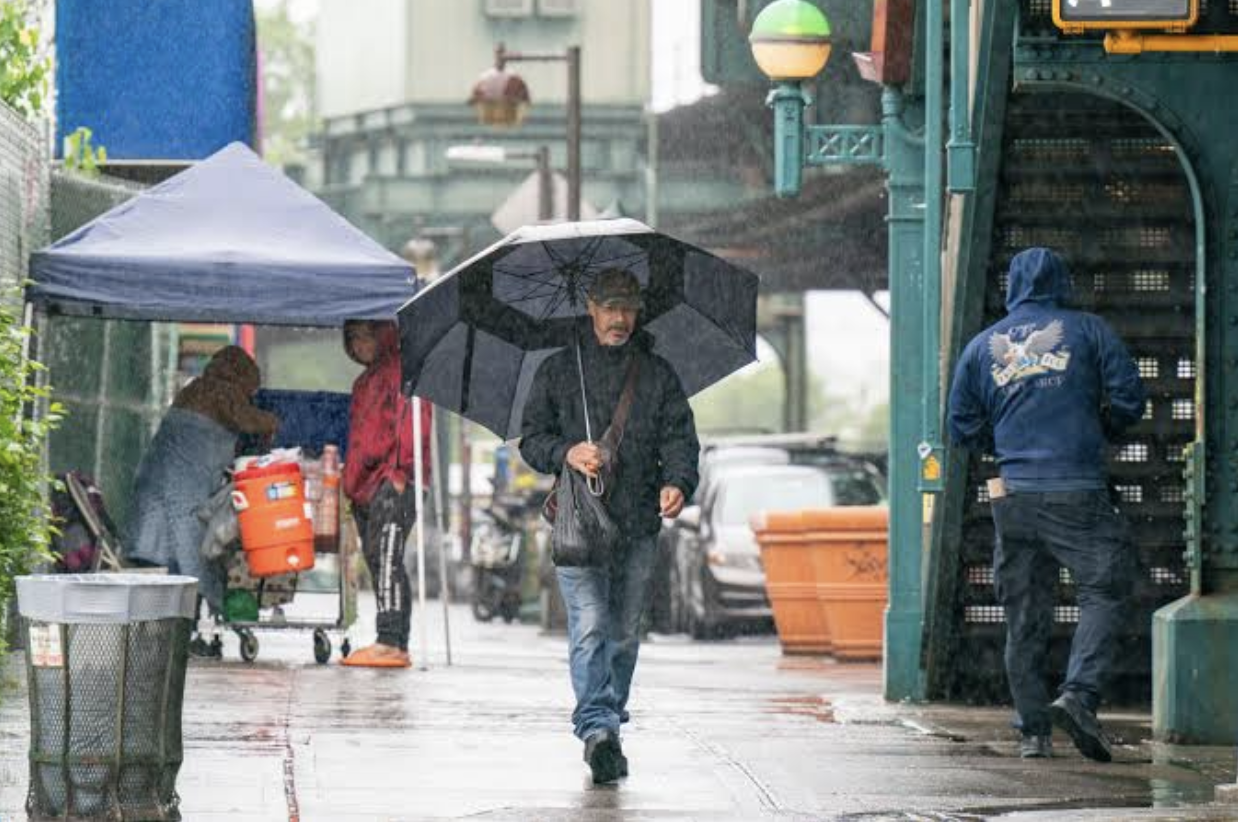
Photo via New York Daily News
***
A few weeks ago, a Nor’easter hit New York City hard, deluging it with rainfall and shutting down train and subway lines for most of the weekend. Known for wreaking havoc, this Nor’easter, like many others, resulted in massive coastal erosion and significant damage to infrastructure. Although the extent of property damage is not yet known, the storm killed at least one person in Brooklyn and injured four more, including two children, according to CBS News. After the storm subsided, many New Yorkers asked themselves how a Nor’easter, typically a winter storm, could be possible in September: was it climate change, and if so, what are people doing about it?
The last Nor’easter is only the tip of the climate change iceberg. For decades, New York has been experiencing dramatic weather events. In addition to rising rainfall, increasing temperatures, and worsened air quality, extreme weather events like wildfires and hurricanes are taking their toll. Many New Yorkers remember Hurricane Sandy in 2012, a traumatic event that, according to New York State Climate Impacts, was “unlike any the city had seen before: communities across the region experienced power outages, limited access to necessities such as food and medical care, and damage to critical infrastructure at an unprecedented scale.” Hurricane Sandy caused more than $19 billion in damages, $5 billion to the MTA alone, destroyed or damaged 69,000 residences, flooded 17% of the city, and killed 43 people in NYC and 100 people in the Tri-State Area. In 2021, Hurricane Ida, another September storm, while not as bad as Hurricane Sandy, still significantly impacted New York City, especially the Bronx. According to the New York State Climate Impacts Assessment, “[a]bout 33,500 buildings were damaged. Much of the damage was concentrated in lower-income and immigrant communities of Queens, Brooklyn, and the Bronx, which have a high percentage of at-risk populations.” Earlier this year, smoke from Canadian wildfires choked New York City residents, prompting New York City Emergency Management to describe it as “a historic wildfire smoke event that blanketed the five boroughs in thick haze and drove air quality to its worst levels in more than three years.” ScienceNews attributed the wildfire’s cause to climate change.
As climate change accelerates and severe weather events become more frequent and more devastating, New Yorkers suffer in quality of life because already limited public funds are increasingly redirected to clean up the consequences of climate change. This is not a problem for the future; it is urgent and a problem for the present. Yet, nationally, there is no consensus in political discourse around climate change. Politicians in liberal areas like New York treat climate change as a crisis and use it to advance their campaigns. On the other hand, politicians in conservative areas deny its severity and use it as a cultural wedge issue to divide the nation and promote inaction. One side argues that climate change is happening and that it is absolutely necessary to fund climate research and limit its devastating effects, while the other side remains skeptical that climate change is real, citing historical climate patterns. While a majority of people acknowledge that climate change is happening, the difficulty arises in agreeing on what to do about it. For example, according to Pew Research Center, only 15% of Republicans believe that climate change is due to human activity, while 79% of Democrats attribute climate change to humans. Many people who acknowledge climate change exists are more worried about the effects certain proactive measures will have on businesses, taxes, and their financial well-being. Those who believe humans are exacerbating climate change want to reduce gas emissions as quickly as possible, regardless of the financial effects, integrate climate change prevention into everyday life, and embrace environmental justice. The two sides are seemingly at odds, but given the undeniable risks posed by the current climate, politicians must work as quickly as they can to reach a compromise at all levels of government.
Although the national debate is causing inaction and delay, what are local politicians actually doing to address climate change and help New Yorkers live safe, healthy lives? It turns out that New York City is doing quite a lot. Even prior to Hurricane Sandy, in 2007, Mayor Michael Bloomberg created PlaNYC, a long-term plan updated every four years, focused on sustainability, enhancing city living by addressing climate change, and investing in a green economy. The primary purpose of PlaNYC is to reduce New York City’s contribution to climate change. According to its website, its activities have included: establishing long-term greenhouse gas reduction targets and transitioning to clean energy, promoting urban infrastructure improvements to ban fossil fuels in new builds, adopting the use of “green” cars in city fleets, and promoting a green economy. PlaNYC, in turn, launched the New York City Panel on Climate Change (BPCC) a year later to create a body of experts to provide scientific information and advice to leaders about climate change projections and mitigation strategies. Through these efforts, New York has been enacting laws and adopting plans to combat climate change. Some of the initiatives developed included planting more trees, reducing carbon emissions, expanding public transportation, and launching a new, environmentally friendly training program for New York Public Schools. Even with these efforts, the repercussions of climate change continued to impact New Yorkers and, in response, in 2022, the city launched an effort called ADAPTNYC to help its communities deal with climate change-related weather threats, such as extreme heat, tidal flooding, coastal flooding and erosion, and extreme rainfall. Most recently, Mayor Mamdani is working to reduce greenhouse gas emissions from buildings under Local Law 97. This landmark law targets one of New York’s main sources of gas emissions: existing and new buildings over 25,000 square feet. The law’s goal is to reduce building emissions by 40% and achieve net zero emissions by 2050. The city is also investing billions in coastal preservation through the Lower Manhattan Coastal Resiliency Initiative and Staten Island Seawall. The city’s Comptroller’s Office maintains a dashboard showing the city’s progress in reducing carbon emissions and preparing its citizens for the effects of climate change. Most recently, the dashboard has added a map of designated environmental justice communities to identify low-income communities most likely to bear the brunt of environmental issues. Interestingly, the city’s targets closely follow the global Paris Agreement initiatives.
Although New York City‘s climate initiatives are laudable, they are sometimes stymied at the state and national levels. In 2019, New York State enacted the Climate Leadership and Community Protection Act, which set ambitious goals to address climate change. Although much effort has gone into compliance with those goals, as much effort has been spent to delay or derail them. Recently, according to The New York Times, Governor Kathy Hochul has slowed timelines, delayed the effective dates of regulations, and altered standards. Some argue that pressures surrounding the taxpayer costs of such initiatives are driving the changes. The state asserts that federal actions, including tariffs and President Trump’s attacks on offshore wind projects, are contributing factors, stating that, in no event, could the state have met its aggressive timelines for renewable energy use. The NYISO Executive Vice President and Chief Operating Officer Emilie Nelson wrote in a December Daily News op-ed that it is not abandoning the goals but must balance them with “reliability, certainty and resilience.” Meanwhile, the state approved a new Northeast Supply Enhancement project, a natural gas pipeline.
New York City residents have been literally paying the price of climate change for decades, through housing costs, construction, and energy prices. Housing shortages and higher housing prices are byproducts of older housing that cannot withstand climate extremes and climate change-related flooding. New York’s Regional Plan Association says, “With global emissions worsening, extreme weather events—aggravated by rising sea levels—will only grow more severe, frequent, and damaging over time,” which means the housing crisis will only worsen with time. In addition, energy costs are rising significantly, largely due to climate change and rising temperatures. The New York Comptroller says, “New York City is at the brink of an energy affordability crisis—one that poses a growing threat to both household budgets and public health. As climate change drives more extreme temperatures, the rising costs of energy are not just a cost-of-living issue, but could mean life or death for New Yorkers trying to stay cool.” Climate change, its costs, and its risks to daily life are a serious issue for New Yorkers.
Climate change and politics are inextricably linked. For New York City, climate change is becoming less about how it will affect the city; it already has, but more about how the city, and the country as a whole, will respond to it. As climate change becomes increasingly daunting, it falls more heavily on politicians to protect the people and land they govern.
***
This article was edited by Corrina Gapp and Reva Maslekar.
 Thomas Tisdale
 Samuel Speiser
 Nathan Wellman