
Image Via Democracy Docket
***
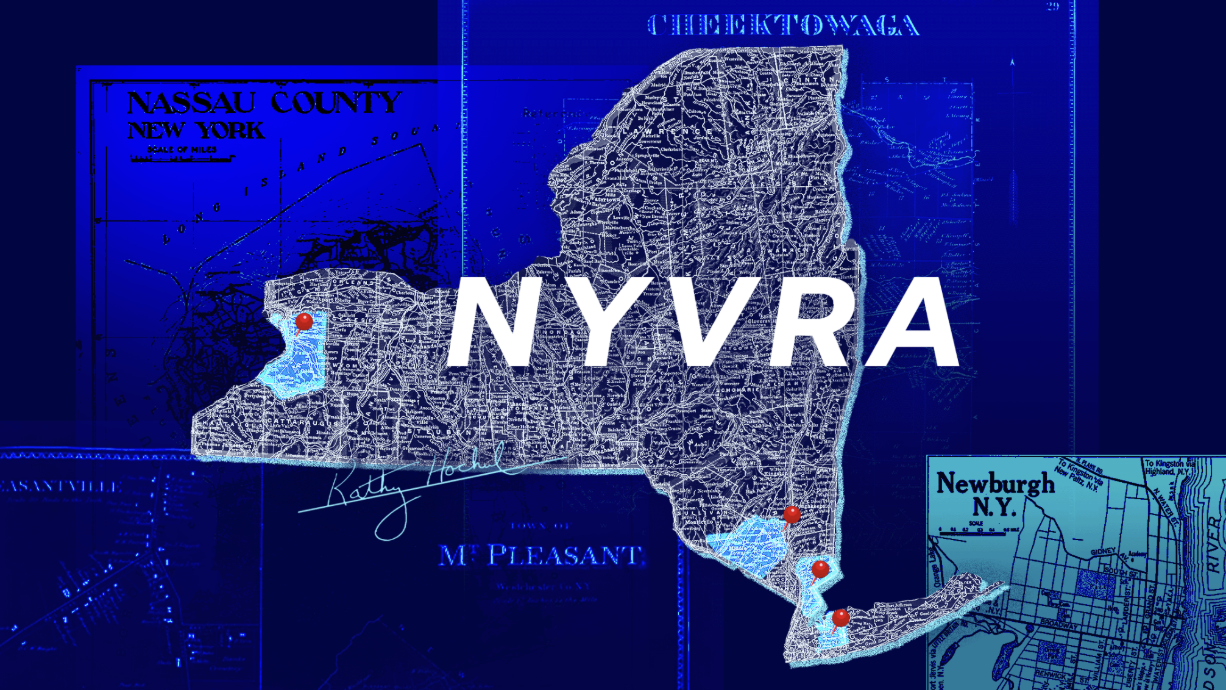
Under the New York Voting Rights Act, Black and Hispanic residents took legal action over Newburgh, NY’s town board election. Six Black and Hispanic voters filed the 2024 suit challenging the town’s at-large system. An at-large system is one in which all voters in a town or city vote for every seat on a governing body, rather than each seat representing a separate district. The suit claimed the system favored white voters and diluted minority political power. The town, however, argued that the NYVRA violates the equal protection guarantees of the U.S. and New York constitutions.
Newburgh’s case is now part of a new national legal landscape, shaped by the Supreme Court’s recent decision in Louisiana v. Callais (2026). Section 2 of the federal Voting Rights Act prohibits voting practices that discriminate on the basis of race or color. This is very important in vote dilution cases, where an election system or district can make it harder for a racial minority group to elect candidates of its choice. Louisiana had been ordered to create a second majority-Black congressional district after a lower court found that its previous map likely violated Section 2. The Court ruled 6-3 that Louisiana’s second majority-Black district was gerrymandered and therefore unconstitutional. Racial gerrymandering is the practice of drawing electoral district boundaries predominantly on the basis of race or ethnicity to dilute or manipulate the voting power of minority communities. The decision was issued on April 29, 2026, and placed new constitutional limits on when race can be used to remedy vote dilution. The Court said that Section 2 did not require Louisiana to create that particular district. Callais did not strike down Section 2 itself; it remains federal law. However, the decision places new limits on when Section 2 can justify the use of race in drawing electoral districts. Supporters of the decision argue that it prevents unconstitutional racial classifications in redistricting. Voting rights advocates argue that the decision makes Section 2 substantially harder to use to correct racial vote dilution. So, if federal law provides a narrower path for challenging racial vote dilution, what happens to the state laws that provide broader protections, like NYVRA?
Democrats are calling for new federal legislation, but President Trump is likely to stall this legislation via his veto powers. Advocates point to the John R. Lewis VRA and state-level statutes as responses. So, state VRAs may now be the main tool left. After Callais, state VRAs may become the primary, if not the only, legal tool for challenging racially dilutive electoral systems. States can adopt their own protections so voters stay shielded when federal ones fail. New York is a model for this. The NYVRA, which was enacted in 2022, granted protections beyond federal law.
The same equal-protection logic now applies to state VRAs. Newburgh filed an amicus brief in Callais arguing that state VRAs impose unconstitutional race-based requirements. Newburgh signaled it would appeal to the U.S. Supreme Court if the NY Court of Appeals upheld the law. The NY Court of Appeals ruling was narrow, so it is necessary to be precise about it. On Nov. 20, 2025, the NY Appellate Court held that the town, as a government entity, could not bring a facial challenge to invalidate the law. It affirmed the Appellate Division’s decision upholding the NYVRA and left the residents’ lawsuit free to proceed. In the end, the court ducked the merits. The constitutional question is still open. The parties later reached a settlement requiring Newburgh to replace its at-large election system with proportional ranked-choice voting. Callais may diminish state VRAs’ potential impact, yet state VRAs largely remain an effective tool.
Critics claim race-conscious remedies, even state-enacted ones, are constitutionally suspect. Justice Samuel Alito, who wrote the majority opinion in Louisiana v. Callais, believed that since the VRA did not require the 2nd District Court, there was no compelling interest that justified using race. Professor Rick Hasen, an electoral law professor at UCLA, believes Newburgh’s brief argues that state VRAs eliminate the safeguards built into Section 2. However, his position concerns the risk to state VRAs, not his belief that state VRAs are unconstitutional. The courts’ track record is relevant here. The Appellate Division’s ruling was consistent with every other state appellate and federal court to review a state VRA.
The larger question after Callais is whether state Voting Rights Acts can continue to provide protections that go beyond the federal VRA as the Supreme Court imposes greater constitutional limits on race-conscious remedies. Callais was directly concerned with federal voting rights laws. However, legal scholars and voting rights advocates warn that the reasoning could encourage further challenges to state laws that use race-conscious remedies. Newburgh’s case shows what a state VRA can actually do after a federal limitation; the town ultimately agreed to replace its at-large election system with proportional ranked-choice voting as part of a settlement under the NYVRA. Callais has already influenced redistricting debates in other states, including Louisiana, Tennessee, Florida, and Texas. They have considered or pursued changes to congressional districts in response to the decision. The future of voting rights protection may increasingly depend on what states are willing and constitutionally permitted to do as federal protections narrow. State VRAs could fill some of that gap, but Callais raises the question of whether those state protections themselves could eventually face constitutional challenges.
***
This article was edited by Olivia Goodman and Sabrina Pala.
 Katie Mulhall
 Joseph Gilardi
 Sophia Kiosses