
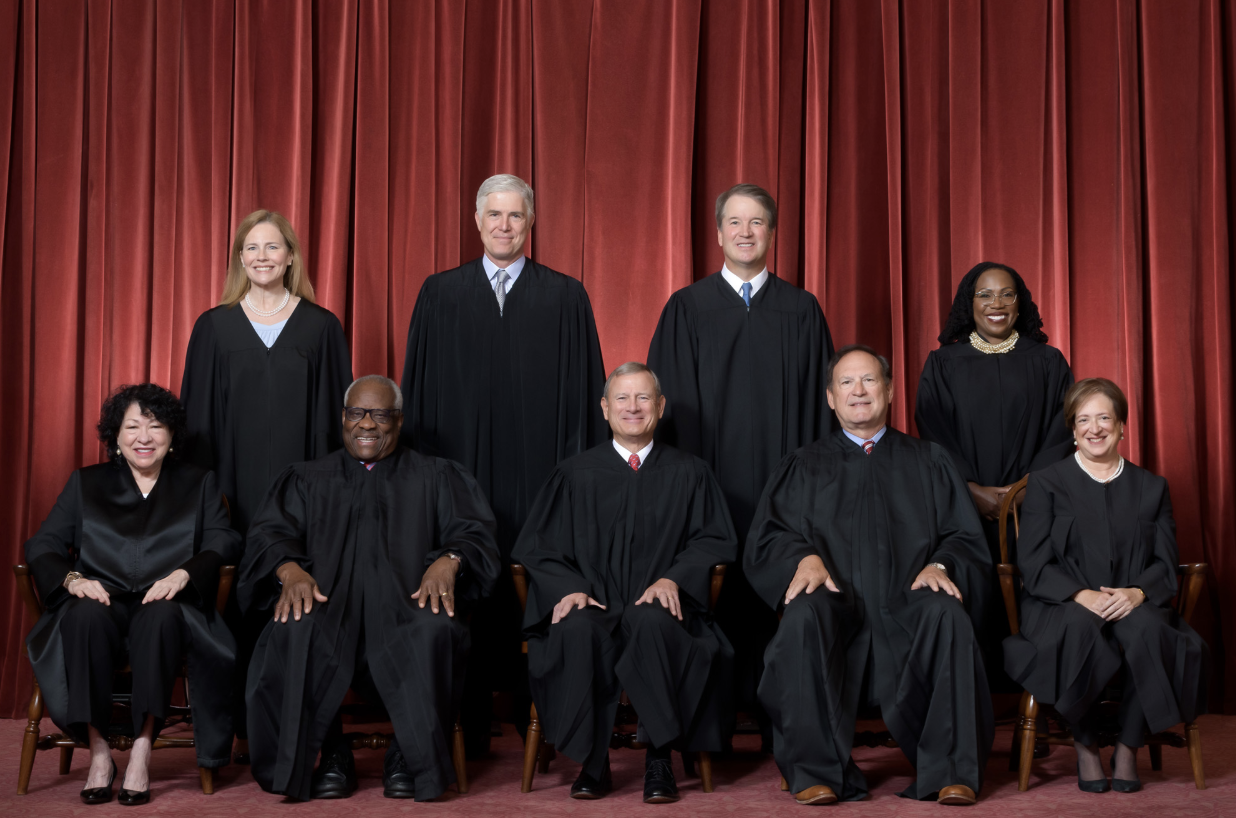
Photo via Supreme Court Historical Society
***
Justice is blind. That statement captures the essence of how many feel the law should operate. From the founding of the United States, the founding fathers sought to establish a nation governed by the rule of law, accountability, and an orderly system of government. These are ideals reflected in the establishment of many government institutions, including the highest court in the United States: The Supreme Court.
Many look to institutions such as the Supreme Court to apply the law impartially to everyone regardless of gender, race, or status. In many ways, citizens would like to say we’ve come a long way in reflecting those ideals with many landmark decisions, such as Brown v. Board of Education (1954), which declared racial segregation in public schools unconstitutional and rejected the application of the “separate but equal” doctrine established by Plessy v. Ferguson (1896). But with both historical and recent controversies, questions have emerged about whether the Supreme Court has been faithful to the principles it was established to uphold. Have the individuals appointed to the Court been impartial in fulfilling their roles? Is justice truly blind?
The Supreme Court’s origins can help us determine whether or not we have been faithful to the principle of impartiality. As reflected in the Constitutional Convention of 1787, the Founders held numerous debates over how to prevent the abuse of power and prevent the concentration of unchecked power in a single branch’s hands. This concern prompted the creation of Article III of the Constitution, where the Supreme Court was established as the highest court in the federal judiciary. In 1789, Congress passed the Judiciary Act, organizing the federal court system and establishing a Supreme Court consisting of six justices. Unlike the president or members of Congress, Supreme Court justices were never elected by the public. Instead, they were granted tenure for good behavior, generally allowing them to serve for life.
So the question then becomes: what makes a good judge?
When many people imagine a judge, they picture a person in a robe, entrusted with determining whether the law has been upheld or broken, unique in their sense of fairness. But the responsibility of a judge extends beyond interpreting the law as it is written. It also demands impartiality, integrity, and a commitment to upholding ethical standards in order to administer justice. After all, how could the public place its trust in the law if it questions the impartiality of the individuals interpreting it?
Throughout American history, controversies around the Supreme Court have raised this very question. In 1969, Abe Fortas resigned following revelations that he had accepted a $20,000 payment from a foundation associated with financier Louis Wolfson. Although Fortas returned the money, the controversy raised questions about potential conflicts of interest and the ethical obligations of the nation’s highest judicial officials. More than half a century later, these questions remain relevant today.
In 2023, investigations into current Justice Clarence Thomas revealed previously undisclosed luxury travel provided by billionaire Harlan Crow. Further reporting uncovered a previously undisclosed real estate transaction involving Thomas and Crow. Meanwhile, Justice Samuel Alito faced Scrutiny over an undisclosed luxury fishing trip involving billionaire Paul Singer, whose financial interests later came before the court. Although both justices defended their conduct, these controversies sparked renewed debate over whether the Supreme Court’s ethical safeguards truly protected its impartiality and public credibility.
Although these relationships do not necessarily mean that judicial decisions were improperly influenced, they raise concerns about the concept of impartiality being put into practice. Amid growing scrutiny over judicial ethics, the Supreme Court adopted its first formal Code of Conduct in 2023, outlining ethical standards intended to preserve judicial integrity and public confidence. The code did not establish an independent enforcement mechanism, leaving the responsibility for upholding those standards in the hands of the very justices whose conduct they are intended to regulate. While judicial independence is essential to protecting the Court from political interference, independence should not mean an absence of ethical oversight.
Ultimately, the Supreme Court was established to uphold the Constitution and administer justice impartially, not to operate beyond scrutiny. The controversies surrounding justices appointed to the Supreme Court do not automatically mean that the word justice holds no bearing on judges. Rather, it showcases that justice must be more than an ideal written into law; it must be upheld through meaningful accountability. If justice is truly blind, shouldn’t those entrusted with administering it also be subject to the same standards of accountability that the court is known for?
***
This article was edited by Hayley Dunn and Andrew Kravatz.
 Samantha Kornsey
 Jackson Cutrone
 Ryan Scriven