
Image via ABC
This article was written on October 16, 2026, prior to the announcement of the midterm election results.
***
In the world of politics, New York is often considered a “blue state.” New York has voted for a Republican president only once since 1984 when Ronald Reagan was in office, and the state has not re-elected a Republican governor since 2006 when George Pataki left office. New York has two Democratic Senators, along with 19 out of the 26 House members of the state. Democrats also have supermajorities in both chambers of the state legislature.
This year, as the midterm elections approach, Democrats remain heavily favored to maintain their control in Albany. However, some competitive congressional races, mainly Mike Lawler’s reelection campaign in NY-17 and Mike LePetris’ attempt to unseat Representative Tom Suozzi in NY-3, demonstrate that Republicans still remain competitive in some parts of the state.
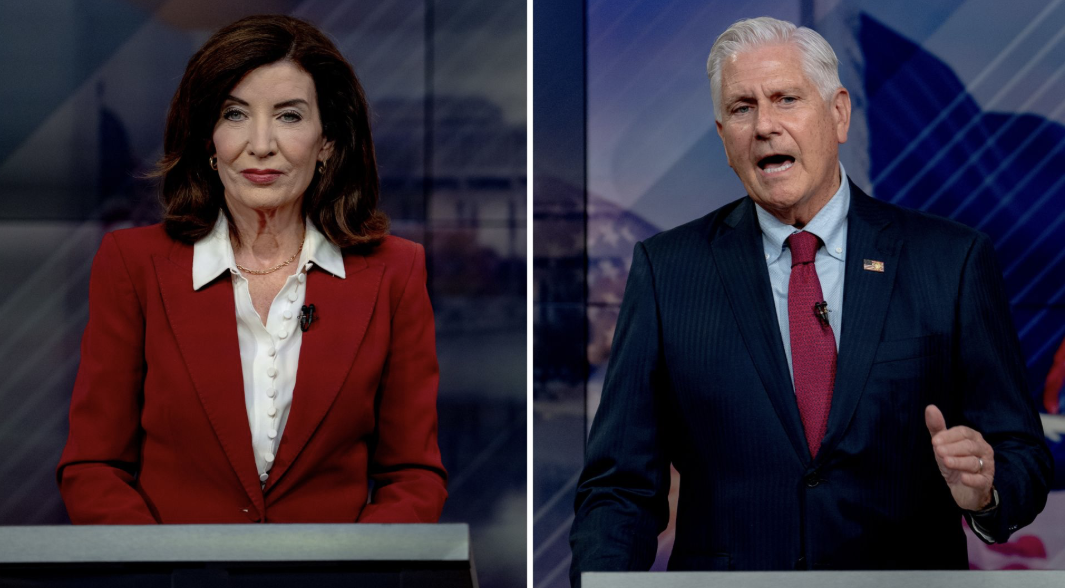
The race drawing the most attention is the governor’s race, where incumbent Democrat Kathy Hochul will face Republican Bruce Blakeman. Hochul has been in office since 2021, when Andrew Cuomo’s resignation promoted her to state executive. She won her first gubernatorial election in 2022, but her margin of victory was considerably narrower than Cuomo’s 2018 victory against Republican Marc Molinaro. Hochul received 53.1% of the vote against Republican Lee Zeldin in 2022, demonstrating that even in a traditionally Democratic state, Republicans can pose a serious challenge.
The Republicans intended to capitalize on the success of Zeldin in 2026, with NY-21 representative Elise Stefanik as the early frontrunner for the Republican nomination, but she withdrew from the race in December 2025. Blakeman eventually won the Republican nomination and will face a race that centers around issues of affordability and public safety.
Polling still favors Hochul, but the size of her lead varies. An October 2026 Marist poll found her leading 53% to 42%. A Pollfinity survey released October 13 put the margin at just three points, with Hochul ahead 47% to 44%. Although some polls show the race is close, none have Blakeman in the lead, making a flip highly unlikely.
The candidates’ October 13 debate offered another glimpse of their strategies. Their televised exchange focused on affordability, immigration, energy costs, and public safety. Blakeman criticized Hochul’s record and rising expenses, while Hochul repeatedly connected him to President Donald Trump. Blakeman must appeal to moderate voters without sacrificing Republican turnout, while Hochul must defend her record rather than rely exclusively on opposition to Trump.
New York City’s budget crisis could also have lasting consequences for state politics. A multibillion-dollar deficit prompted negotiations with Hochul and state lawmakers. In May, the city and state announced nearly $8 billion in additional state assistance over two years, closing the immediate budget gap. However, the dispute exposed disagreements over how much revenue New York City contributes to the state and how much funding it should receive in return.
The political consequences may extend beyond this election as well. Although Hochul’s decision may prove helpful for her in retaining her base in New York City, any other request from state taxpayers for more help from the state may raise ire among taxpayers and lawmakers Upstate and in the suburbs. The Republicans can exploit such differences in order to convince voters that the Democrats are giving priority to New York City over the rest of the state.
Geography remains critical to the outcome, as New York City provides Democrats with a substantial share of their statewide votes, while Republicans perform better in rural upstate and on Long Island. The October Marist poll found Hochul leading by almost 50 points in New York City, while Blakeman led by eleven points in Upstate. The suburbs were more evenly divided. Hochul needs to contend primarily over concerns about housing costs, tax increases, and public safety. Those issues can turn the election into a referendum on Democrat leadership in Albany, something the party would want to avoid.
Hochul by no means should be worried about losing, but she should be worried about the margin. If Republicans can come within striking distance of flipping the state for the second time in a row, the chances of New York changing from a solid blue state to a purple swing state drastically increase. If they can successfully capitalize on dissatisfaction with Albany and nominate candidates who can appeal beyond their base, winning the governorship could become a realistic goal within the next few election cycles.
***
This article was edited by Hayden Schreck and Kaitlyn Horn.
 Samantha Kornsey
 Matthew Subramani
 Ryan Scriven