
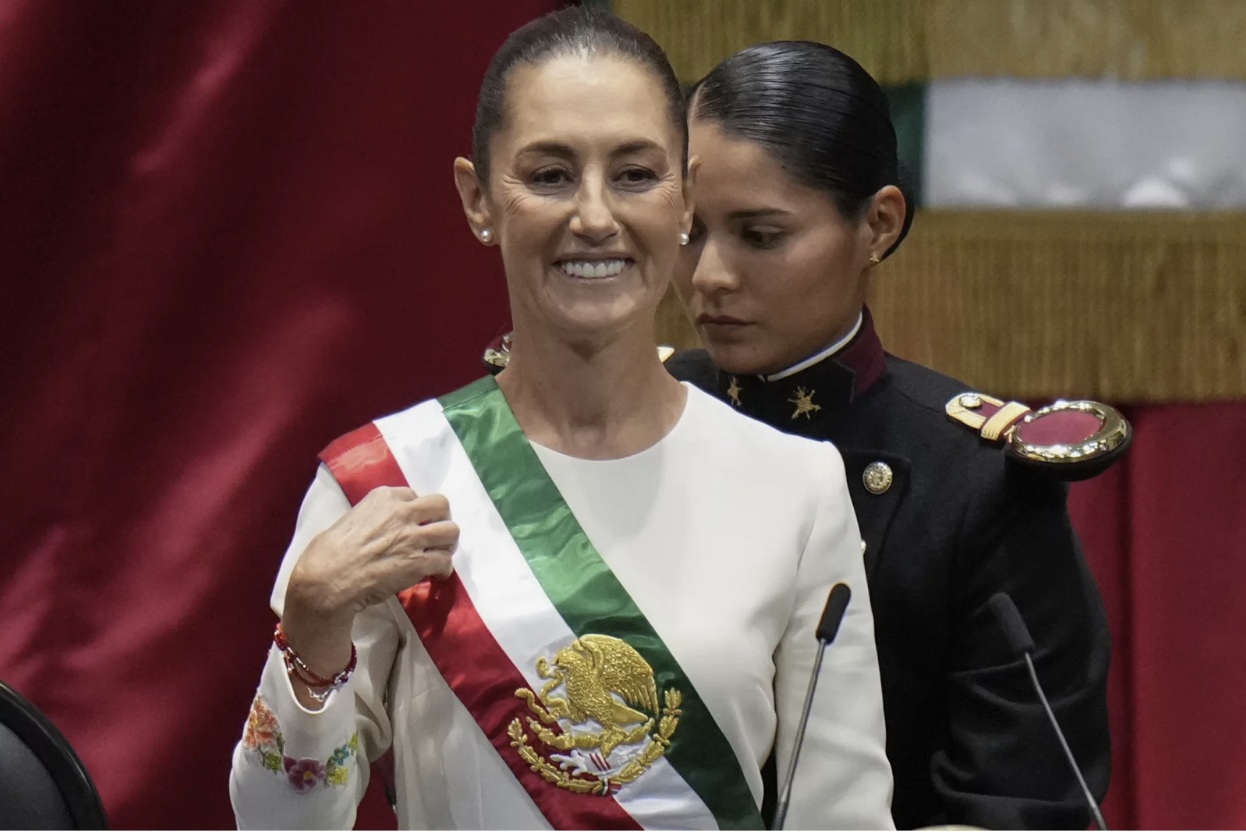
Photo via NPR
***
When Claudia Sheinbaum rose to victory and became Mexico’s first woman president, the glass ceiling had seemingly been broken. The inauguration was a national milestone because it encapsulated decades of feminist struggle in a country where women have historically been excluded from political and institutional power. For many, it was proof that progress was the new face of Mexican politics.
As soon as she took office, international headlines declared the start of a new era. Analysts called it a transformation. Morena loyalists named it the consolidation of their Fourth Transformation. Mexico had finally elected a woman president.
But symbols are not the same as solutions.
Sheinbaum inherited a country where an average of ten women are murdered by femicide every single day, where survivors of domestic violence face indifference from the justice system, and where Mexico’s most powerful feminist movement distrusts the state more than any political party. A massive contradiction sits at the center of her presidency: she is celebrated as a feminist icon in a country where feminist activists constantly state that the government has failed them.
Sheinbaum’s challenge is not breaking the glass ceiling. It is fixing the floor on which millions of women stand.
This doesn’t mean that representation doesn’t matter. Mexico waited far too long to elect a woman president. The emotional weight of Sheinbaum’s election cannot be ignored, especially in a country where gender norms and machismo persist.
Little girls were able to see someone who looked like them take the oath of office. It matters that the birthplace of Sor Juana, Frida Kahlo, and Marcela Lagarde finally has a woman leader.
This moment should not be ignored. But representation is only the start of political transformation, not the end.
Women in Mexico are demanding change to achieve safety on the streets, protection in their homes, and accountability in the justice system. The feminist movement is not simply celebrating because a woman is in power; it is asking whether her administration will finally confront institutions that have failed women over and over.
A woman being in power does not equal women having power.
Mexico’s feminist movement is known for being fierce, powerful, and uncompromising. Its marches, strikes, and occupations from the last decade were not polite demonstrations; they were demonstrations of collective anger, grief, and disappointment.
There has been graffiti on monuments, people chaining themselves to public buildings, and writing the names of those who are missing across the walls in Mexico.
Their enemy has not only been the patriarchy, but also the state.
It is a state that fails to investigate disappearances. It is a state that allows femicide cases to go cold. It is a state that blames victims for their own femicides.
In the early stages of her presidency, Sheinbaum has offered rhetoric, not true reform. She has presented plans and flashy titles, not prosecutions. Commissions have been created, but the search for thousands of disappeared people lies in the hands of mothers searching, digging through fields and mass graves with their bare hands.
So far, the feminist movement has only seen continuity, not change.
The most urgent problem of Sheinbaum’s presidency is not ideology or infrastructure; it is violence. Mexico is experiencing a security crisis that affects every single citizen. This is a deeply personal issue that needs immediate attention.
Violence occurs within homes, in relationships, workplaces, public streets, and with police complicity. This is why feminism in Mexico is not a theory; it is existential.
Sheinbaum is a scientist, a technocrat, methodical and data-driven. But the violence that women experience in Mexico is emotional, intimate, and rooted in fear, grief, and trauma.
More than 130,000 people remain missing in Mexico, and families are left to their own devices to search for them.
Sheinbaum stands before the media every morning to present plans, reports, and numbers. She has promised improvements, and Yet Femicide rates at the national level remain practically the same. The crisis is not being reversed; it is simply being narrated and explained. When mothers are still digging through fields for bodies, “management” is not enough.
The collapse of public trust is worsened because the levels of political violence are continuing at alarming levels. Mayors, candidates and journalists are being killed constantly. Among those who lost their lives because of political motives is Carlos Alberto Manzo Rodriguez, the mayor of Uruapan, Michoacan, who was shot just days before the country took to the streets in protest.
Claudia saw the protest as a political attack against her administration. She responded as many world leaders do, with mere condolences and polished statements, but no clear solutions or a strategy to move forward.
Mexicans are now noticing her true governing method: defensive.
Instead of accepting that the public’s outrage stems from institutional failure, her administration has often framed criticism as partisan hostility rather than a country-wide issue. Any evidence of protest is classified as opposition according to her. Any anger is deemed an exaggeration. And any grief is used as a political tool.
Still, when violence is this damaging, it is not a partisan issue; the whole structure is at fault.
Mexico is now a country where running for office will get you killed. Entire municipalities operate under organized crime. Journalists are intimidated and murdered. Local officials are silenced at the first attempt to change the institution. This is not an indication of instability, but of erosion.
If a democratic state cannot guarantee that its elected officials are safe from any opposition, how strong is its democracy, really?
Claudia Sheinbaum’s vague and cautious approach raises crucial dangers, as it signals continuity with her predecessor’s security strategy. Andres Manuel López Obrador promised “hugs, not bullets.” He believed that the way to reduce crime was to expand the military’s role in civilian security. What ended up happening was a paradox: militarization without any accountability meant presence with no protection for the citizens.
Sheinbaum has failed to break away from this model, leading many to believe her rise to power was due solely to her predecessor’s appointment to the role.
Instead, she has chosen to inherit the entire political architecture that was set. The National Guard remains central. The armed forces are still embedded within public security. Institutional reform, especially involving prosecutors and state police, remains slow and highly politically sensitive.
This is where symbolism finally collapses into reality.
A feminist presidency cannot be successful if it relies entirely on continuity. If the National Guard remains as it is, if prosecutors cannot successfully work, if femicide investigations remain stagnant, then the historic nature of her win is completely overshadowed. Mexico did not elect Claudia Sheinbaum to copy others’ administrations; it elected her to start a new one.
History books will not record the cheers on Inauguration Day. It will remember the outcomes she achieves.
If women are not safer, if political violence remains, if impunity keeps overshadowing law enforcement, then her presidency won’t be defined as “transformative” but as a “failure.”
***
This article was edited by Gwynneth Paolo Mack and Elaina Gibson.
 Jonathan Kho
  Anika Bobeck
  Emma Carreno