
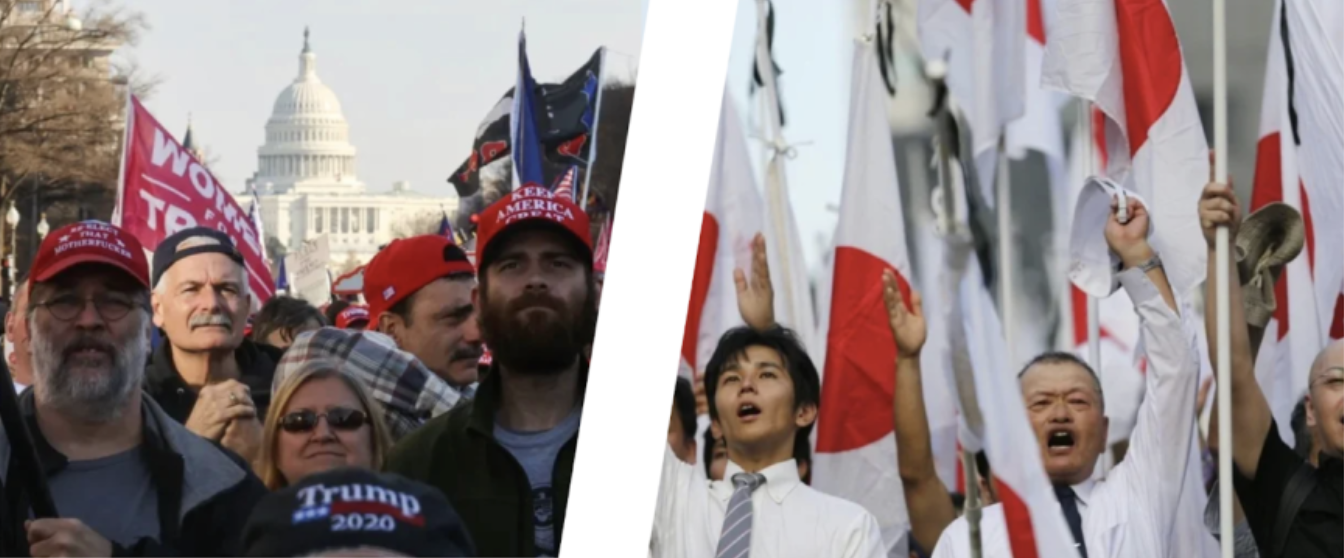
Image via Johnathan Ernst (left), Issei Kato (right)
***
Otherization has manifested itself in American tribal politics as well as Japanese isolationism; however, it has varying results when the “other” is a foreigner versus a fellow citizen. In turn, this dividing or unifying sense of national identity provides two distinct playing fields in which nationalism may proliferate in both ethnically diverse and homogeneous countries.
Evidently, nationalism is once again on the rise globally, as populist right-wing politicians are winning more and more elections each year. Threats to national culture, prioritizing your nation’s interests, and closing borders have created a political sphere in which domestic and international unity has been compromised and fragmented amid a boom in globalization. However, the way nationalism is advertised to society changes depending on the role politics plays in identity. Japan’s outward-facing otherization and the United States’ internal polarization illustrate how nationalism manifests differently when a nation aims towards uniformity or domestic ideological competition.
Japan, the most ethnically homogeneous nation in the world, is no stranger to xenophobia nor seclusion. Legislation that discriminates against foreigners or “outside people” (controversially referred to as gaijin) remains despite “changing demographics due to immigration and interracial marriages.” Unlike the more ethnically diverse nations within North America and Western Europe, this ethnic uniformity subsequently manifests in social norms and uniform identity that persist throughout Japanese culture. The saying “deru kugi wa utareru” (出る釘は打たれる) or “the nail that sticks up gets hammered down,” signifies the push for uniformity while actively deterring individuality through societal pressure. Meaning, Japanese society has cultivated a harmony that foreigners and their customs may threaten. This approach to otherization separates Japan from foreigners while encouraging conformity. Therefore, nationalism within Japan functions to protect the nation from outsiders who pose a threat to its existing purity and unity.
The United States does not have this same kind of ethnic homogeneity, according to the 2020 US Census, as the probability of randomly selecting two individuals of different races reached 61.1%, indicating much ethnic diversity. However, from its founding, American identity has been constructed through exclusion. The Alien and Sedition Acts of 1798 depict the fabrication of boundaries to American identity that do not include Native Americans nor enslaved people brought to the United States; rather, being an “American” was gatekept by only specific European settlers. As more non-English speaking people immigrated to America, prejudice and discrimination against new arrivals deemed “un-American” began to rise from non-indigenous American citizens who ignored their own history of immigration.
This debate over inclusion and exclusion, often shaped by prejudice against people of color, inevitably bridged a gap between politics and individual identity; intertwining the two while simultaneously giving way to tribal politics fueled by racism and ego-driven political idealism. The divide along partisan lines fundamentally shifted when Democrats reorganized party membership following the passage of the Civil Rights Act and the Voting Rights Act in the 1960s. Ultimately, party affiliation came to reflect far more than policy; it became rooted in “what Democrats and Republicans looked like, what kind of religious services they attended, what kind of cultural television shows they watched, and where they lived.”
As this persists, American party politics continues to prioritize the dominance of a single kind of political idealism, culture, and identity over another. Facilitating fragmentation and a kind of nationalism that otherizes immigrants as well as fellow nationals, rather than focusing on policy.
Although, like in the U.S., dissent exists in Japan, the societal uniformity that puts pressure on homogeneity allows for a kind of nationalism that resurrects imperial pride. In turn, unifying the people against an external threat. On the other hand, nationalism within the U.S. has led to further polarization that pins Americans against each other, leading to political idealists (namely, right-wing politicians) using extreme means, often resorting to political violence, to save America or “make it great again.” In other words, Japanese nationalists lead with othering an external threat to the nation, while American nationalists point to an internal threat.
Although displays and the expression of nationalism in the United States and Japan differ, there is, without a doubt, a pattern that appears to strengthen a nation’s nationalism: the creation of an enemy, or the “other.” Whether this leads to domestic or international polarization, ploys to instill fear in the general public for power should be recognized as a danger to domestic and international economies, democracy, equality, and the founding principles of many nations (namely the U.S.) based on universal natural rights. Ultimately, the collectivist ideology diminishes global progress from the 20th century, merely inciting conflict rather than prioritizing the prosperity of any nation–effectively condemning history to continuously repeat itself.
***
This article was edited by Simon Shalett and Cynthia Duchitanga.
 Nathan Wellman
  Nadia Garriga
  Ariana Sebourne