
Photo via Reuters
***
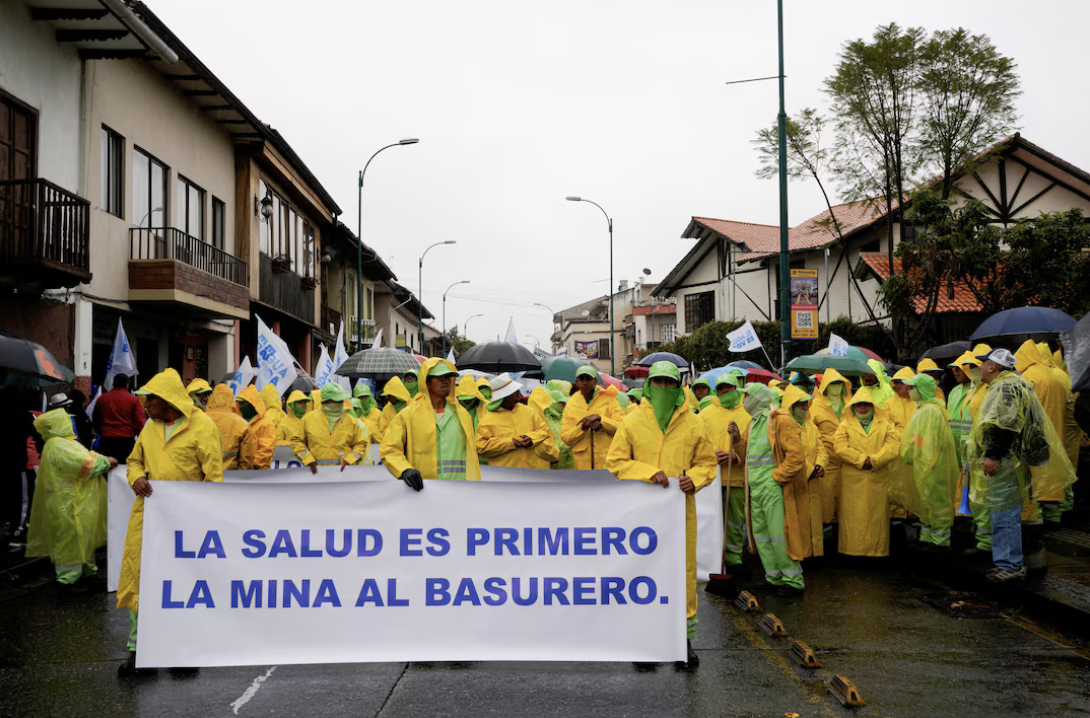
On September 16, 2025, thousands of people took to the streets of Cuenca, Ecuador, to defend what they considered an irreplaceable natural resource: water. Indigenous and local communities filled the streets of the southern Andean city, all chanting, “Water is worth more than anything!” in response to the government’s approval of the Loma Larga mining project. While their chants displayed their disapproval, they also raised a larger question of who was behind the growing environmental conflict in Ecuador and why it was happening in the first place. Unsurprisingly, the answer to this question lay within the priorities of the Ecuadorian government.
Incumbent Ecuadorian president, Daniel Noboa, first took office on November 23, 2023, as the National Democratic Action (ADN) candidate. His election was a result of a snap presidential election called by former President Guillermo Lasso. Amid impeachment proceedings over allegations of embezzlement linked to a state oil-transport contract, Lasso invoked a constitutional mechanism known as muerte cruzada (mutual death), dissolving the National Assembly and triggering early elections. With little prior political experience, Noboa entered the presidential race promising to combat organized crime, create jobs, and bring a youthful perspective to traditional politics. His opponent, Luisa González, ran on a Correismo campaign that many Ecuadorians weren’t in support of due to its connection with former President Rafael Correa, who was found guilty of aggravated bribery and corruption in 2020. Noboa’s opponent and campaign promises worked in his favor, and he defeated González with 51.83% of the vote.
For the next 18 months in office, following his first presidential term, Noboa heavily focused on addressing Ecuador’s crime issues. He deployed military forces to patrol the streets and declared an internal armed conflict against criminal organizations such as Los Choneros and Los Lobos.
When Ecuador returned to the polls in April 2025, Noboa and González campaigned once again on the country’s economic and security issues. However, environmental concerns received considerably less attention from both candidates during this election. This was particularly concerning for environmental advocates, who had already questioned Noboa’s environmental record during his first term. His administration faced heavy criticism for delaying the implementation of the 2023 referendum in Yasuni National Park. The referendum, which more than 59% of voters agreed on, mandated an immediate end to oil extraction in Block 43 (ITT) of Yasuni National Park within a one-year deadline. Noboa’s administration was in charge of carrying out this referendum, but instead, he chose to put his own interests first. His administration proposed to extend the closure process as far as 2034, 10 years more than the original referendum had designated. His reasoning: fiscal deficits and the reliance on oil revenue from the park to sustain the economy. Despite all of it, Noboa secured reelection with 55.63% of the vote, defeating González once again. While his victory was celebrated by many, it also left environmental advocates worried about how his second administration would approach Ecuador’s environment and whether or not his economic goals would put natural resources at stake.
These concerns were quickly turned into a reality, and President Noboa was met with an even greater wave of backlash in the first months of his second presidential term. On June 23, 2025, the Ministry of Environment, Water, and Ecological Transition (MAATE) granted Dundee Precious Metals (DPM) the environmental license to begin the Loma Larga project in the Quimsacocha páramo.
The Loma Larga project was designed to extract underground gold, silver, and copper from the Quimsacocha páramo in Azuay Province, located in southern Ecuador. From an economic perspective, the project presented an opportunity to save the struggling country. DPM committed to a direct investment of $419 million USD into the country, raising substantial capital investment. Under Ecuadorian law, about 50% of the project’s benefits would remain in-country through corporate income taxes and sovereign duties. Not only that, but the project was expected to generate new jobs for the Ecuadorian population, helping address their high unemployment rates.
On the surface, the project’s expected results appeared to align with two of Noboa’s primary campaign promises: economic growth and job creation. Yet the anticipated benefits did not outweigh the environmental effects Noboa’s administration was turning a blind eye to.
In the environmental aspect, Loma Larga was nothing but a slow death sentence to Quimsacocha’s sensitive páramo ecosystem and surrounding water resources. Noboa’s government officials maintained that the project would not contaminate Cuenca’s water supply, but it wasn’t enough. Local authorities, environmental organizations, and surrounding communities continued to raise concerns about the risks mining could pose to the region’s watersheds.
Quimsacocha, meaning “three lakes” in Kichwa, is a high-altitude páramo ecosystem sitting at about 3,040 and 3,960 meters above sea level. This páramo feeds lagoons, wetlands, and rivers that supply drinking water, agriculture, and power to more than 500,000 residents in Cuenca and surrounding populations. For many indigenous communities in the region, Quimsacocha represents far more than an environmental resource. It is an ancestral site with deep cultural and spiritual significance. Indigenous people understand the land through the concept of Pachamama, or Mother Earth, viewing nature as a living entity that sustains human life and deserves respect and protection. From this perspective, hurting the páramo would be like hurting the Pachamama itself, something that is a part of Indigenous cultural identity.
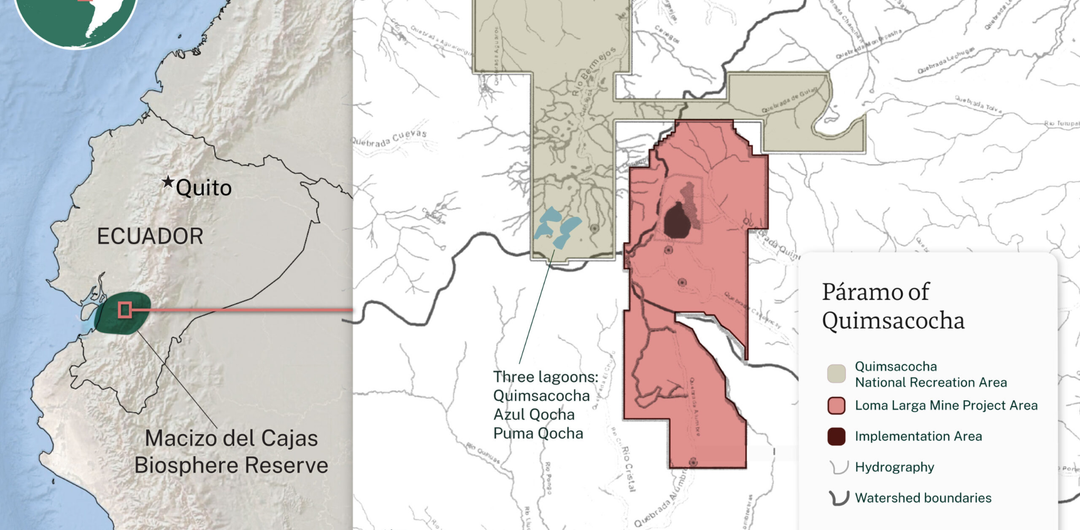
Photo via Mongabay
For such reasons, Ecuadorian citizens, Indigenous leaders, environmentalists, and local authorities decided they were not going to leave their precious Quimsacocha in the hands of the Ecuadorian government. They took to the streets of Cuenca in September 2025 and marched through the city, chanting “Hands off Quimsacocha,” ensuring their discontent and disapproval were vividly heard.
Their efforts, fortunately, were not in vain. On October 3, 2025, the mounting public pressure and opposition resulted in a significant reversal. The Ministry of Environment and Energy issued a resolution revoking the environmental license previously granted to DPM. The decision was publicly announced the following day, after the government also considered technical reports submitted by the Municipality of Cuenca (available in Spanish) that pointed out mining contamination risk to the region’s watersheds.
This revocation was a win for Quimsacocha, its water supply, and the communities that had spent years opposing mining projects. For them, it wasn’t just about saving the environment but about applying pressure to their government and holding them accountable.
Ultimately, the controversy around the Loma Larga project revealed a larger challenge Ecuador will continue to face, which is reconciling an economy that depends on natural resource extraction with the environmental interests of the communities that depend on those same resources. Noboa’s administration was behind the mining goals these last couple of years, promoting it as an opportunity for investment, employment, and economic growth. While those areas remain important for Ecuador’s stability, they shouldn’t happen at the expense of the environment.
For those who took to the streets of Cuenca, water was never simply a resource to be extracted or traded for economic gain; it was the foundation of their communities, their culture, and their future. And as the fight for Quimsacocha made clear, no promise of economic progress can truly be measured without considering what a country stands to lose along the way.
***
This article was edited by Hayley Dunn.
 Simon Shalett
 Sahir Sadat
 Jonathan Kho