
Image via Telegraph
***
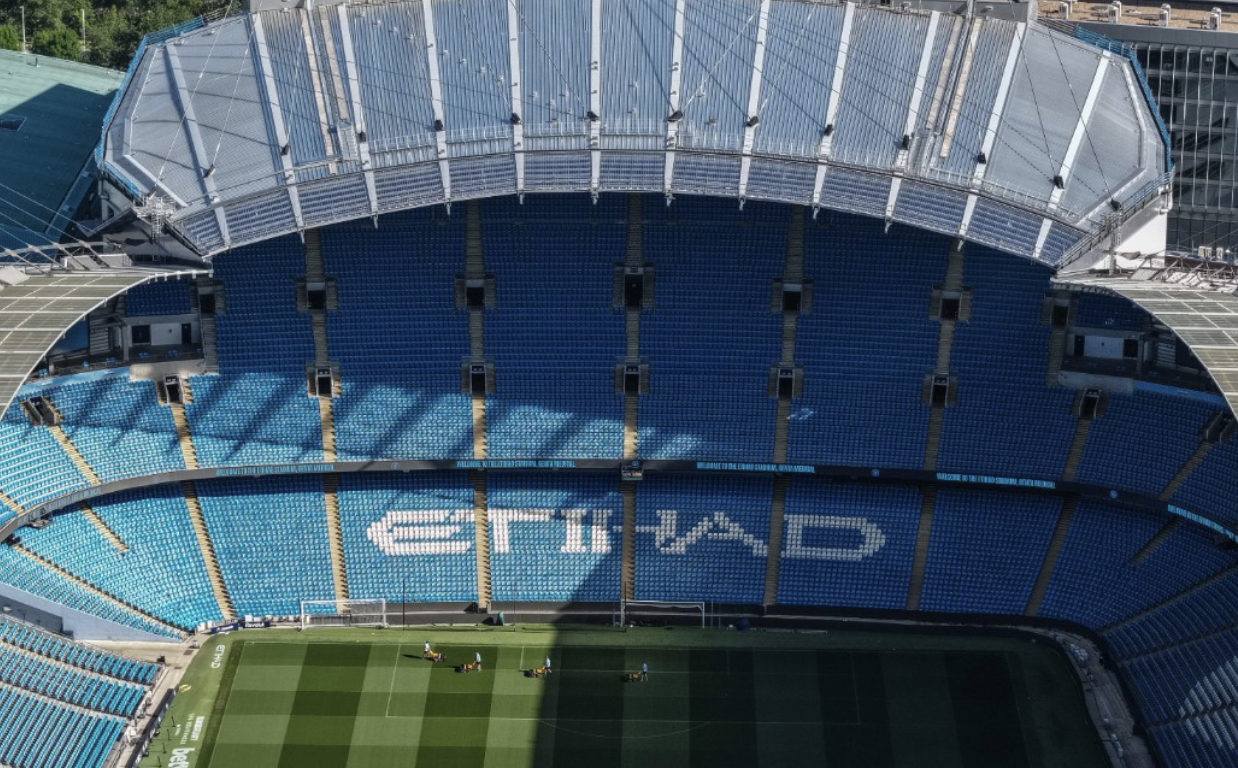
English football club Manchester City was found guilty of breaking over 100 financial rules by the Premier League, England’s main football association and the highest level of its league. The violations were recorded between 2009 and 2018 and involved sham contracts and other schemes to hide hundreds of millions of dollars in undisclosed funding from the club’s owners. While the verdict has been delivered, Manchester City awaits sentencing that could range from a point deduction in the current season of the League to relegation to a lower level of football.
While the scale of this scandal is extensive, it is not the first financial scandal of its kind in England. What is unprecedented, however, is the political implications that have come from it. The club was purchased by Abu Dhabi United Group in 2008, headed by Emirati royal Sheikh Mansour. Since the acquisition, it has become one of the wealthiest and successful football clubs in the world, providing a substantial boost to Manchester’s economy.
In addition, the United Arab Emirates has expanded its investments in the United Kingdom over the past few decades and has established itself as one of its most reliable trading partners in the Middle East. Quite counterproductively, the guilty verdict has posed a challenge to the relationship, with the country reportedly considering pausing its investments in the UK over the matter.
The UAE’s investments in Prime Minister Andy Burnham’s hometown, who hails from Manchester and served as mayor before his time in Parliament, have become a point of criticism his opponents have raised. The Greater Manchester Combined Authority (GMCA) released details of his interactions with Manchester City, including a formal meeting with its chairman in 2021. This information, however, has done little to extinguish concerns over his potential involvement in the case.
Despite the immense political consequences of the Manchester City debacle, sport as a whole has previously become a focal point of international politics, especially during increasing Cold War tensions. In 1980, the United States led 64 other countries in a boycott of that year’s Summer Olympics in Moscow in protest of the Soviet invasion of Afghanistan. In response, the Soviet Union and several other nations would boycott the 1984 Olympics in Los Angeles.
Given the influence of politics in sporting events, some matches have been viewed as extensions of interstate relationships and tension. At the 1956 Olympics in Melbourne, Hungary defeated the USSR in a violent water polo match after the Soviets brutally repressed protests in the Hungarian Revolution. In a similar example, Argentina’s victory over England in the 1986 World Cup was a “symbolic revenge” for its defeat in the Falkland Islands War – an issue that has continued to define foreign policy and subsequent matches between the two nations.
Additionally, states have long used sports competitions to project a positive image of themselves on the global stage. This desire has particularly led to the phenomenon of “sportswashing,” a term commonly used to describe the practice of countries using sporting events to distract public attention from serious issues, especially those on human rights. This term can be applied to the purchase and ownership of Manchester City.
At the same time, the football club is just one of many investments the UAE has made to diversify its economy and gain a foothold in global markets. This has especially led to the development of linkages—a term used to denote cases in which states make policy shifts in one field based on another state’s actions in a separate matter. This very aspect has defined the conversation about Manchester City, and has now become a flashpoint of UK-UAE relations.
Manchester City’s financial scandal has elicited comparisons to the Calciopoli scandal, which rocked Italian football two decades ago; it instead involved reports of manipulated refereeing to favor certain teams in the Serie A, the country’s equivalent of the Premier League. Top club Juventus was relegated to the Serie B and had multiple league wins stripped from its record. Some have pointed to this as a model for dealing with Manchester City. Between the period of 2009-2018 established by the verdict, the club won 7 trophies, including 3 Premier League titles, which now hang in jeopardy.
What should have been a simple decision on the conduct of an English football club has spiraled into a complex political discussion on foreign policy. If Manchester City receives what is considered a light punishment for its breaches of financial conduct rules, it will be attributed to the UAE’s increasingly influential ties to the UK; conversely, a comparably harsher punishment would likely damage these relations. While football and sports as a whole have never been immune to political conflict, the effect that background politicking has on sports has ranged from distant murmurs to an active force shaping their trajectory.
***
This article was edited by Andrew Ang and Maahi Kumar.
 Samantha Kornsey
 Matthew Subramani
 Jackson Cutrone