
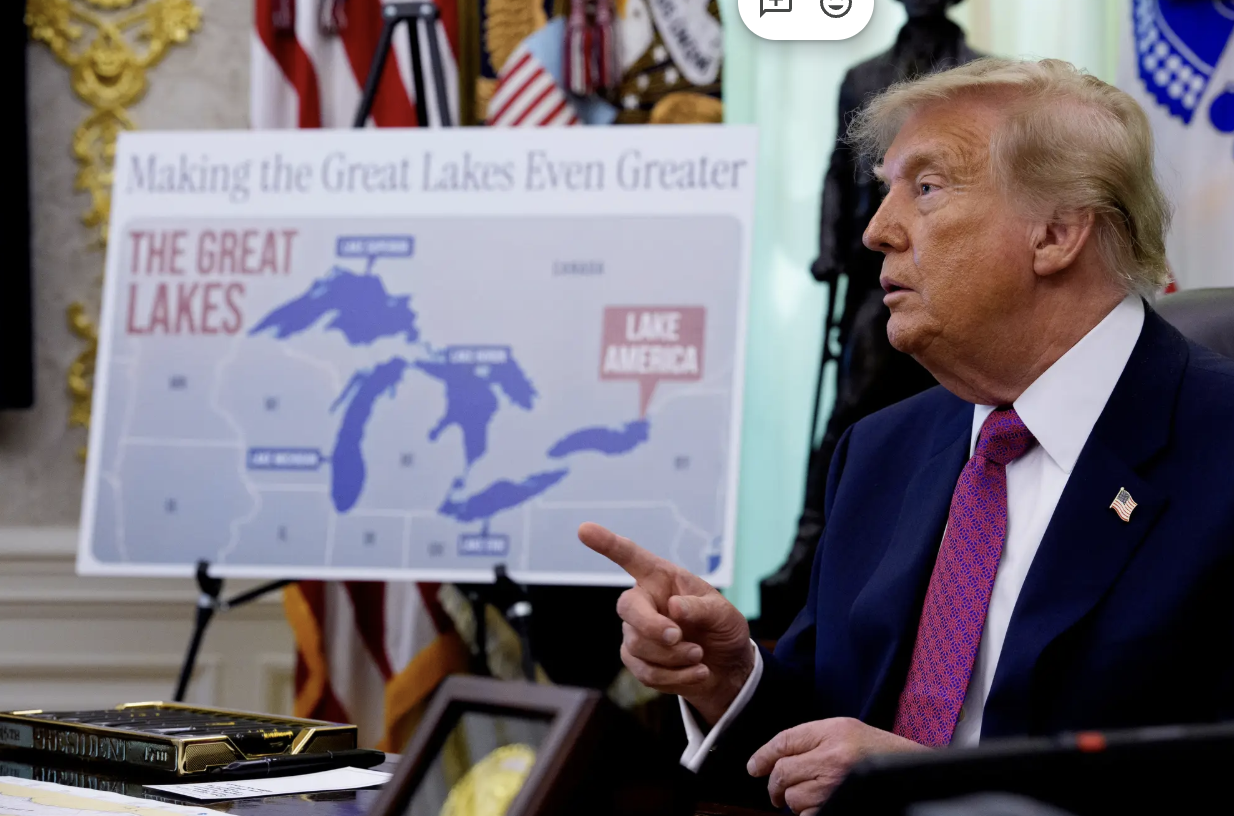
Photo via Andrew Harnik/Getty Images
***
With the renaming rampage of President Donald Trump, cartographers worldwide are no doubt having a conniption over the amendments being made to and around the United States. Engravers and stonecarvers are likely on standby for if–and when–Trump chooses to commandeer a new government building or cultural center.
A few of the changes among long-established titles are: renaming the Gulf of Mexico to the Gulf of America, Lake Ontario to Lake America, and Palm Beach International Airport to the President Donald J. Trump International Airport, directing federal implementation and adoption within U.S. jurisdiction. Trump has also added his name to both the John F. Kennedy Memorial Center for the Performing Arts, as well as the headquarters of the U.S. Institute of Peace.
Trump has also offered an alternative passport option, featuring a portrait of the president gleaming through the Declaration of Independence and the nation’s flag. This appears to be the most ironic merchandise, as most who align themselves with MAGA state they would never consider or want to leave his great nation.
These alterations and revisions reflect the musings of a self-aggrandizing leader, whose behavior is reminiscent of a peer who insists that their name goes first on every group project to appear more important than everyone else. These actions prioritize personal recognition over historical and cultural significance, which acts as a slap in the face to indigenous histories.
The president’s renaming frenzy comes as an effort to homogenize the nation and erase the already largely ignored native populations. However, a name change alone cannot reverse the histories and roots of our nation – histories that are largely unknown and unspoken. So, what is the story behind these names, and why should people be concerned with the dissolution of their original names?
Lake Ontario
The Wendat people occupy the Great Lakes region and speak the Iroquois language, which bestowed the water source with its original name, “Ontarí’io.” The term is often translated as “Lake of Sparkling Waters” and enshrines the importance that the lake held for this group. Ontario provided a gateway between different indigenous groups of the region, symbolized elemental relationships, and facilitated the survival and development of the Wendat people.
Just this past August, Trump announced that he was changing the name from Lake Ontario to Lake America. Whether this alteration was born from a place of national pride or spite for uncooperative neighbors, one thing is clear: the change exhibits the sense of disregard the president has for native histories. From the Gulf of America debacle to this, it’s starting to look like no body of water in or adjacent to the country is safe from Trump’s branding.
The Commander-in-Chief even jested at rebranding the Atlantic and Pacific Oceans. However, with Trump’s deceptive and ambiguous sense of humor, one can never be sure of what is a joke and what is a potential new executive order.
Mount Denali
The interior landscape of Alaska is home to the indigenous Alaskan Athabascan tribe. They have referred to the mountain as “Denali,” meaning “the great one,” honoring the legend of the native warrior Yahoo and his mystical, thrilling journey to find a wife. The mountain serves as a sacred spiritual landmark for the community, and the landmark and name hold significant meaning for the tribe.
However, in 1896, the mountain took on the name Mount McKinley after prospector William Dickey explored the region. He chose to dedicate the mountain to the soon-to-be president, disregarding any previous native significance or association with the mountain. The name stuck around until 2015, when former president Barack Obama signed a secretarial order restoring the native name. Going in the face of this reparation, Trump recently reverted to the name Mount McKinley after making a promise to his fans during a campaign rally.
There is no denying that America has been anything but respectful to those on the terrain before us, but after centuries of growth and distance from the previous horrors endured by native people, one would hope that the government would learn its lesson and start taking steps to rectify their indignities.
Unfortunately, the new administration is demonstrating anything but remorse, seemingly going out of their way to seize name rights and establish jurisdiction and ownership of these longstanding landmarks that serve no apparent legislative or bureaucratic mission. Where Trump thinks he is cementing the legacy of his regime, he is really immortalizing the ignorance of America’s past and glorifying its disrespect.
***
This article was edited by Andrew Kravatz and Hayley Dunn.
 Cooper Toland
 Jonathan Kho
 Simon Shalett