
Photo via Mint
***
After his historic 2025 victory, mayor-elect Zohran Mamdani is set to begin his long-awaited mayoral run. Beyond his new wave of democratic socialist policies, Mamdani’s introduction to office is paving the way for generational shifts in politics. A new culture is emerging in City Hall, and while it may start with Mamdani, it’s quietly growing with a new, unexpected figure, his wife.
Rama Duwaji is a 28-year-old American animator, illustrator, and New York City’s next first lady. Born in Houston, Texas, Duwaji lived in Dubai before moving back to the U.S. to study art at Virginia Commonwealth University. After receiving a Master’s in Fine Arts at the New York School of Visual Arts, Duwaji went on to illustrate for the New York Times, BBC, and Apple. Long before Mamdani’s success, she shared her work on Instagram, addressing issues such as Palestinian rights, gender equality, and mental health among women of color.
This past year, Duwaji was the driving force behind Mamdani’s wildly successful mayoral campaign. His iconic imagery—a bright primary color palette and designs featuring classic New York motifs—was reportedly finalized by Duwaji. Despite her proximity to one of the biggest names in politics right now, Duwaji has remained mostly silent about her personal life and makes public appearances sparingly. When Mamdani swept Andrew Cuomo in the election, Duwaji opted out of the victory speeches and instead shared one of her illustrations—a quiet image of the New York City skyline, captioned “So proud to be a part of this city.” Her involvement in Mamdani’s campaign, along with her quiet commitment to her own identity, suggests a broader cultural shift in the evolving role of political spouses, particularly campaign wives.
When we think of the term “campaign wife,” what comes to mind? Images circulate of a pristine woman, carefully treading the line between headstrong and nurturing. She is assertive enough to conjure a picture of the infamous “power couple” archetype without stepping on the toes of her ambitious husband. She wears pantsuits, pearls, and has four children clinging to her arms, all with a seamless smile and no complaints. When looking at the political wives of the current administration, this delicate balance (reminiscent of the infamous “tradewife” caricature) promotes the foundations of conservatism’s new American wave; family values, gender roles, and a dedication to the domestic sphere.
Yet, there is a gap between the right-wing notion of what a campaign wife should be, versus what she actually is. Examining the campaign wives of the Trump administration, such as Erika Kirk and Usha Vance, reveals undeniable tension. While Vice President J.D. Vance labels Democratic women as “childless cat ladies” and champions traditional family values, his wife is a lawyer with a concentration in civil litigation. After Charlie Kirk’s passing, his wife Erika Kirk assumed his position as executive director of the conservative think tank “Turning Point USA,” despite his critiques of career women. The notion of a timid, behind-the-scenes campaign wife barely clings to the reality of women adjacent to politics.
As long as there were political spouses, these expectations reigned true for many, specifically women. Yet, as younger political figures approach office things are changing, and Duwaji is one of Gen Z’s first examples. Rather than engage with the facade, she embraces her work independent of her husband’s political success. Her dedication to herself and unique career path have, whether intentionally or unintentionally, paved the way for a new archetype of political spouse.
Duwaji’s adherence to her own identity, regardless of her relation to Mamdani, creates the authenticity that so many Gen Z voters seek in their politics. Her decision to remain unseen, yet consciously involved, in Mamdani’s campaign characterizes her as an individual, rather than a political extension of her husband.
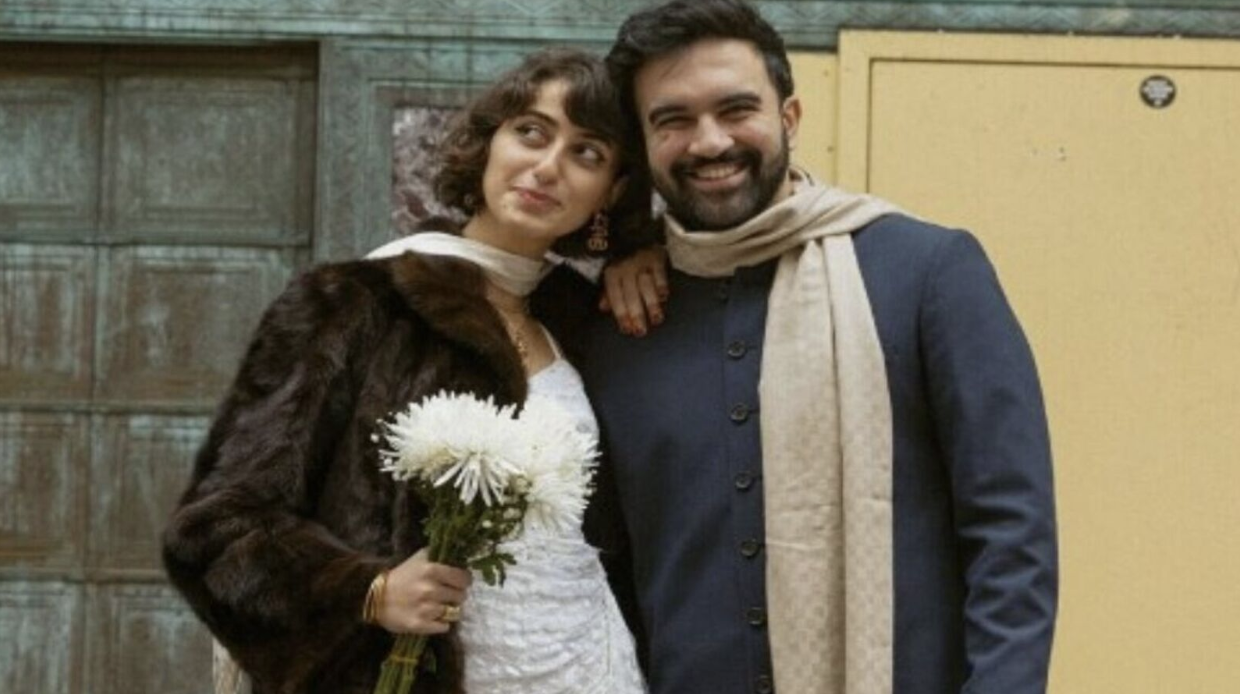
Duwaji’s consistency with her identity is the transparency that has been missing from politics. In an era where political spouses, particularly women, are often defined by their proximity to their husbands and families, Duwaji’s unapologetic career goals, values, and stylistic choices actively defy the norm. Her artwork, presence, and even her courthouse elopement to Mamdani—announced through a grainy photoseries published on Mamdani’s Instagram—communicate an genuine identity that, now more than ever, young voters crave. As Duwaji prepares to become Gen Z’s first-ever first lady, her decision-making and personal integrity shape a new definition of what it means to be a politician’s wife.
***
This article was edited by Abigail D’Angelo.
 John Virgil Aton
  Lara Ejzak
  Amelia Felice