
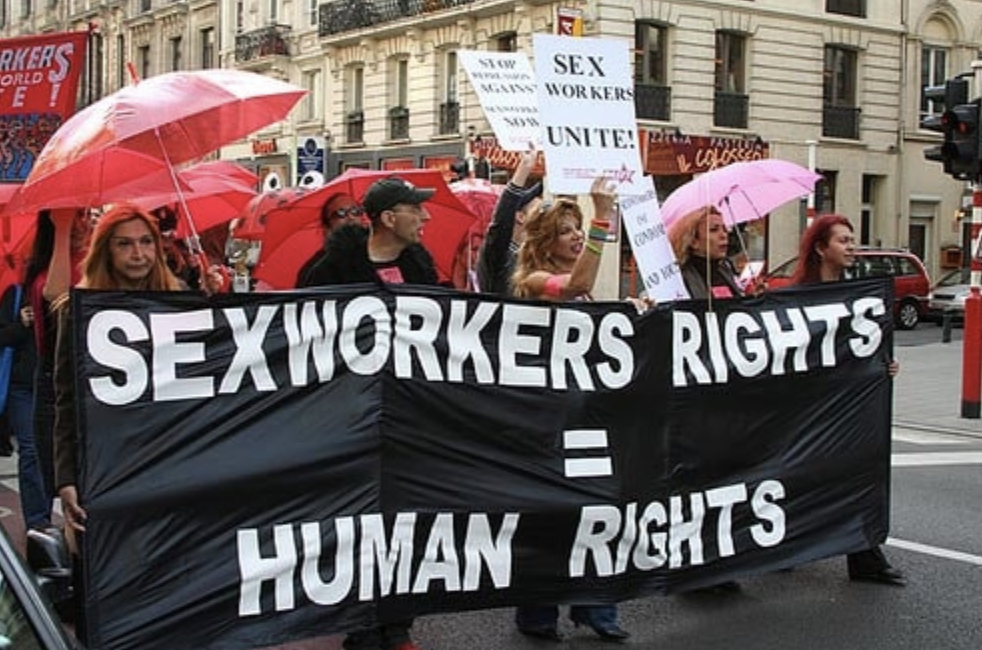
Photo via British Columbia Civil Liberties Association
***
Sex work, or prostitution, as defined by Merriam-Webster Dictionary, is “the act or practice of engaging in sex acts and especially sexual intercourse in exchange for pay,” and is often referred to as “the world’s oldest profession.” The Roman Empire legalized and taxed prostitution, signifying its normalization in ancient times. Sex work has also been referenced in sacred texts such as the Bible.
This notion changed over time, most notably with the emergence of religions in the West after the fall of the Roman Empire. This has led to various misconceptions and persecutions of sex, such as those laid out by Sexologist Shere Hite in The Hite Report on Female Sexuality (1976). She challenges these misconceptions of sex as taboo, or the stereotype that women have to be “good girls.” This notion was further challenged during the women’s and sexual liberation movements of the 1960s-70s, leading women to be more open about their sexual preferences and their bodies and arousal. With many challenging the limited or often inaccurate sexual education they received from their houses of worship.
In the legal realm, Miller v. California (1973) left us with an important paradox. The U.S. Supreme Court held that: “speech that is obscene and thus lacking First Amendment protection must be without serious literary, artistic, political, or scientific value. It also must appeal to the prurient interest in the view of an average person according to community standards, and it must describe sexual conduct or excretory functions in an offensive way.”
Officially, this ruling recognized that non-obscene speech is protected by the First Amendment, while also defining the term “obscene” at the federal level, narrowing it from previous state provisions. This ruling effectively recognizes most forms of pornography as legitimate speech and thus protects pornography in accordance with the First Amendment unless deemed obscene. Nevertheless, sex work is illegal in the majority of U.S. states, with the exception of Maine and a few counties in Nevada.
One should also note that being an adult entertainer or having an OnlyFans account is considered a legal job, and as such, one can legally enter contracts, as pornography is legal. Thus, protected by terms of service and labor laws. In contrast, sex workers have their work criminalized, which means contracts can’t be entered into and thus sex workers have limited to no workers’ rights.
In the debate against sex work, there are three major arguments against the legalization of sex work: that the majority of people engaged in sex work are forced, that it is misogynistic, and that the industry is dangerous, seeking to exploit sex workers both physically and mentally.
The first argument is that people forced into sex work are forced as part of sex trafficking or due to coercion. Most studies claim the actual number of trafficked persons is less than 6%, although this figure is also uncertain due to data collection limitations. Even human trafficking organizations recognize a distinction between human trafficking and sex work. While human trafficking exists and is of major concern, it is commonly overstated as a means of concern by law enforcement to prosecute sex workers. Victims, who are often people already poor or with limited options for work, are criminalized, arrested, and charged.
Additionally, the perspective on sex work as being misogynistic and sexist is often championed by anti-porn feminists. This view is not completely accurate, as within the feminist movement, there has been a series of debates, titled the “Porn Wars,” which caused a schism between anti-porn feminists and sex-positive feminists. Anti-porn feminists primarily rely on the sex industry as being inherently misogynistic, and should be considered rape even if the sex was consensual, while sex-positive feminists often equate participation in the sex industry with a personal choice. The anti-porn position, being arguable against the sexual liberation movement, relies on previous “good girl” or “sex is filthy” stereotypes. This issue is split among feminists and is likely to be debated into the foreseeable future. This argument relies heavily on women in sex work but discounts the sizable portion of this industry that includes men and other sexual minorities who make up a sizable amount of sex workers. Sex work is a trade participated in by people of multiple backgrounds, and defining it as a man’s or a woman’s issue trivializes the lived experiences of sex workers.
Others might argue that sex work is dangerous and often leads to abuse. However, reports contradict these claims, instead showing that efforts to persecute sex workers have led to more abuse. For example, the UN found that social stigma regarding sex work has led to negative views of those who participate in it, using derogatory terms such as whores, sluts, and more. This stigma leads to widespread discrimination, especially in investigating crimes reported by sex workers, who are often arrested by police on charges of prostitution if they report a crime. This perspective is incredibly important to consider when asking the questions of sex workers reporting abuse. This cycle limits the credibility of sex workers as crime victims, which in turn allows bad actors to commit abuses against them with little recourse.
Each major argument against sex work has been shown to have fallacies, but it’s important to also discuss possible solutions. The ACLU, Amnesty International, and Human Rights Watch have all called for an end to the criminalization of sex work. Although there have been multiple models put forth as to how it should be done. The primary models put forth are legalization, the “Nordic model,” and decriminalization. Legalization is often criticized for giving too much power to organized entities, leading to worker exploitation. The “Nordic model” focuses on criminalizing sex buyers rather than sex workers, which many in the industry argue does not allow sex workers to negotiate with clients. Decriminalization is the model most often associated with New Zealand, often regarded by sex workers as the best option; it allows for the buying and selling of sex to be subject to laws like other jobs. New Zealand was one of the only countries to consult sex work organizations when crafting regulatory laws.
Regardless of your moral opinions regarding coitus, intercourse, sex, whatever you call it, it should also be recognized that sex workers are people worthy of dignity and respect. That sex work should not be criminalized by a government or moral crusaders, but instead be the personal choice of men, women, and any other who wishes to engage in sex work buying or selling. They can be accepted despite their chosen profession, come forward with their experiences, and have honest discussions about their abuses and their humanity.
***
This article was edited by Nola Coburn and Emma Saliasi.
 Christian Dziura
  Amelia Felice
  Samara Shelby-Nishita