
Photo via Michael Kappeler
***
September 22nd, 2026, marks an incredibly significant day in international politics. It is the opening day of the high-level General Debate for the 81st session of the United Nations General Assembly, right here in Fordham University’s backyard. This General Debate is of utmost importance because international conflicts are at a historical high—to be exact, the highest since World War II.
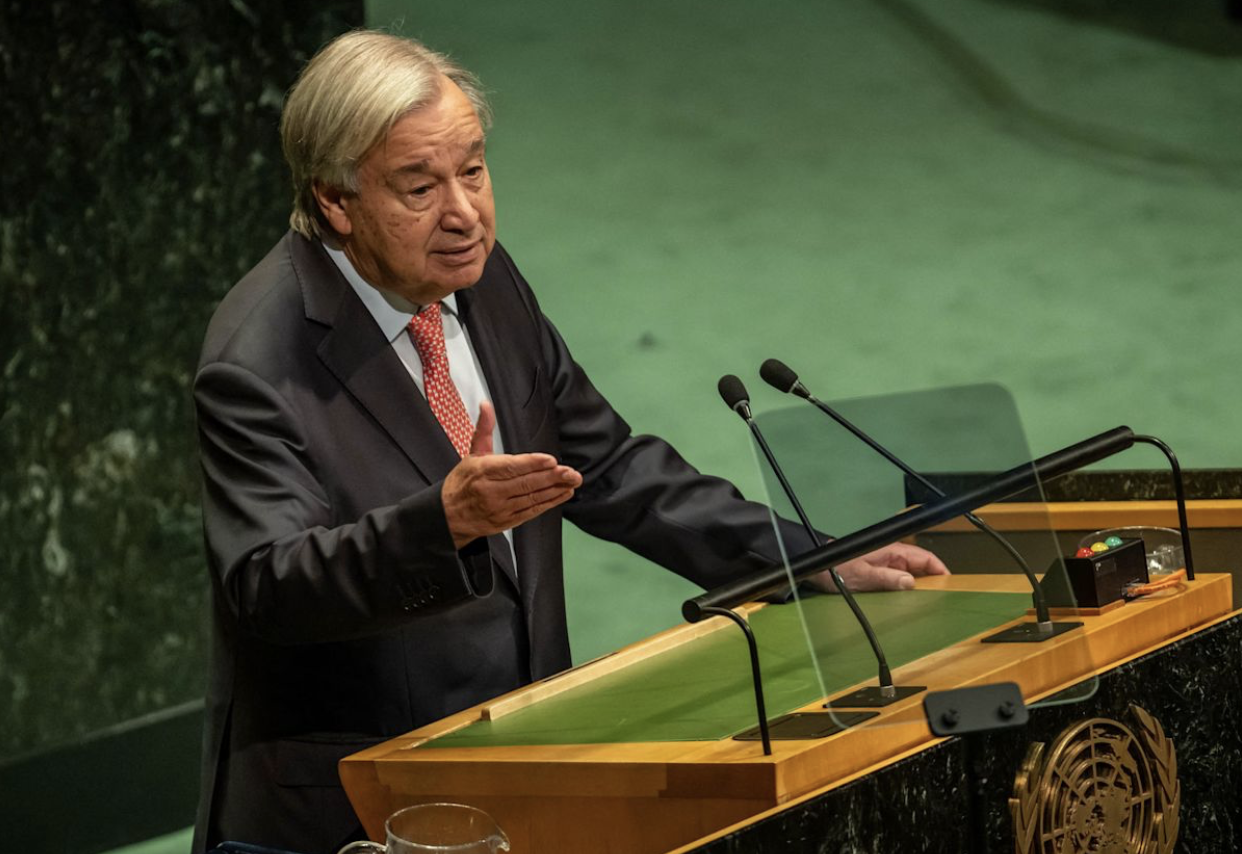
On this day, the Secretary-General of the United Nations, António Guterres, delivered his final General Debate Address. He named Security Council reform one of the four defining “tests of power,” alongside war, inequality, and Artificial Intelligence. As for the Security Council, Guterres singled out the continuous lack of permanent African representation as “unjust and indefensible.” Guterres’ speech had a broader framing as well. He warned superpowers that their power “isn’t so super” and that it has limits; military power alone cannot secure peace. A world built on interdependence and cooperation is stronger than one built on fragmentation and mistrust.
It is necessary to provide a scale when discussing the absence of African representation in the UN. Africa has been the subject of roughly 80% of UN Security Council resolutions over the past decade, yet it holds zero permanent seats. Critical decisions affecting the peace and security of Africa must be made with the proper African representation.
This raises the question of how African countries view this underrepresentation and what change they would like to see. The African Union’s position, adopted in 2005 in Eswatini, formally known as the Ezulwini Consensus, calls for a more representative and democratic Security Council. The agreement covered mostly collective security, such as preventive measures, the use of force, and United Nations reform. Specifically, the Ezulwini Consensus calls for no fewer than two permanent seats with full prerogatives, including the veto, and, in addition, five non-permanent seats. The African Union frames this as correcting a historical injustice rather than requesting a favor. The Chairperson Youssouf of the African Union Commission argued that, “The credibility & legitimacy of the Security Council depend on its ability to reflect the realities of today’s world, not the geopolitical order of 1945.”
So, why has reform stalled for two decades? France and the United Kingdom have offered conditional backing for Africa’s representation; however, their support often stops short of advocating for the veto power, which is a fundamental demand of the Ezulwini Consensus. The U.S. has been historically hesitant to support changes that could potentially weaken its own influence in the Council. China and Russia have deliberately used their positions to sustain the status quo. This divide among the permanent members has caused a stalemate that prevents any meaningful restructuring of the Council. Other reform blocks, such as the G4, which includes Brazil, Germany, India, and Japan, would agree to non-veto permanent seats, but Africa’s veto demand blocks the broader consensus needed.
Admittedly, adding veto-holders risks a worsened gridlock, since even in a large Council, a single veto can still invalidate a resolution regardless of support. The Heritage Foundation argues expansion is more likely just to produce inefficiency rather than legitimacy. More permanent votes, which would be necessary for the Council to act, could possibly slow crisis response procedures; for example, a Gulf War-like resolution needing 12 votes instead of 9 would take much longer to discuss.
The Security Council was intentionally designed as a small “select body,” not a representative one. The Charter’s drafters deliberately excluded most member states from decision-making, unlike the General Assembly. A further compelling argument is that a larger Council raises the political cost and value of the veto. The reasoning behind this is that if a larger quantity of nations agree to something, the value of one “no” to veto the majority’s decision holds much more value.
Unfortunately, the September 22nd speech from Guterres does not change the math. A charter amendment requires support from all five permanent members, in addition to a two-thirds majority in the General Assembly. Guterres’ term ends on December 31, with no successor yet named; while his support is admirable, this push passes to a new Secretary-General.
Guterres’ broader warning is regarding global governance built for a past assignment of power that is struggling to adapt to how power is now distributed. However, whether that adaptation happens is no longer his problem to solve — it is rather the next Secretary-General’s, and the world’s, problem.
***
This article was edited by Olivia Goodman and Sabrina Pala.
 Christian Dziura
  Javeer Khan
  Samara Shelby-Nishita