
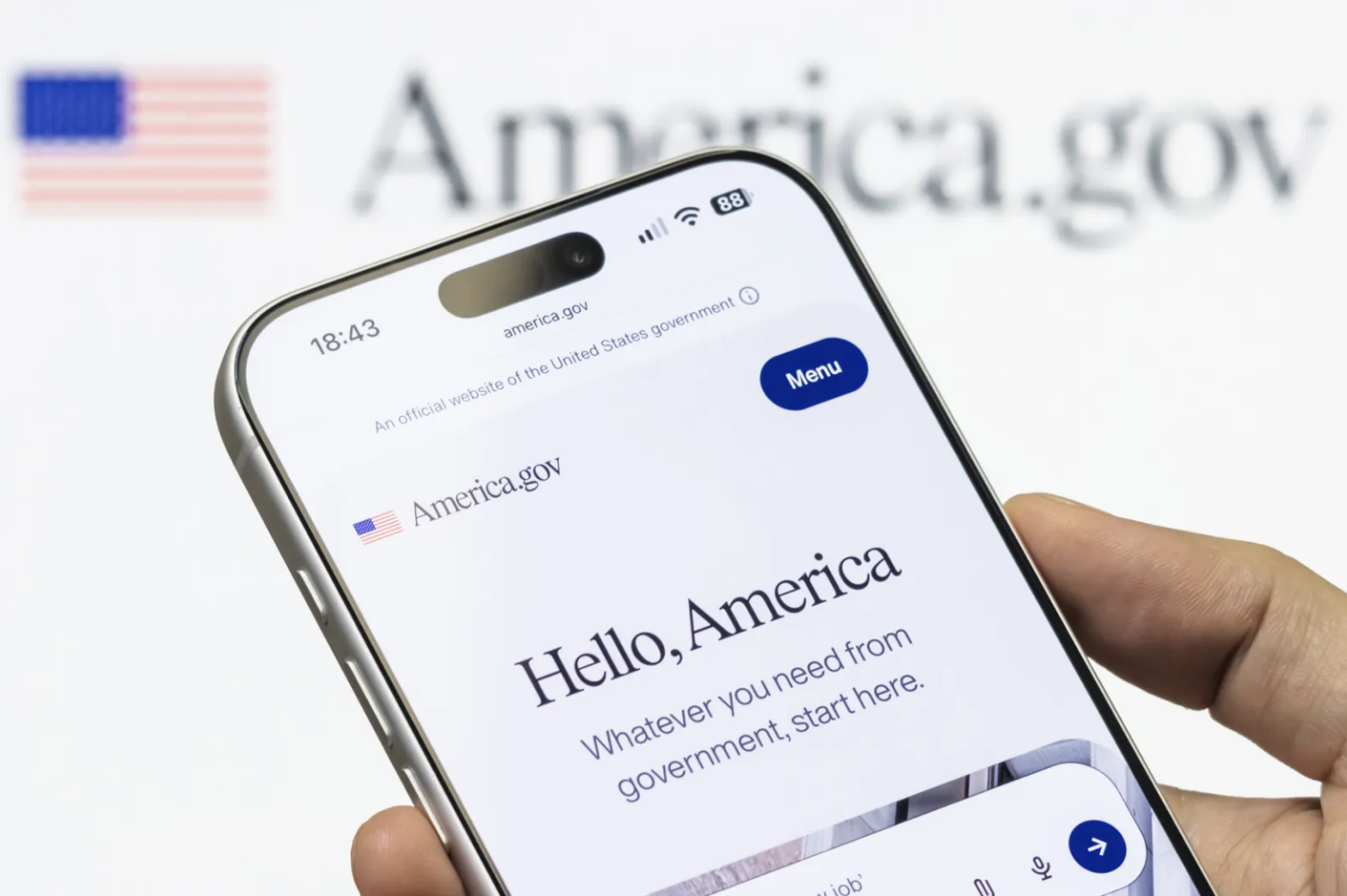
Image via Cheng Xin/Getty Images
***
On the morning of September 29th, United States President Donald Trump announced a new Artificial Intelligence (AI) chatbot for the federal government website america.gov. Trump originally claimed that the robot would provide remote assistance, with future plans indicating that passport updates would be possible through the chatbot, as well as viewing documents on the site. Instead of having to wait in line for hours, or schedule appointments over days to update documents, you could do it through a chatbot at home. While none of these features are available yet, the White House seems to hold high hopes for its future potential. However, problems have already begun to arise over the bot’s responses.
Users began noticing replies directly contradicting Trump’s own previous claims, in many cases fact-checking his statements and proving him wrong. For example, when asking the bot who won the 2020 election, it responds with, “Joseph R. Biden Jr won the 2020 US presidential election,” a direct contradiction to Trump’s own claim since 2020 that he “WON THIS ELECTION, BY A LOT!” Moreover, when questioned about the attendance numbers at Trump’s inauguration, the chatbot responded saying, “Official sources do not support that [2017] had the largest in-person crowd of any US inauguration…” A very different stance than the one Trump took, when he claimed back in 2017 that it was “the largest audience ever to witness an inauguration, period, both in person and around the globe.”
So where does the AI come from, and why is it contradicting Trump? As to who made it, the AI was developed by the National Design Studio (NDS), a temporary federal organization established within the White House Office by President Donald Trump’s August 2025 executive order, “America by Design.” The head designer of the NDS, Edward Coristine, was 19 when he was hired to be part of DOGE, and recalls the hiring process as “feeling like it had no real structure.” Now, he’s leading the federal government’s first AI chatbot. The site itself is run and maintained by the General Services Administration (GSA), who handles most of the government’s tech-based services. The AI model is run using Gemini and Grok, with a Google spokesperson telling CNBC, “Google is proud to be named a technology partner in this vital initiative, leveraging Gemini to help more than 100 million people access critical public resources with greater speed and ease.” While it’s not clear yet how the model was trained and what information it was fed, it’s clear it’s not the same ideas Trump’s been spouting.
If Trump’s administration isn’t able to handle a basic chatbot, how can they be expected to develop a complex AI system with multiple functions, such as the handling of important matters like passport and documentation updates?
Unease over AI’s impact on the environment have arisen as well. With large data centers using up to 5 million gallons per day (the equivalent use of a town populated by 10,000 to 50,000 people), concerns over water consumption are becoming increasingly legitimate. This is in addition to further environmental degradation caused by the construction of the data centers themselves. As AI-run systems require massive computing resources, data centers housing and training these systems require thousands of memory-chip racks and cooling gear, reinforcing the need for large, empty lots. Initially launched in June 2024, the Amazon data center in New Carlisle, Indiana, will destroy more than 10 acres of wetlands and fertile farmland and will take up more than 1,000 acres of land in total, approximately the size of the town itself. These concerns have largely shadowed the anti-AI movement, and similar sentiments have begun to make their way onto the Congress floor, as lawmakers debate the safety of AI, with Bernie Sanders and Greg Casar leading the movement, pushing for pauses and even bans. Trump’s administration seems to echo none of these opinions, however, as they plan to fix their AI chatbot rather than disable it, showing no intention to stop.
As AI becomes inseparable from our shared reality, we need to have serious conversations about the dangers it presents to our environment. The rollout of this chatbot raises an even more fundamental question: what happens when the government itself begins relying on AI to communicate with the public? AI may be the future. But before we hand over more of our government, our jobs, and our environment to it, we should make sure we understand what we are receiving in return. For now, if you want to know what the government says, maybe there’s a simpler option: Google it. Just don’t ask america.gov.
***
This article was edited by Catherine Dalton and Andrea Dominguez
 Jorja Mulvihill
 Vedha Gokul
 Nathan Wellman