
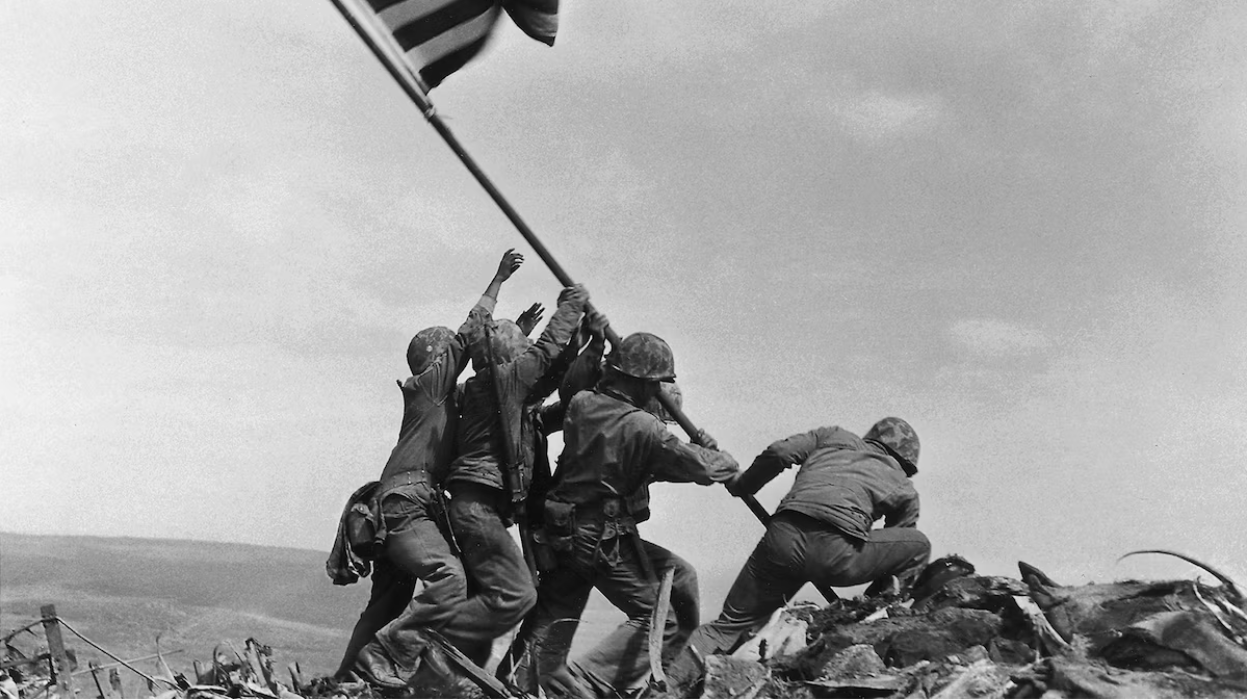
Photo via Joe Rosenthal, AP
***
It’s never fully about destroying nuclear weapons, stopping drug trade, or promoting national security. The United States will always be at war, and this is why:
The Nation’s Identity
It goes all the way back to the beginning; the U.S. was born under an ideal of war, expansion, and strength. The British contested the resilience of the thirteen colonies, so the patriots took up arms and fought against suppression. In 1823, for example, the Monroe Doctrine was issued and became a foundational document for U.S. foreign policy. It prohibited further European colonization of the Americas, establishing a separation between Europe and ‘The New World’. From this point on, the United States was rooted in a vow to combat powers with which it disagrees. After independence, the White House was constructed, a symbolic structure of power, and Western expansion soon began. Moving to the 20th century, as World Wars I and II unfolded, the United States began to view itself as a global power with an international duty. In 1943, the Pentagon was born, and a few years later, so was the Department of Defense, again, all symbols of power.
On September 5th, 2025, President Donald Trump signed Executive Order 14347, restoring the name “Department of War” and designating it as an alternative to the Department of Defense. This title dates back to an executive order signed by George Washington. Evidently, the U.S. has not lost its deeply rooted identity of war.
The Military-Industrial Complex
Iron triangle, a term coined by Dr. Martin Barnes in 1969, refers to the relationship among “congressional committees, special interest groups, and regulatory agencies.” Each corner of the triangle supports the others and receives support in return, transferring money and policy changes to keep each other afloat. There are countless iron triangles throughout the United States government.
The military-industrial complex (MIC) refers to a specific iron triangle dealing with the economics of war. The ideology was popularized by President Eisenhower in his farewell address, in which he warned the American public that “we must not fail to comprehend its grave implications.” The military-industrial complex consists of three key players: large weapons manufacturers (e.g., Lockheed Martin, Northrop Grumman, and General Dynamics), Congress, and the Department of Defense (DOD). Each works together to benefit one another: weapons manufacturers earn revenue, Congress members gain campaign contributions, and the Department of Defense receives increased tax funding.
This year, the DOD plans to spend $81.48 billion in contracts to arms manufacturers. There is an immense amount of government funds flowing to private companies, and because of the MIC, it ends up benefiting politicians. In 2024, the senators who voted in support of the FY2024 NDAA, a bill to increase military spending, received, on average, $150,000 from the arms industry. Meanwhile, senators who voted no received, on average, $28,000 in donations. Money talks, and it is clear that voting for increased military spending puts cash into politicians’ pockets. This is yet another reason the U.S. will always be at war; without conflict, there is no demand for weapons, and the entire triangle crumbles.
Oil
According to CNN, in 2000, Big Oil companies “spent more money to get fellow oilmen Bush and Cheney into office than they had spent on any previous election.” In return, just weeks into Bush’s presidency, “the National Energy Policy Development Group, chaired by Cheney, was formed.” This brought “the administration and the oil companies together to plot our collective energy future.” This coverage was published in 2013, shortly after the war with Iraq; however, it remains relevant because it illustrates the development of another iron triangle that continues to this day. Big Oil donates to politicians, politicians run intergovernmental groups, and oil companies receive favorable policy and funding to increase revenue, following the same formula as the MIC.
For decades, countless politicians in office have received donations from oil companies. Some current senators include Ted Cruz, Mitch McConnell, and Mitt Romney, among others. This prompts these politicians to use their leverage in favor of war, because war increases oil prices, but why is this?
The economics of the oil industry are rarely based on true supply-and-demand theory. While barrel production may fluctuate, the world has yet to reach its peak; oil is not yet scarce. What matters for oil prices is the perceived future scarcity of oil. If companies can convince consumers that oil production will be scarce, they can raise prices. Since the 1960s, almost every war in the Middle East has followed periods when the top oil companies performed worse than the average Fortune 500 company. It took war to bump oil company revenue to new highs. According to Timothy Mitchell, in his book Carbon Democracy, throughout past outbreaks of war, “Oil companies often used those interruptions [war] to raise fears about a more prolonged threat to supplies, using the public alarm to obtain increased government subsidies and tax exemptions, or to justify higher prices” (pg. 234). In the midst of war, especially in the Middle East, where oil is a valuable resource, companies often cite disruptions to their supply chains or unusable oil facilities. The aim is to raise fear of future scarcity and thus raise consumer prices.
Current Implications
Today, amid the ongoing war in Iran, we can see these models repeating. Gas prices in California have risen to $5.62 per gallon, up from $4.59 a month ago—it’s no coincidence. The U.S. military has recently requested $200 billion in additional funds for the Iran war—more funding means more political donations.
Lastly, Trump’s stated rationale for starting the war was to eliminate Iran’s nuclear weapons capabilities. However, according to Daryl G. Kimbal, executive director of the Arms Control Association, after the June 2025 bombings of Iran, “There is no evidence from the IAEA, from independent analysis of commercial satellite imagery, nor any evidence presented to Congress from the U.S. intelligence Community that Iran was rebuilding the damaged nuclear facilities…” If we read between the lines, it becomes evident that nuclear weaponry was not the only factor provoking the U.S. to go to war.
Ultimately, the forces that drive American involvement in conflict haven’t disappeared. From a long-standing identity rooted in global power, to the ties between Congress, defense contractors, and the DOD, the incentives for sustained military engagement remain firmly in place. Add in the influence of oil markets, where fear and instability can drive prices more than the actual supply, and the pattern becomes harder to ignore. War is not just a response to threats; it is deeply woven into the political and economic fabric of the United States today. Until the system changes, the U.S. will always be at war.
***
This article was edited by Colin Mitchell and Whitney Woodrow.
 Sarah Olivia Sullivan
  Nadia Garriga
  Ariana Sebourne