
Image via Giovanni Esposito
***
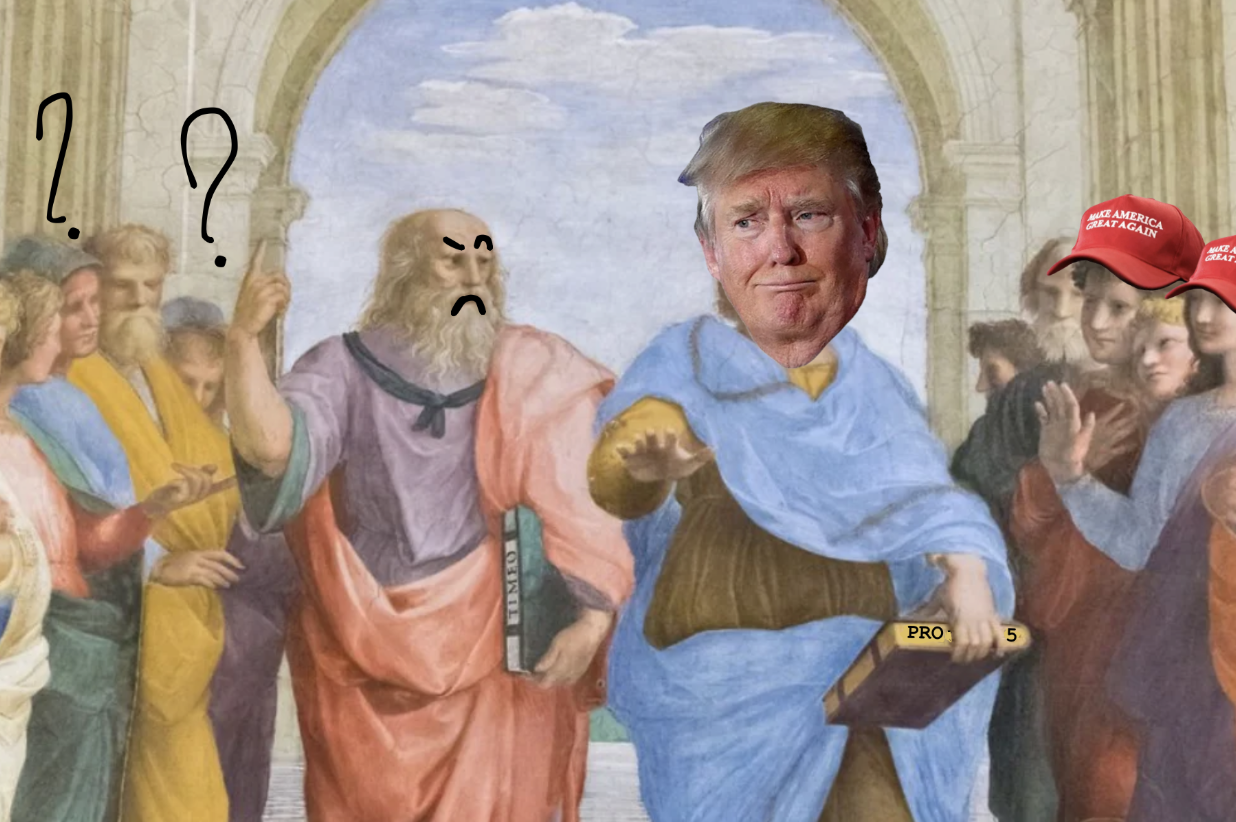
Despite ruling over the most powerful empire of his era, Marcus Aurelius was never recorded as saying anything close to “A whole civilization will die tonight,” as Donald Trump wrote on Truth Social on April 7, 2026. This is because Marcus Aurelius was what Plato called a philosopher king. The term comes from his longest collected work, The Republic, in which Plato outlines his ideal society. His utopia embodies wisdom, courage, discipline, and justice.
Let’s discuss wisdom. A wise carpenter makes a good table. For a good society, you must have wise society-makers (Republic 428b-e). Plato calls these people Guardians. They are meant to serve in a manner similar to modern politicians. One problem: there are comparatively fewer people with the propensity for Guardianship.
A state should be courageous and steadfast in its principles. Principles are judgments developed via proper education. A Guardian can hold these in the face of powerful forces such as pleasure, pain, fear, or desire. Plato gives the analogy of a cloth: improperly dyed, its color can easily be washed away by water or even stronger detergents, but a well-dyed cloth will maintain its color, even against the strongest cleaning (Republic 429d–430b).
A state should also be self-disciplined. Plato claims we wrestle with two natures: a better nature that is interested in right pursuits, and an inferior nature, which desires sensuous pleasures. There is a natural conflict within both the state and the individual about which nature rules. A Guardian places right pursuit over pleasure by being self-disciplined (431a-d). This is, once again, a rare pursuit.
And finally, a state should be just. Plato goes into considerable detail about how natural callings relate to job assignments in his utopia. Justice brings these virtues to the state level. The greatest of all evils, for Plato, happens when someone who doesn’t have the nature of a Guardian holds that position (434a–d). If someone of a contrary nature (i.e., a businessman) becomes a politician, they are susceptible to conflicts of interest involving money or power. That is the epitome of injustice.
People who are called to be Guardians are Philosophers. Plato points to the lack of Philosophers in power as the problem with his home, Athens, circa 428-348 B.C. He reasons this by saying a Philosopher, by definition, seeks to know what is real and true. By extension, a Philosopher will continue to pursue what is true, past initial or even developed opinions. This pursuit of knowledge is an ideal quality for a leader. If Philosophers have the desire to grasp the eternal and immutable truth, while others stop at opinion, who should run the state?
Plato says the Guardians, who are Philosophers, are fit to rule; they have the proper nature to pursue truth, making them courageous and steadfast in their principles. They are self-disciplined, prioritizing justice over pleasure, despite its difficulty.
Donald Trump does not exactly exemplify the traits of a Guardian. For starters, truth doesn’t seem to register as particularly important to him. An Associated Press fact-check of his September 22, 2026, address to the UN General Assembly identifies multiple false and misleading claims about U.S. munitions supplies, drug seizures, oil, and the economy. This is one instance in a long history of misleading claims. The Washington Post documented 30,573 claims from January 20, 2017, to January 20, 2021. Material gain seems to be a priority for Trump. According to a Reuters report published in The Spokesman-Review, Trump reported more than $1.4 billion in income from his family’s cryptocurrency ventures in 2025, while his administration pursued policies benefiting the industry. His response to the deaths of Rob Reiner and his wife, Michele, offers an example of a cruel lack of sympathy: in a December 15, 2025, post, Trump suggested without evidence that Reiner’s opposition to him had contributed to their deaths. Trump hasn’t shown himself to have the nature of a Philosopher.
But despite these moral failings, Donald Trump was elected the Guardian of our society with 312 Electoral College votes. If what Plato is saying is true, wouldn’t the people be inclined to put a Philosopher in the role of Guardian?
Trump’s particular brand of populism capitalizes on a side of human nature that Plato writes about extensively. The process of arriving at the truth is painful. In his allegory of the cave, Plato likens it to emerging from darkness into sunlight. Suppose we have been bound since childhood, facing a cave wall, unable to move or turn our heads. Behind us, a fire casts shadows of objects onto the wall in front of us. The only reality we know is those shadows, and so for us they are real. One prisoner is freed from his bindings and compelled to turn around. He can see the objects that cast those shadows, but the firelight hurts his eyes, and at first the shadows seem more real to him. He is then dragged out of the cave, where the sunlight is painfully blinding. Gradually, his eyes adjust, allowing him to see the world beyond the shadows and eventually the sun itself. Upon returning to the others, he struggles to see in the darkness. They take this as evidence that leaving the cave has damaged him and resist being led out, because the shadows in front of them are still the only reality they know (Republic 514a–517c).
If the light in this example represents the truth, a Philosopher undergoes the painful process of acclimating to it. If the darkness and shadows are a false reality, we know it’s not challenging to be satisfied with shadows, but once acclimated to the truth, anything less doesn’t appeal to you.
Plato understands that to know the truth, you must go through the process of questioning your beliefs until you understand your own ignorance. This process is very damaging to the ego. He calls it catharsis.
When you understand the truth, you are better equipped to handle complex political and societal issues. Plato’s central concern with democracy is that the majority will always be more attracted to the easy solution—the sensible reality that does not require the difficult process of catharsis.
Donald Trump feeds into this nature. Through tools like scapegoating, he turns complex problems into easy solutions. Many middle-class American voters feel disenfranchised by politicians who seem unable to identify with their problems. Reduced spending power, inflation, home prices, and poorly explained foreign conflicts are unsettling. On September 9, 2024, Pew Research Center found that 74% of people were very concerned about food and consumer goods prices, and 69% about housing costs.
These problems are complex, difficult to understand, and even more difficult to solve. In response to this, Trump offers us the shadow on a cave wall. Often, he blames illegal immigration; in one instance, blaming illegal immigration for a 40–50% increase in rental housing costs, exaggerating a Federal Reserve study that attributed 4.3 percentage points of the increase to immigration. Now, instead of needing to offer his voter base a complex plan to tackle rental costs, he can speak passionately about closing the border. Building a wall is much simpler than reducing barriers to construction or increasing housing supply.
A Philosopher, in the pursuit of truth, would not be deceptive or reductive in this way. They would be compelled to fully comprehend and communicate how to solve these problems. Most people are not willing to contend with that difficulty.
So, why don’t we have a philosopher king despite all its benefits? Because we don’t want one.
Trump speaks to the side of our nature that is afraid to challenge our preexisting beliefs, that shelters our ego, and fails to hold us to a higher standard. Today, Plato would identify Trump’s presidency as an injustice and an example of the greatest of all evils. He would diagnose Trump’s nature as unworthy of governing our society.
For Plato, the ideal Republic is led by Philosophers capable of idolizing the truth. In reality, people are not attracted to the painful, complex demands of the truth. It’s easier and more sensible to have access to quick understanding and solutions. To be clear, this nature is one we all participate in. We will all be tasked with many things, on a daily basis, that are more complex than they appear. I would consider myself lucky if I could comprehend more than one truth a day.
Plato leaves little room in his theory for our imperfection. We will mess up. We will take the easy path. We will blame someone who isn’t at fault. We are human. But this is the space that Donald Trump occupies. Take Plato’s idealism as a guide: hold our Guardians to the truth, and we might find ourselves in a kinder, self-disciplined, courageous, and more just society.
***
This article was edited by Zahra Akhtar and Nicholas Meetze.
 Thomas Tisdale
 Caroline Smith
 Samuel Speiser