
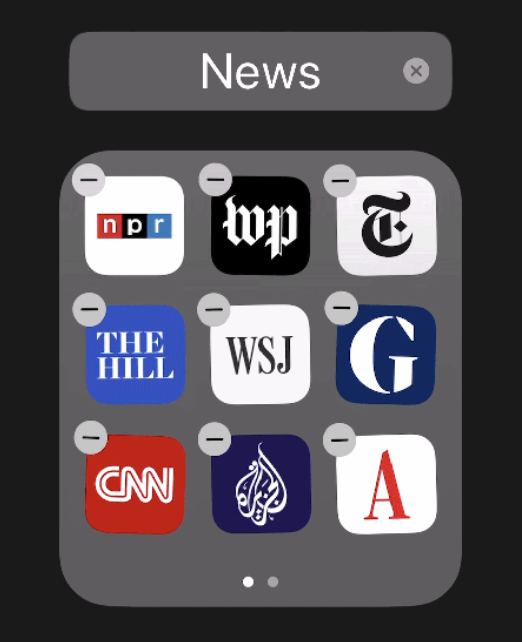
Image via The Guardian
***
For the past few months, I have become relatively apathetic to the news. Burnt out by constant headlines about today’s biggest atrocities and whatever gossip or drama has been dug up each week, I have started to just tune it all out. Going from someone who prided themselves on being aware and informed about what was going on politically to someone who could barely tell you who was running in which midterm election was far from expected. Still, unfortunately, it has happened, and I can’t be the only person experiencing this. After weeks of beating myself up for not being attuned to what was happening, I began to look outward; instead of blaming myself for becoming “lazy” or “uncaring,” I started to question how the media and news outlets themselves might be contributing to this shift in my feelings toward the news. Social media provides a constant stream of information, and the expansion of what qualifies as “news” coupled with increasingly emotional styles of reporting has made political burnout a predictable consequence. However, in a time when the news is so readily available, we often forget that we don’t have to be informed about everything; we are not meant to absorb this much information, and instead of beating ourselves up about this, we must find new ways to experience the news beyond the bombardment of social media and the overly dramatic news cycle.
What does it mean to be politically burnt out or apathetic to the news? “Political apathy refers to a lack of interest or engagement in the political process among citizens.” This disengagement can range from deleting the New York Times app to avoiding conversations about politics to not voting to completely disconnecting from the system altogether. Withdrawal from the news and politics can happen for many reasons at any time. Currently, the political climate and the news cycle are becoming particularly toxic for consumers, with about 30% of Americans citing the political landscape as one of their biggest sources of stress. Within the news, it feels like there is no end in sight, with constant headlines covering more tragedies and stressors than one should have to handle in a week. For example, by simply searching “news,” several headlines immediately pop up: “Four American tourists among 6 killed after explosion levels building near Athens’ Acropolis”, “Bomb squad searching vans near U.S. air base in Britain as five men arrested on terror charge”, and “White House Airs another government-funded ad, this time with Trump warning of ‘final battle’” – these are only three of the major headlines that initially appeared in my search. Combine this with constant alerts from news stations, social media breakdowns of what’s going on, and conversations swirling around you about the newest atrocity that has been committed, and the only reasonable reaction is to disengage.
As these feelings continue to fester, people are turning to a tried-and-true stress manager: therapy. While political stress has always existed, individuals turning to therapy because of this stress is a new phenomenon. “This is the first time that we’re really seeing people initiating therapy because of political [anxiety],” says Veronica Calkins, a clinical director at the California-based Pacific Mind Health. These providers have seen an uptick in political stress-based therapy following the second inauguration of President Donald Trump; however, these anxieties seem to be bipartisan, as most people across the country are affected by some type of political stress. While the current administration is making major headlines and causing more stress than usual for many, we also have to look at how the news and media in general are contributing to rising political stress, and what changes in the media may be fueling this trend.
Over the past 30 years, news has shifted from objective, fact-based coverage to emotional, subjective coverage meant to tug at viewers’ heartstrings. “Before the substantial decrease in viewership of news programming on all three major networks (ABC, NBC, CBS) around the year 2000, broadcast news—which often includes precise and academic language—was where most Americans got their evening news.” With online news broadcasts now focused on airing emotional sound bites or heated debates about current issues, any form of news consumption, whether through a news channel or social media, will be less factual and more about the opinions of those delivering it. Not only are the tone and message of the news we consume shifting, but the way we consume it is changing as well, further contributing to the helpless, stressful feeling many are experiencing right now.
About a year ago, when I was visiting my grandmother, I sent an exasperated text to my mother, “You’ll never guess what grandma just put on the TV… Fox News!” Rolling my eyes, I ignored the TV, turning to my phone and Instagram to distract myself from the (as I saw it) “trash” on the TV. As I scrolled, I was hit with stories, reels, and posts about politics and the news, all while trying to avoid just that on the TV. We all probably have that one grandparent who still loves to watch the news every night, their TV blaring the questionable news source of the evening. At the same time, to ignore this, we turn to social media, only to be bombarded with the same news in a different form. This common scenario is a tangible example of the repositioning of news consumption over the past couple of generations. With the rise in social media and the speed at which information travels, where individuals get their news has been shifting for decades; however, starting in 2025, “for the first time, social media has displaced television as the top way Americans get their news,” and while the uptick in social media as news is happening worldwide, “the changes are happening “faster and with more impact” in the United States.” Overall, about half (52%) of TikTok users in the US say they regularly get news on the site, even if they are not following a news source. As news becomes easier to access, the amount of information available and its importance have shifted, leaving many feeling adrift, unable to escape the constant news cycle, and resulting in a nagging feeling that they don’t know enough or always need to know more.
Of course, the increased availability of information and news across social media is not entirely negative. With easier access to news, people can become more informed and aware of the world and politics around them. Especially for younger generations, these platforms can make political participation feel easier or more accessible, thereby leading to higher levels of political involvement. However, the problem is not necessarily accessibility itself, but the expectation that, because this news is so accessible, everyone must know everything. And along with this mounting pressure, the rate of accessibility of the news makes it hard to escape. Rather than simply becoming more knowledgeable, it is easy to leave social media feeling “news fatigue”, feeding into the journey towards burnout.
Contrary to what this new news cycle and social media may make us feel, not all news is created equal, and the average American isn’t expected to know or be invested in every single thing happening in politics and around the world. The idea that some news can just be “thrown away” and not harped on is a reality lost to the world of social media. In the 2000s political drama, The West Wing, the press secretary, CJ Cregg, played by Alison Janey, featured the friendly rapport with news reporters and the ease with which she delivered information; however, even with this close relationship to the press, not everything needed to be said or harped on with the same enthusiasm, and The West Wing highlighted this important distinction in season 1, episode 13, Take Out the Trash Day. In this episode, CJ prepares for her Friday night briefing, during which she will share unimportant news and news that the White House hopes to fly under the radar of the general public, as Fridays are considered “take out the trash day” due to the low readership of the Saturday morning paper. The idea that not all news is equally important or necessary for the public to know has been lost in the current day, because even on a Friday evening, news outlets can publish pieces within hours, and social media will be filled with clips within moments. This lack of distinction between “important” news and news that can just be “thrown out with the trash” is one of the many things that, in past generations, helped to keep the public sane when it came to politics and news. Now, because this distinction is lacking and almost nonexistent, audiences are exposed to a constant stream of information, regardless of its significance, and as they fall deeper into the pit of the never-ending news cycle, they are pushed closer to burnout and apathy. Because there is less of a filter between politics itself and news sources, the definition of “newsworthy” has broadened, increasing the amount of political and personal information shared on social media every day, which only makes finding the “actual” news more difficult, deepening that feeling of burnout or apathy toward the news in general.
With the emergence of social media and the speed at which “news” can be spread, personal gossip and scandals have become a part of everyday political news. In 1995, however, personal drama making its way into the news was far less common and occurred only when a true “scandal” broke out, such as the Bill Clinton cheating scandal. Following the breaking of this news, there were months of hearings, lawsuits, and the eventual articles of impeachment against President Clinton. This scandal dominated the news cycle, being reported on all news channels, making the front pages of countless magazines and newspapers, and filling political discourse for months. In a time when news was delivered through channels like newspapers and word of mouth, rather than social media, the personal details of a political figure’s life had to be astounding to make the news. Nowadays, anything and everything about an individual’s personal life can make the news. Recently, President Trump made headlines for his relationship with his personal aide, Natalie Harp. While this story cycled through the news for a few days, it received barely any attention compared to President Clinton’s scandal. While the two instances are different, they demonstrate the shift in public interest in political figures’ personal lives and the weight these issues carry in the news. Because the news has become so saturated with drama and gossip, specific instances rarely stand out, hidden within the whirlpool of social media “news”, signifying yet another shift in the news and media that makes being an informed citizen all the more difficult.
News and politics will change over time, and as society advances, this makes sense; however, as these things change, so should our expectations of ourselves. Years ago, to be an informed, involved citizen, it was important and necessary to watch the news, read the paper, and engage in conversations about this. Today, to be an informed and involved citizen in the same manner, you have to read the paper, watch the news, sort through what constitutes actual, newsworthy information, not get burnt out by the constant headlines and notifications, and be able to have civil conversations in an incredibly polarized political climate. The bar has been raised to almost impossible standards, and instead of trying to reach this bar, it is time to adjust it to our reality. We can’t spend all day consuming news on social media and expect not to become burnt out, but we also can’t ignore the news altogether. We can’t focus solely on policy issues without being bombarded by personal opinions, emotional messages, and digs at individuals’ personalities. We have been placed in a news cycle that is so toxic it feels almost impossible to escape, but we are still expected to keep up with the news, be involved, and care about every single thing happening. I wish that I had some perfect answer to this situation, but something that runs as systematically deep as this doesn’t have a simple answer. Being an informed citizen should not be based on how much news you can handle before breaking, or how many frustrating headlines you can consume. Being an informed citizen now comes with a new task: separating the issues and information that matter most to you and to politics as a whole from the gossip-driven, media-hungry news that exists only to create headlines and capture views. We must also be able to do this while still allowing ourselves to step away from the monstrous news cycle when this constant flow of information becomes too much, without feeling like we have failed at being informed, involved members of society, because sometimes, it is okay to be burnt out, overwhelmed, and apathetic toward the news; what really matters is that in the end, you find ways to be informed and consume the news that work for you.
***
This article was edited by Mila Cabanlit and Ria Mukherjee
 Thomas Tisdale
 Caroline Smith
 Samuel Speiser