
Image via The Indypendent
***
One popular phrase has been circulating on the internet for some time: “men used to go to war.” It is typically used in response to men who are seen engaging in purportedly feminine activities, such as thrift shopping or being concerned with taking pictures at dinner. This narrative frames men as unproductive and frivolous for waiting in line to use the tanning beds at a gym. Commenters on one video viewed men as “princesses” because they didn’t give up their seats on public transportation to women.
While not always serious, this rhetoric serves to shame men for breaking out of patriarchal norms and renders them as less than a “real man.” Men who do not act tough are seen as feminine, even prompting people online to ask, “Who will be the men?” if men are allegedly now acting like women. These online discourses further entrench gendered expectations of men to protect and provide for women. Additionally, equating femininity only with vain activities ignores the ways in which women have meaningfully contributed to society, supposedly like these men who used to go to war, through reproductive labor, political protest, and even military service.
Engaging in violence and warfare should not be upheld as the standard one needs to meet in order to be seen as a valuable member of society. However, if it is the benchmark in place for respectability under this framework, women have certainly met the mark. While women are valuable to society in their own unique ways that often go unnoticed, they have also broken through gender norms and powerfully inhabited male-dominated spaces, such as armed conflict.
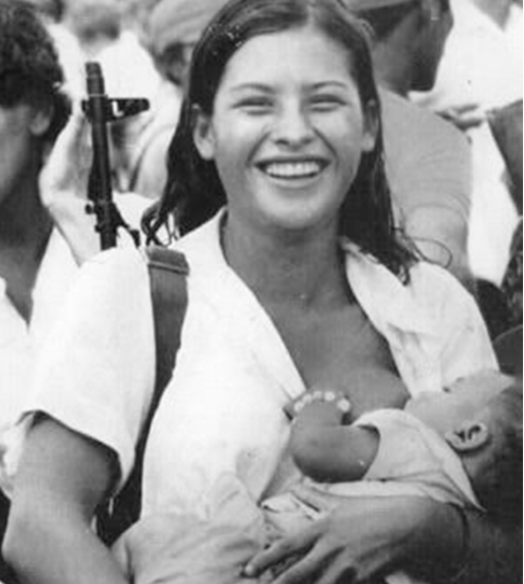
During civil wars in various Latin American countries, women took up the fight against repressive regimes. While certain guerrilla groups were coercive in their attempts to recruit women or limited their role, this was certainly not always the case. The Sandinista movement in Nicaragua trained women for and allowed them to participate in combat, rather than simply cooking meals for male combatants or nursing them back to health. Not only that, women took an active role in the effort to overthrow the Somoza dictatorship, rising through the ranks, even to the position of Commander. Unlike in most national armies, women were integral to guerrilla armies. The Sandinistas sought to reward women’s efforts with equal rights when they eventually took power.
In Colombia, the Revolutionary Armed Forces of Colombia (FARC) was around 30-35% women, meaning the movement was impossible without them. The recruitment of women was more forceful in this case, but once they were in the army, they were widely seen as equal to men.
Women took on roles beyond those that the patriarchy delegated to them, but their participation in guerrilla armies didn’t always succeed in meaningfully changing their status and equality in society, as is the case in Colombia. Since the 2016 peace deal, women have been pressured to assume traditional roles. The efforts to reintegrate soldiers from the FARC army into society have been especially lacking for women, who struggle to find jobs. Despite representing up to 35% of the guerrilla forces, only 20% of former FARC combatants reintegrated through government programs were women.
Colombian reintegration does not account for the experiences of women, which makes it difficult for them to fully participate in the programs. What is more, women face demands to “rebuild feminine traits” that they supposedly lost to more masculine traits during their time in the FARC army.
The Nicaraguan and Colombian examples are just snippets of the widespread involvement of women in armed conflict. However, they illuminate women’s capabilities as well as the struggles they still face today. Even after they have proven themselves as capable of more than simply being housewives, women’s triumphs go unrecognized. They are still expected to succumb to patriarchal expectations.
It is important to acknowledge that, just like men, women used to go to war and are equally capable of fighting in and leading armed revolutions. However, they are still being forced into a gendered box. Today, by figuratively pushing men to go to war, harmful patriarchal roles are upheld by ignoring the wartime efforts of women and encouraging men to be the sole providers. Instead, it should be made clear that women can and have contributed in the same ways as men, all while child-rearing and running the household. In this way, we can move not backward, but forward.
***
This article was edited by Sydney Sternagel and Ruben Ortiz-Fuentes.
 Vedha Gokul
 Stella Chang
 Thomas Tisdale