
Image via The Boston Globe
***
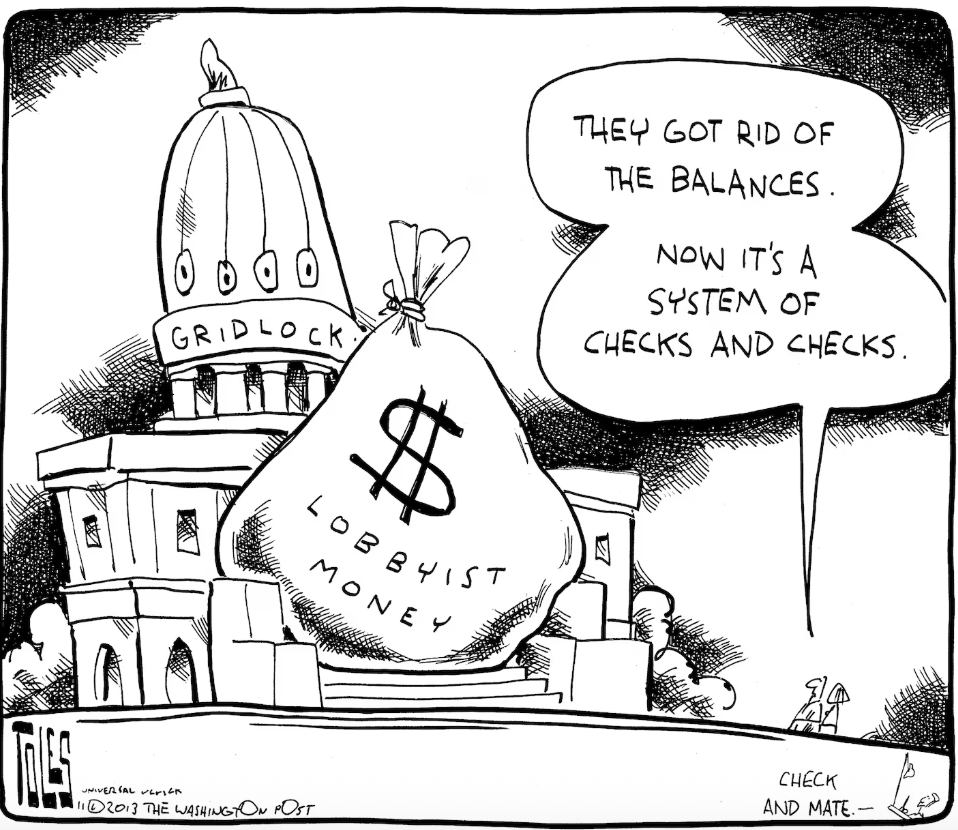
Are government officials being paid to vote in favor of policies that are not in our best interest, but rather, the best interest of those who can line their pockets?
Federal lobbying spending has increased by $150 million since 2016, reaching $4.4 billion in 2024. “Business associations, corporations, labor unions, and other organizations are spending more than ever to influence policy decisions at the federal level.” When researchers also point out that politicians only vote in favor of the majority opinion roughly 30% of the time, the question must be asked, whose interests is our government voting for?
The United States is the only nation that allows investor-owned corporations to “treat health care like a market commodity instead of social service.” Leading said companies distribute health care “not according to medical need but, rather, according to the ability to pay.” In turn, the scientific leader in health care research and the nation with the highest government expenditures ranks dead last in healthcare access and equity among developed nations. Even with the highest per capita healthcare spending in the world, 5.3 trillion dollars in 2024 ($ 15,475.00 per person), free market practices without universal access or cost controls continue to burden national and personal spending. So, as the pharmaceutical and medical sector spends on lobbying for drug pricing, insurance regulations, and Medicare Advantage ($4.7 billion total, an average of $ 233 million per year), it comes as no surprise that the system is made to incentivise through profit, making room for an easily manipulated Congress.
A similar pattern of misrepresentation of public opinion, skewed by lobby money, is evident in federal taxation. More than six-in-ten American adults say tax rates on businesses, corporations, and higher-income households should be raised. However, will that be reflected in legislation when congressional members are incentivised by lobby money? Clearly not, as studies found a 1% increase in lobbying expenditures “expected to reduce a corporation’s next-year tax rate between 0.5 percentage points and 1.6 percentage points.” A prime example of this, Amazon, a company paying a “$1.2 billion tax bill last year, down from $9 billion the previous year, [while its] profits jumped by nearly 45% to nearly $90 billion… largely because of the generous new depreciation breaks GOP lawmakers included in the One Beautiful Bill.” Simultaneously, the company’s federal lobbying expenditures have increased over the last few years, rising from $17.86 million in 2020 to $19.86 million in 2023 (roughly a 11.2% increase), with a peak of $21.38 million in 2022.
Without a doubt, these two policy issues make it evident that money plays a vital role in American politics. The rising lobbying expenditures also signal a financial divide between those who can afford to influence policy and those who cannot. We are far beyond the beginning stage of corruption within the American government, as loyalty to corporations that spend pocket change compared to how much they are growing has greater influence on politicians in Congress than their constituencies. Although a free-market economy is synonymous with freedom, this disregard for the American people and the prevalence of fiscal influence lead me to believe that a government funded by the elites works for the elites. Follow the money, and when an incentive to vote for policies that favor corporations at the expense of Americans arises, politicians will side with those lining their own pockets.
Ultimately, there is a link between federal lobby spending and the policies raised and voted on within the U.S. government. As Congress only votes with the majority less than half the time, it is clear their efforts are not fully aligned with the American people; this is further evident in public polling on higher corporate taxes and on concerns about expensive, inaccessible healthcare systems, both dismissed by Congress. Therefore, when the government is not working for the American people, it is working for the highest bidder.
***
This article was edited by Simon Shalett.
 Catherine Topps
  Sahir Sadat