
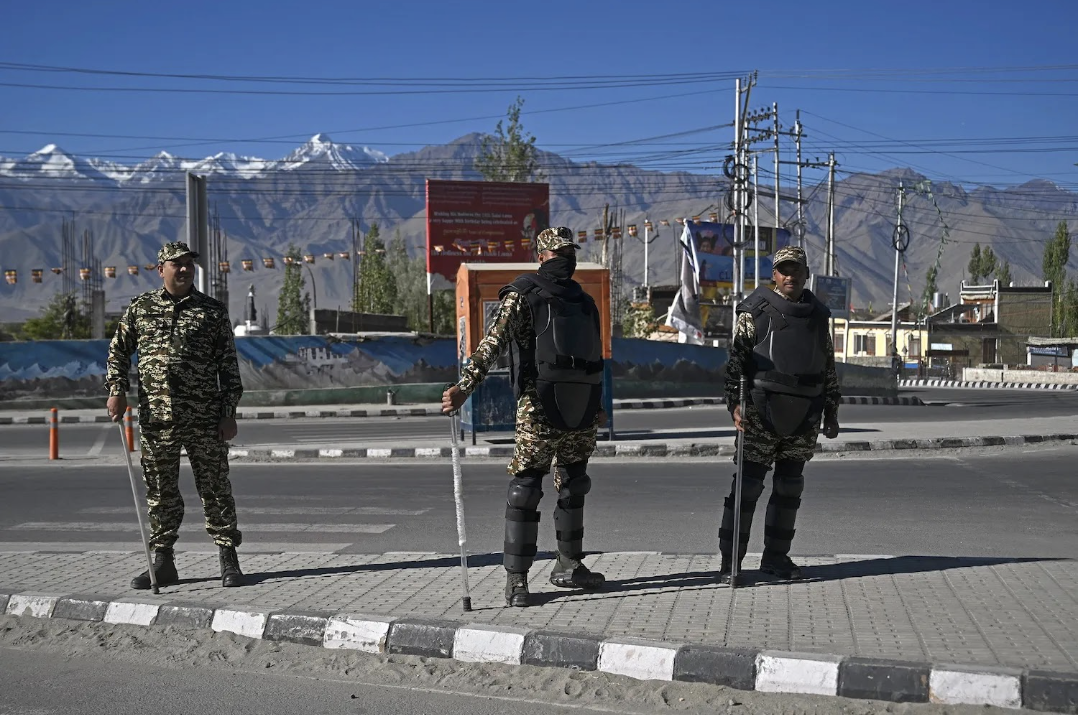
Photo via Tauseef Mustafa (Getty Images)
***
The region of Ladakh is classified as a “cold desert;” intensely arid, low in oxygen, and with soaring mountain ranges abounding on nearly all sides, the remaining valley settlements have withstood the type of climate most invading nations wouldn’t care to brave for longer than they absolutely had to. This consensus has similarly underscored the domestic and international perception of the violent outbreaks which broke out in its borderlands of northern India in late September. Amongst hundreds of protesters, police resorted to open fire and tear gas, leaving more than seventy injured and five dead: the worst crackdown in the region’s modern history.
The events which transpired during this crisis, and the ones which allowed for its creation, exemplify that more than arbitrary expressions of wrath have been transpiring. Instead, they are the expression of long-held dissent in the critical frontier of Ladakh and heightens the urgency to address the demands of the people by the Modi administration.
Ladakh may be a small region, but its strategic importance is invaluable; lodged in between China, India, and Pakistan, all of whom lay claims to the area. Ladakh is situated within the upper reaches of the Indus watershed, providing water for up to 210 million people in both India and Pakistan. In addition, South Asian countries can reach Central Asian markets through Ladakh to Tajikistan, Uzbekistan, and Turkmenistan, while China could hypothetically gain direct access to the Middle East. Hence, the region’s calls for formal statehood within India are underscored by the existential threats to its borders and identity from larger nation-states, most notably against China. Ladakh is the epicenter of the Line of Actual Control (LAC), established as the contested 2,200 mile long border between the two economic giants following the 1962 Sino-Indian War. India claims the disputed Aksai Chin region as part of its Ladakh union territory, but it is administered by China and incorporated into both the Tibet and Xinjiang autonomous regions. In addition China’s growing cooperation with Pakistan and construction of China Pakistan Economic Corridor (CPEC) has raised significant concern from India. In recent years, China has periodically initiated provocations around the LAC that it has repeatedly claimed as its own territory.
The most serious escalation of tensions was in 2020, where a standoff along the LAC’s demarcation of Ladakh, Tibet, and Xinjiang culminated in the deaths of at least twenty Indian troops and four Chinese soldiers. This was the first border dispute in the area in more than forty-five years, creating what has been subsequently referred to as “the Ladakh crisis.” The motivations for China’s 2020 incursions remain a mystery, but their effect has been clear: New Delhi’s trust in Chinese motives regarding national security have been shattered, with increased military personnel within Ladakh and on the LAC ever since. Despite recent thaws in relations from the Xi-Modi meeting at the October 2024 BRICS convention, bilateral engagement has remained limited. And the region has more international implications in the West than the regional tensions may lead on. Just in the same year at the INDUS-X defence summit, India’s then-defense secretary Giridhar Aramane admitted that India had depended on U.S. intelligence during the Ladakh crisis and would “expect” close coordination if a similar scenario is set to happen again. Clearly, tensions in Ladakh are at an unprecedented high.
But these are not the only tensions Ladakhis are grappling with. Following the current Bharatiya Janata Party’s (BJP) government’s decision to revoke special status for Jammu and Kashmir provided under Article 370 of the Indian constitution, Ladakh became a separate administrative unit and Union Territory. This development means that while their lawmakers are elected into the national Parliament of India, the region is now governed directly by New Delhi, not local jurisdictions. Residents were initially hopeful with the change, as the Buddhist majority has demanded a separate polity for its own culturally distinct residents, while those closer in proximity to Kashmir in Muslim-majority Kargil have historically wanted to remain integrated (Kargil was also the backdrop to the battlefield for the Siachen Glacier between India and Pakistan in 1999). Regardless, the revocation of this special status has had bearing on local authority and governance on a wider and more systematic level for all residents.
The autonomy of the Ladakh Autonomous Hill Development Council (LAHDC), formed to give locals a greater say in their politics, began to wane. These councils have otherwise been the middle man in communicating the needs of small communities who make decisions on taxation, education, and land use. In addition, New Delhi has yet to fulfill their September 2019 pledge to include the province into their “Sixth Schedule” of the Indian Constitution, which provides measures of autonomy by permitting the use of village councils and courts in creating laws and policies; i.e., protecting the cultural and economic safeguards which other forms of legislature cannot guarantee. As a result, the revocation has allowed non-residents to buy land and property in Ladakh, as unemployment for native Ladakhis has skyrocketed. In the 2023-2024 fiscal year, 39.6% of graduates in Ladakh reported being unemployed, whilst the national average stands at 12.4 percent. And even though much of Ladakh’s economy still depends on self-run enterprises and tourism, for many young people, the dependency on these sectors offer little security, as they largely refrain from providing social security benefits or permanent contracts. Leading up to uprisings, local news outlets have described on-ground effects. On July 16, 2025, the LAHDC Recruitment Board advertised 534 jobs across departments; 50,000 applications were received, amounting to one in six Ladakhis.
The demonstrations of September 24 were led in conjunction with the 2-week long hunger strike of prominent activist Sonam Wangchuk, on the grounds of either full statehood for Ladakh or for further constitutional protections due to its fragile state of environmental, tribal, and inter-state affairs. Last October, Mr. Wangchuk led a non-violent foot march to highlight the existential concerns of the region, but was detained on the ground of violating orders on assembly. It was after these attempts at irenic forms of protest that the violent overflow of death in Leh and Kargil ensued. At 11:30 AM, thousands of residents marched through the capitals demanding change. Most coverage surrounded the acts of violence committed by young people in Leh, where stones were hurled at police and incited tear gas & gunfire. The mob also set fire to a local BJP office and nearby government building.
Mr. Wangchuk is currently in jail under the National Security Act (NSA), one of India’s most stringent preventive detention laws, and accused of inciting violence—a charge he denies. Under the Act, he remains detained under the pretense of the security of the state. Wangchuk, a prominent environmentalist and scientist had been clear in his opposition to large-scale corporate projects on an economic scale, and was foundational in the implementation of solar energy in Ladakh, but was similarly invested in strengthening Indian interests. This is a violation of Section 8 of the NSA, which states that when a person is detained pursuant to a detention order, the authority making the order must explain the grounds on which the order has been made within fifteen days, and must also afford him the earliest opportunity of making a representation against the order to the appropriate government. In the habeas corpus petition to the Supreme Court challenging the grounds of detention, it is alleged that the arrest was not based on grounds of public safety but “a case of silencing dissent under the garb of national security.” The authorities have been quick to remove traces of Wangchuk’s influence in Ladakh’s social infrastructure; rescinding operational licenses for donations to his NGO supporting domestic education initiatives.
Amongst the casualties was 46-year-old Tsewang Tharchin, a Kargil war veteran. On a regional, domestic, and international scale, the efficacy of these protests as viable for Ladakh’s future are called into question when their forebears are caught in the line of fire. While the individual motivations behind the protests make sense, collectively, they cancel each other out, leaving the BJP administration in a precarious position in the months moving forward as both Pakistan and China watch their movements closely. The anger felt in these events are painfully reminiscent of similar movements in Nepal and Bangladesh; clearly, there is a growing amount of resentment amongst young people in the face of their government encroaching on civil liberties and economic futures. The shift from mass mobilization to murders marks a significant turning point within the internal affairs of South Asian governments and needs to be appropriately rectified not only for the security of their nations, but greater international stability. Ladakh isn’t seeking a complete separation from India just yet, but if legal statutes continue to erode at local security, India’s constitutional morality in relation to its frontierlands must be reassessed.
***
This article was edited by Thomas John McCarthy and Madison Boyd.
 Andrew Kravatz
  Atacus Jarrett
  Eloisa Harper