
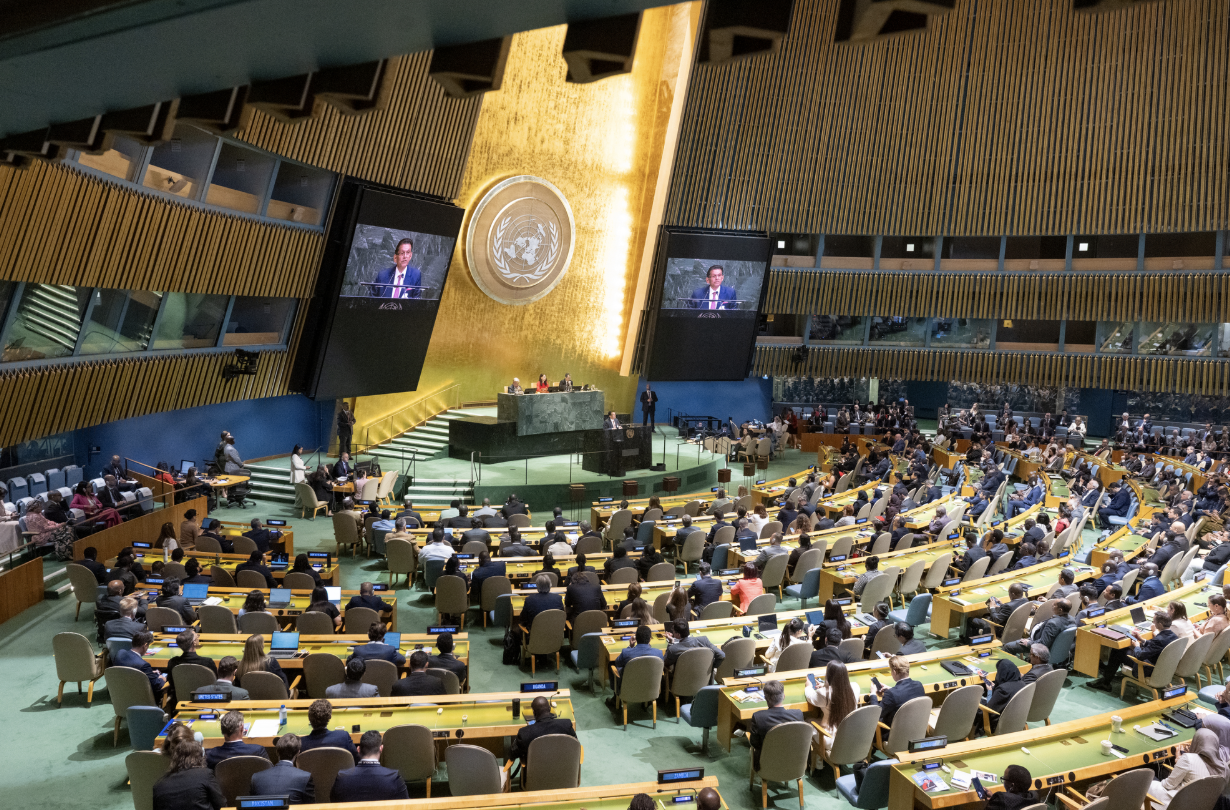
Photo via the UN
***
On September 22, 2026, the United Nations (UN) convened for its 81st General Assembly in New York City. Led by Khaliur Rahman of Bangladesh, its theme is “Restoring trust, managing transformation: A United Nations that delivers for all.” Alongside the weeklong general debate, with speeches by global leaders, this year’s General Assembly includes discussions of addressing issues such as climate change and preventing global pandemics.
While much of the media attention has focused on addresses by more influential world leaders, such as United States President Donald Trump, little attention has been given to the words of delegates from smaller nations.
In many regards, it highlights a significant contradiction in the United Nations: despite the organization and its General Assembly including all member states (who have equal voting power in the Assembly and thus technically equal representation), the organization still overwhelmingly represents the interests of larger powers at the expense of smaller, less influential states.
When Khaliur Rahman was elected president of the General Assembly earlier this year, he declared that “this is not 1945” and that his leadership would bring the United Nations into line with the needs of the future. With this pledge in mind, it becomes clear that the UN would need significant structural changes to address the evolving global order.
The Conflict of the “United” Nations
The United Nations derives its authority from the Declaration of the United Nations, signed in 1942 by twenty-six Allied nations that committed themselves to defeating the Axis powers during the Second World War. These nations also pledged to ‘support the future establishment of a wider and permanent system of general security’ in the postwar world.” This agreement would serve as the backbone for the eventual formation of the UN following the end of the war in 1945.
One of the main goals of the UN was financial stability in the post-war era; to achieve this aim, the World Trade Organization (WTO) and International Monetary Fund (IMF) were created as parts of the modern financial system. Originating from the 1944 Bretton Woods Conference, the former was designed to fund post-war reconstruction, whereas the latter was designed to control exchange rates.
As a result of the drastic increase in UN membership, largely due to decolonization, these financial institutions shifted their focus to former colonies that had just gained independence. In particular, they would issue loans to these countries under Structural Adjustment Programs, which often required them to implement economic reforms such as cutting spending, financial deregulation, and privatizing state-run enterprises. These policies reflect the interests of wealthier nations that had greater voting power in these institutions due to their economic influence. Critics have often derided these initiatives as benefiting Western powers while harming people in these developing nations.
Arguably, the most notable example of the UN’s hierarchy is the Security Council and its five permanent members that have veto power. This veto gives them disproportionate power by granting them the authority to approve resolutions (including those on the admission of new UN member states), impose sanctions on countries deemed in violation of international law, and adopt resolutions on international events. As such, these five nations can use their vetoes to slow or completely block UN Security Council actions, preventing the larger UN from addressing pertinent issues.
One such issue is climate change, which the Security Council has often been inadequate in confronting. The General Assembly speech from Hussein Mohamad Lateef, the Vice President of the Maldives, effectively demonstrates this point. Coming from an island nation at high risk from climate change, he acknowledges that the international community must take steps to confront this existential danger. Importantly, he calls for his country to be included in discussions to ensure that solutions and developments work for the Maldivian people. And, in a nod to the words of the General Assembly President, he declares that “The Security Council cannot reflect the world of 1945 while deciding for the world of today.”
The Future of the UN
It is true that the UN may inevitably reflect world hierarchies, especially given that wealthier nations have continued to provide a large share of the organization’s budget. However, if the organization claims to be moving on from the old-world order, it requires changes beyond just the language. The General Assembly is a forum for underrepresented nations to make their voices heard and bring attention to issues that matter. Real policy change comes with a redistribution of power that ensures these perspectives are given a proper seat at the table in decision-making.
***
This article was edited by Nicholas Meetze.
 Cooper Toland
 Lara Ejzak
 Jonathan Kho