
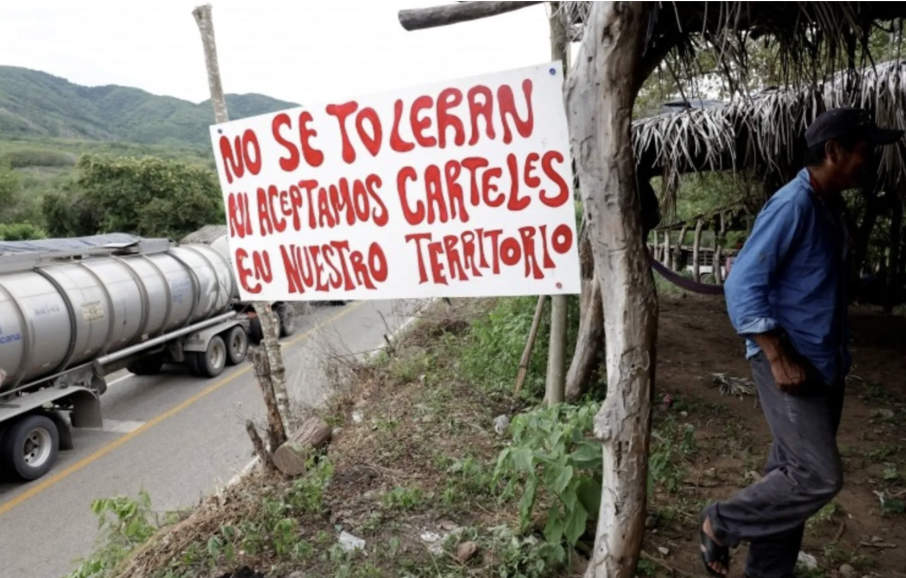
Photo via BBC
***
On November 1st, 2025, Mayor Carlos Alberto Manzo Rodríguez was fatally shot during a Dia de los Muertos celebration in his constituency of Uruapan. Although a shock to international ears, this event was no surprise in Mexico.
Manzo Rodríguez, a former Morena party legislator, was nicknamed ‘the Mexican Bukele’ (after the ‘ironfisted’ President of El Salvador) for his fearlessness and reputation of being tough on crime. Often appearing publicly in bulletproof vests, he spoke out despite fear for his life and pleaded with the federal government for aid in the fight against organized crime. Despite years of promising change and justice, little recent progress has been made, and Mayor Manzo Rodríguez died for his cause.
He wasn’t the first mayor to be martyred for their stance against organized crime. Mayor Yolanda Sánchez Figueroa of Cotija was assassinated in June of 2024, months after surviving a kidnapping by members of Cartel Jalisco Nueva Generación (CJNG). Sánchez Figueroa had notably rejected collaboration between CJNG and the Cotija local police force, disrupting the work of one of the most powerful crime organizations in Mexico, and making her a target of the country’s rampant political and gender-based violence.
Both Sánchez Figueroa and Manzo Rodríguez were residents of Michoacán, one of the most dangerous states in Mexico, known to be a hotspot for cartel violence. Historically, the region has been dominated by groups such as La Familia Michoacana and its breakaway factions, such as Los Caballeros Templarios (The Knights Templar) and La Nueva Familia Michoacana. Other influences include the notoriously violent Zetas, the aforementioned CJNG, and Los Carteles Unidos, an alliance of numerous groups formed in resistance to the rise of CJNG.
Michoacán, a center of agriculture and industry, is particularly vulnerable to criminal chaos and extortion. As of 2022, the state was responsible for 75.2% of Mexico’s avocado production and a majority of its citrus production. Growers in both of these industries are facing increasingly bold demands of protection payments to cartels, cutting into profits. Despite strengthening and unionization, notable leaders like Bernardo Bravo of the Citrus Growers Organization of Apatzingan Valley (ACVA) have paid the ultimate price for speaking out. Bravo encouraged a farmers’ resistance and spoke out publicly to challenge the cartels, but was found dead in his car at the height of his resistance in October of 2025.
Cartel violence in Michoacán and its neighboring states of Jalisco and Guanajuato has skyrocketed in recent months, and the government’s prevention measures have been largely counterproductive. In response to federal arrests of cartel leaders and other high-profile figures in the CJNG, the group has staged blockades on numerous federal highways, using disruption to make a statement of revolt. The cartel has ignited trucks and trailers to barricade roads and torched storefronts and warehouses, all as statements of direct revenge towards the government for arresting their leaders.
The government, for its part, has a complicated history and relationship with the cartels. Many point to the Institutional Revolutionary Party (PRI) as a major contributor to the cartels’ rise to power. The PRI ruled Mexico mostly unchallenged from 1929 to 2000, with its single-party system allowing corruption to easily infiltrate the government from the bottom up. The PRI fell out of power with the election of President Vicente Fox from the National Action Party (PAN), but the cartels retained their influence. In collaboration with local drug producers, prominent cartels like the Sinaloa and Beltrán-Leyva Organization (BLO) took their business international around the 1980s, with their influence stretching as far south as Colombia, and as far north as the United States.
Since then, each administration has tried to innovate its own approach to combat the cartels, but each effort has yielded the same unsuccessful results. President Felipe Calderon (2006-2012) went after cartel leaders to decapitate the organizations, which instead created chaotic power vacuums and warring factions, as well as a disruptive response similar to that of the CJNG in Michoacán today. From 2018 to 2024, the more left-leaning President Andres Manuel Lopez Obrador (known popularly as AMLO) aimed to address the root causes of organized crime with the mantra of “abrazos, no balazos,” or “hugs, not bullets.” Despite his advertisements of a novel approach, he utilized similar techniques as his predecessors, and was himself later investigated for financial ties to the cartel.
Current President Claudia Sheinbaum Pardo of AMLO’s Morena party has said that she plans to continue his “hugs, not bullets” practices. However, she has made exponentially more arrests, drug seizures, and weapons seizures in her first three months than her predecessor. Emphasizing the need for gathering proactive intelligence rather than simply reactions, President Sheinbaum appointed Omar García Harfuch as Minister of Security and Citizen Protection, and constitutionally increased his power in order to strengthen their investigative efforts.
Despite President Sheinbaum and Minister Harfuch’s work, overall numbers of missing persons and homicides have increased since her election. Since the assassination of Carlos Manzo Rodríguez, pressure has mounted for the federal government to intensify its approach. Civilian protests have manifested in Uruapan Square and Michoacán’s capital, Morelia, with outrage towards their government and a tired but determined hunger for justice.
In response, President Sheinbaum has announced a new “Michoacán Plan for Peace and Justice,” pledging to deploy National Guard and federal troops, while also renewing her priority of stopping organized crime at its origins. But, understandably, residents of Michoacán and the majority of Mexican citizens remain unsatisfied.
All levels of government officials appear to be scrambling to control damages, while limited by concerns for their own personal safety. When systemic corruption has managed to infiltrate every level of legislation and enforcement, it’s nearly impossible to enact effective change. Beyond this, any potential changemaker must live in constant fear for their lives, as political violence has become a part of the status quo. During the most recent election season, at least 23 candidates were killed on the campaign trail. Even daring to report on this violence is perilous; from 2017 to 2020, one journalist was killed every week on average.
Of course, it can’t be definitively proven that cartels are responsible for all of these deaths. Their network of alliances and offshoots makes it even more challenging to identify motives, means, and members’ particular allegiances. Reported crime figures also may be lower than the real numbers, as police and officials are often bribed by cartels. Nevertheless, it has been estimated that of 34,515 homicides reported in Mexico in 2020, over 28,000 were directly linked to organized crime, as cartels have battled each other over territory and menaced civilians for profit.
Despite the pleas from the international community and the protests of its people, the Mexican government finds itself at a standstill in the fight against organized crime. Mayors like Manzo Rodríguez are faced with an impossible choice: sacrifice their constituency and morals to the cartel, or sacrifice themselves to the cartel for the sake of their morals and a sliver of hope for their constituency. “I don’t want to be just another mayor on the list of those executed, those whose lives have been taken from them,” Manzo Rodríguez lamented in one of his most recent interviews. “How many mayors have they killed because they opposed making these pacts with organized crime?” he asked in another.
The late mayor himself recognized that without an intensive systemic overhaul, the Mexican war on organized crime remains a suicide mission.
***
This article was edited by Andrea Velez.
 Andrew Kravatz
  Atacus Jarrett
  Eloisa Harper