
Photo via The Art Newspaper
***
It is no question that music is a powerful force for change; its ability to question and redefine the status quo is extremely impactful. From John Lennon condemning the Vietnam War to jazz humming the tune of the Civil Rights Movement, music has demonstrated its ability to not only influence people, but politics as well. Of late, punk has been heavily involved in America’s response to the discourse surrounding President Trump’s turn toward fascism and his expansion of ICE in the process.
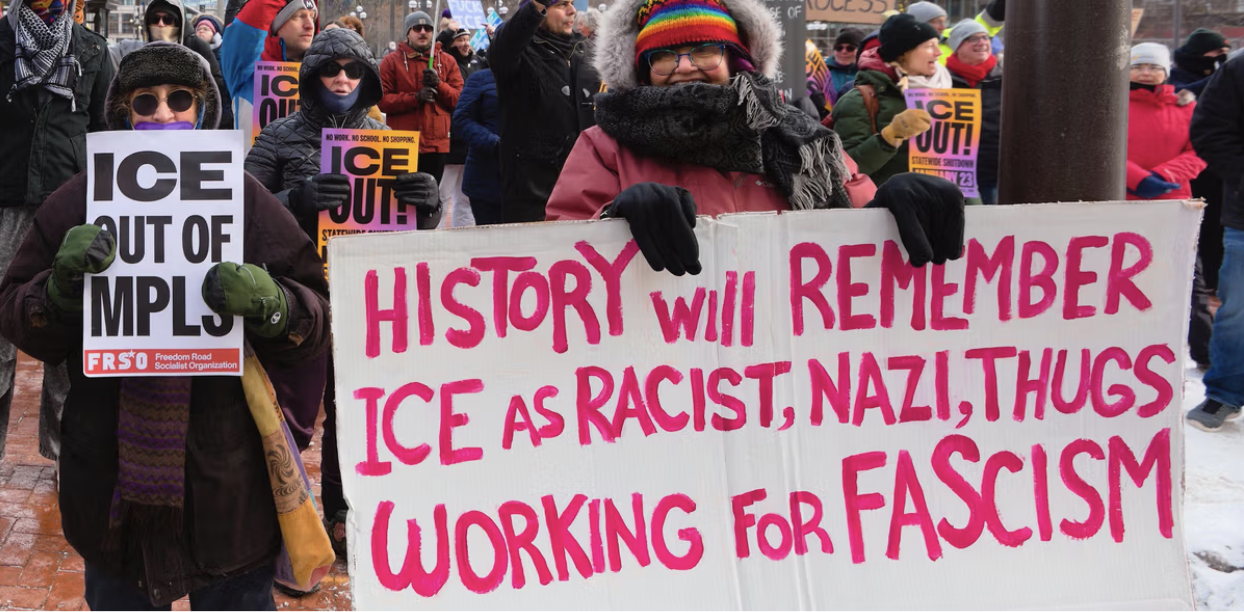
With its recent resurgence during the Minneapolis protests, punk has been making strides to combat Trump’s deployment of ICE and halt the killings of protestors through their performances and condemnation of ICE. If the country’s current downturn alone was not enough to sound the alarms for Americans, the fact that this political strife has stimulated punk protest signals a loss of democracy and a desperate need for change.
Punk’s Political Past
Efforts in Minneapolis to protest an antagonistic reign and effect change are not new endeavors for the punk scene. Punk developed specifically as an anti-facist movement in many countries. Some examples include Los Pinochet Boys, fighting Pinochet’s Chilean dictatorship, and Massacre 68, condemning Díaz Ordaz’s corrupt rule in Mexico.
Most notably, punk came about in both South Africa and East Germany as a resistance to fascism, providing insight about the methods and effectiveness of this resistance as well as the ways in which they were heavily monitored and repressed by the state.
National Wake, a punk band from South Africa, arose from a situation curiously similar to that of Minneapolis where student protestors against apartheid were murdered by state police. The band was continuously harassed and vigilantly monitored by police at their home who were always ready to pounce at the chance to illicitly arrest them. Despite these challenges, punks persisted and National Wake subverted the government by continuing to play music that loudly confronted the regime.
Similarly, Punk in East Germany was notable in terms of its proven success in fighting fascism as it had an essential involvement in bringing down the Berlin wall. The German Democratic Republic, the socialist regime in East Germany, did not take kindly to punk resistance.
East Germany’s secret police agency, the Stasi, brutally beat punks, with one member of the scene recalling how they “put a bag over [his] head and beat [him] in the forest.” They would also detain and interrogate punks without cause as part of their repressive surveillance tactics.
As the “most threatening activist group” to fascist control on their lives in East Germany, this stubborn defiance was critical in weakening the authoritarian state and ultimately bringing liberation. In each country, punk gave a voice to anti-fascist narratives and its rise reflected political repression and the presence of fascist rule.
Why Punk?
Punk’s relentless self-determination and anti-authoritarian principles equip it with the unique ability to resist oppressive regimes. In South Africa, openly defying government regulation by forming multiracial bands like National Wake resulted in a loss of state control.
Along with this self-determination comes self-sufficiency in the form of a “do-it-yourself” (DIY) mindset. In both East Germany and South Africa, punks developed extensive underground networks of communication, like secret performances and independent recordings. This creativity and ingenuity are crucial to punk’s success in thwarting fascism because it allows them to work outside of the gaze of the standard system.
Overall, their brazen confidence in their capabilities and unbending belief system means that they will mobilize to stand up for what is right through whatever means necessary.
Present Punk
Punks have had a significant role as a force for change in Minneapolis as ICE is unleashed in their city. Minneapolis punks mirror past punks in their methods of resistance, with a focus on unrelenting protest and widespread DIY organization.
While there is certainly a persistent punk presence at protests, punks also support the community through performances which provide “PPE… and groceries for neighbors sheltering in place.” Points of connection, like these local DIY performance spaces, historically allowed the punk communication network to spread, strengthening their ability to resist.
Just as Minneapolis punks are employing the same methods of the past, they are being met with the same response. ICE and the Stasi bear a striking resemblance as two state-employed watchdogs who overstep boundaries in an overbearing effort for dominance. Both of them impose a state of constant surveillance; one punk space in Minneapolis plans to provide “cybersecurity trainings for community members to better protect themselves” against this overbearing presence. Not only that, but both are brutal forces in unlawfully arresting protestors. One Minneapolis punk who was violently detained at a protest says “he felt ‘gaslit’ when told he was arrested for ‘assaulting a federal officer.’”
Punk’s current resistance against ICE, and ICE’s response to it, are eerily reminiscent of its previous struggles against fascism in other countries, given the need to organize, repressive policing, and unfounded and vicious detentions. Considering its history and recent revival, a rise in punk seems to serve as the dogwhistle for fascism. It is necessary to criticize our current reality in the spirit of reform. All hope is not lost, though, as present punks are following in the footsteps of past punks who did achieve progress; punk presence can indicate a promising sign that change will come.
***
This article was edited by Samantha Morales and Ella Keddy.
 Catherine Topps
  Sarah Olivia Sullivan
  Sahir Sadat