
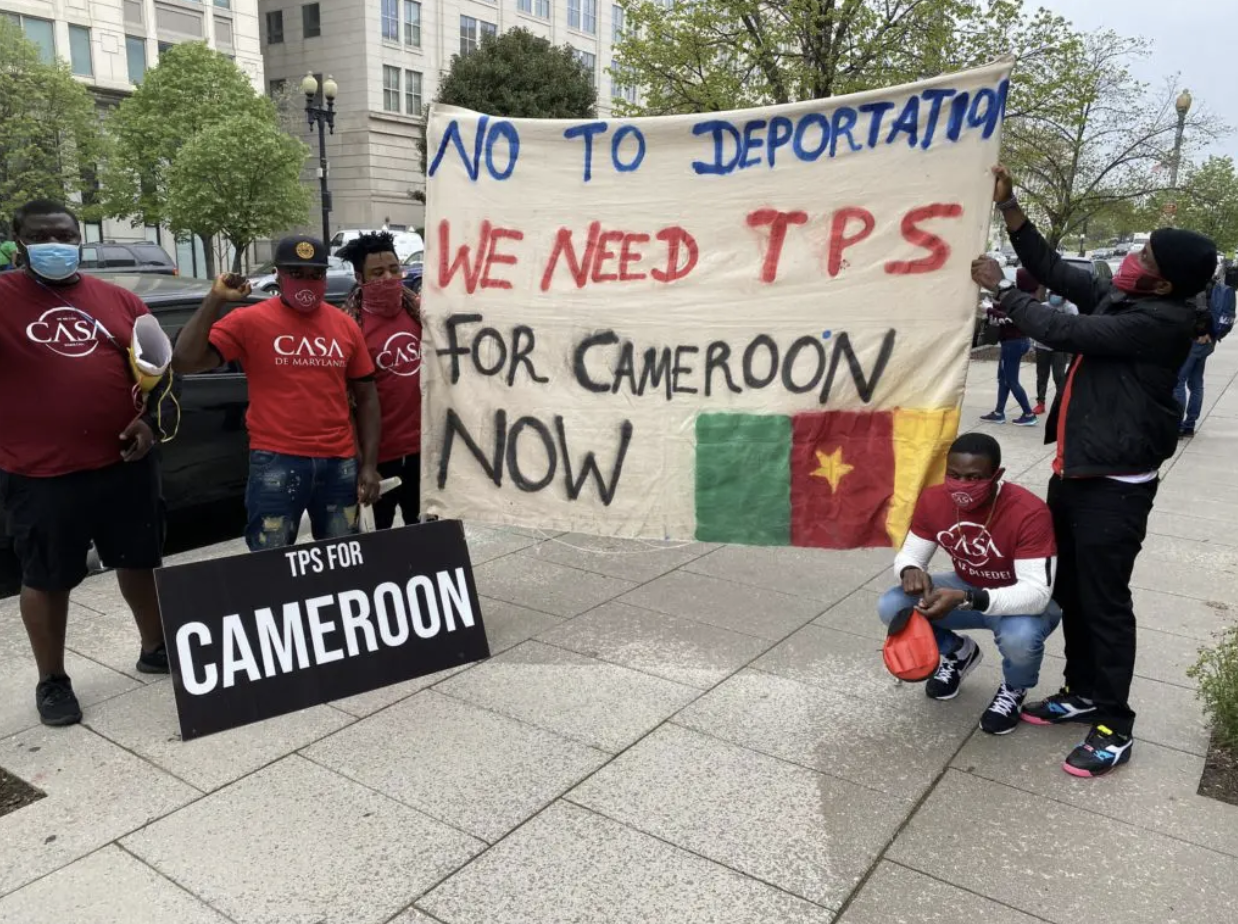
Photo via CASA
***
On February 17, 2026, four journalists reporting on President Donald Trump’s deportations were detained in Cameroon. The journalists were at a facility photographing the space and the migrants detained there, 15 of whom were from the US, before they were arrested. Three of the journalists were documenting these moments for the Associated Press, while the fourth was a freelance journalist who regularly works for the BBC. Once freed, the journalists had their phones, cameras, and laptops confiscated by the police, risking their technology from being implanted with spyware. Additionally, according to The Washington Post, the journalists “did not sustain serious injury” and were released with only bruises, an outcome that appears to have resulted solely from efforts to keep the U.S. deportation agenda confidential.
A spokesperson justified deporting migrants, despite not being from Cameroon, to this facility because “These third-country agreements, which ensure due process under the U.S. Constitution, are essential to the safety of our homeland and the American people.” Trump deporting migrants to developing countries has become the new normal for the President and his administration’s deportation agenda. However, the matter of whether or not this is legal remains in question.
Ahilan Arulanantham, law professor at UCLA, explains, “in cases where they’re being sent to these places, and it’s not necessarily resulting in imprisonment, but it’s resulting in a follow-on deportation, that is illegal—absent the person having had an opportunity to challenge that arrangement in the United States in immigration court. The law requires deportees to receive notice of the country to which they are going to be removed, and then an opportunity to raise any claims against that decision in court.” Arulantham references a case, the Department of Homeland Security v. D.V.D.. This case challenged the government’s practice of sending people to developing countries without providing notice or a chance to challenge the legality of this circumstance. A lower court held a hearing and issued a ruling that declared the procedure unlawful, which required the government to provide notice of these deportations. However, the Supreme Court stayed that order, stating the government can continue practicing third-country deportation while the case is pending. The case is not fully resolved.
As of now, the Trump administration has not publicly announced any agreement with Cameroon to accept foreign deportees, which makes the lack of transparency surrounding the matter even more concerning. Senator Jeanne Shaheen explains, “American taxpayers are being forced to foot the bill as the Trump Administration spends upwards of a million dollars per deportee to send individuals to countries they are not from. Congress and the American people deserve answers about these costly and completely opaque deals.” She also claimed that the treatment of the journalists was “shocking”.
Despite exclamations of the treatment of the journalists, Cameroon has enforced poor protection of press freedom, according to Angela Quintal, Africa regional director at the nonprofit Committee to Protect Journalists (CPJ). CPJ has described the repercussions of being a prisoner in Cameroon, explaining, “Physical attacks, arbitrary detention, and surveillance are common.” Furthermore, according to The Freedom House, the nation received a score of 15/100, with 6/40 in political rights and 9/60 in Civil Liberties. Therefore, to place journalists and helpless migrants in a country with such scathing results in freedom is not only a matter of ignorance but a matter of inhumane treatment, which is an unsurprising aspect of both the Homeland Security’s and the Trump Administration’s agenda.
The current U.S. government’s treatment of people without citizenship and those who are perceived as such because of their appearance is inhumane. Recent federal immigration enforcement actions in Minneapolis, including the fatal shootings of Renée Good and Alex Pretti by ICE and Border Patrol agents, have shocked the nation and raised urgent questions about accountability and public safety. Tragically, these incidents show how vulnerable people, U.S. citizens and immigrants alike, can be harmed by policies that disregard basic human dignity and well-being. Survivors and their communities are left to cope with the fallout from the policies of a nation that once promised newcomers a better, safer life. As a result, they are being sent to countries where physical danger and restrictions on freedom are commonplace, conditions that resemble those of a third-world state. This is a situation the U.S. itself could risk if the Trump Administration continues devaluing and not protecting the well-being of individuals as they are doing right now.
***
This article was edited by Julianna Wottawa and Anna-Rose Barnes.
 Sarah Olivia Sullivan
  Luke Helmholz
  Gavin O'Sullivan