
Image via TIME Magazine
***
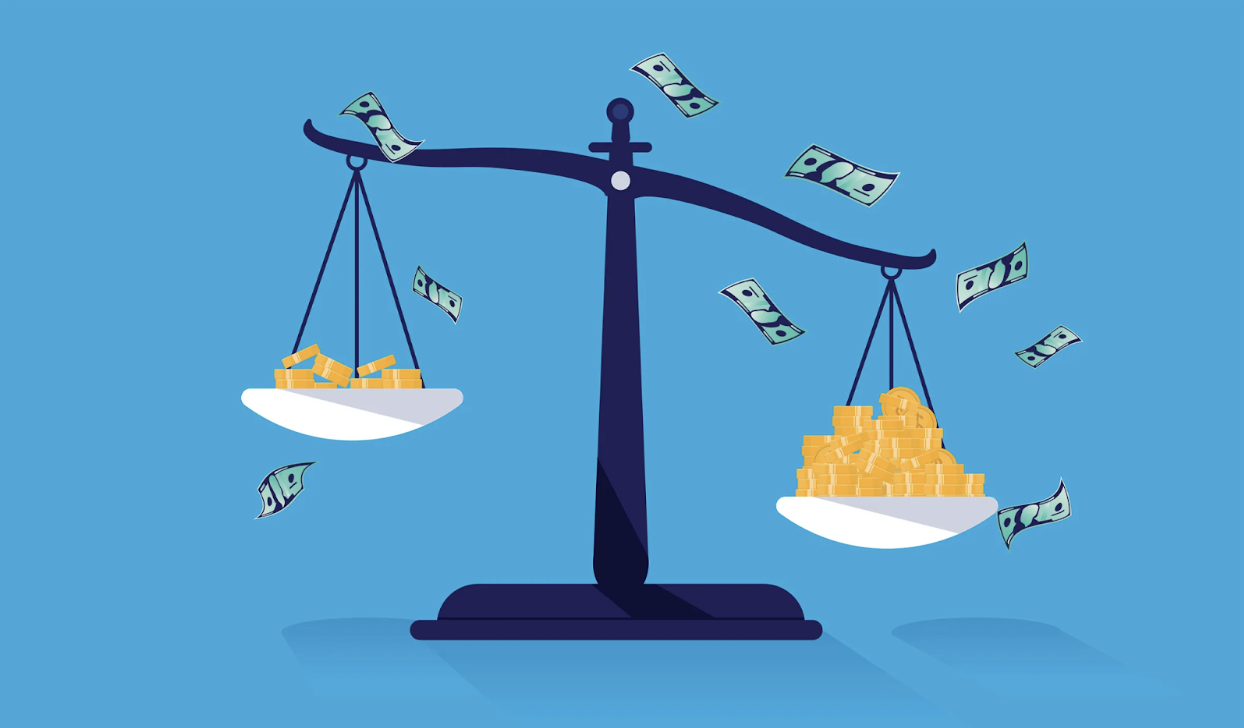
Boomcession is a term coined by Matt Stoller. A fusion of “boom” and “recession,” writer Alex Harring claims it could be the perfect word to describe why Americans do not feel economically secure and believe they are struggling. Harring compares the boomcession to a K-shaped economy. In a K-shaped economy, the top of the K refers to higher-income Americans and the bottom to lower-income Americans. A characteristic of the K-shaped economy is that the rich get richer and the poor get poorer. It demonstrates the growing divide between the rich and the poor. The middle class is nonexistent in this diagram.
The K-shaped economy is in full effect as Walmart sees an increase in sales from higher-income consumers. A majority of their new gains came from consumers making more than $100,000 per year. By contrast, Walmart saw a decrease in consumer spending from shoppers making less than $50,000 per year. Walmart’s competitor Aldi has seen major growth in the U.S. and will open 180 new stores in 2026 alone. Affordable stores are growing in popularity exponentially. These stores are no longer competing with each other. Rather, higher-end stores must compete with more affordable stores.
Yet great wealth inequality is not new to Americans. The Gilded Age (1870-1900) was a period of great economic inequality in America during which the rich flaunted their wealth while the poor struggled to survive. During the Gilded Age, the government operated under the spoils system, in which supporters of powerful political leaders were awarded positions instead of being chosen by merit. This system made it almost impossible for the average American to become wealthy due to the exclusionary practices of the rich in order to merge their wealth and power. We are entering another Gilded Age. Similar to the Gilded Age, wealth inequality is a growing concern, and many Americans are frustrated with affordability and the widening wealth gap.
There is a growing wealth gap in the United States. The wealthiest American households, or the top 1%, owned 31.7% of all U.S. wealth in 2025, according to the Federal Reserve. Wealth continues to be concentrated in the richest 1% of American households, since they own over 50% of U.S. stocks and mutual funds, a figure that has risen by 40% since 2002. Similarly, during the Gilded Age, 4,000 millionaires owned 20% of the country’s wealth. The Gilded Age is remembered as a time of great wealth inequality, and so will the 21st century. However, wealth inequality is not a new phenomenon; it has plagued society for thousands of years and was first documented over 10,000 years ago, prior to the rise of ancient empires or the invention of writing.
But the situation is not hopeless. Wealth inequality can and has been addressed through greater economic regulation. Following the Gilded Age was the Progressive Era, characterized by its great socio-economic reforms. The practice of muckraking or investigative journalism began in the Progressive Era, forever altering both American society and journalism. The Sherman Anti-Trust Act was the first act to outlaw monopolies. Monopolies are the conglomeration of smaller companies into a larger one. Afterward, the smaller, usually family-owned companies were pushed out of business by bigger companies in their industry. During the Progressive Era, small businesses flourished and income rose.
Zohran Mamdani is New York City’s first self-identified Democratic Socialist mayor who campaigned on making the city more affordable, including free bus fares. Politicians and citizens alike were shocked by a Democratic Socialist politician winning such a powerful position, but Mamdani’s win represents a greater theme in American society. New Yorkers felt that prices were too high and saw Mamdani’s progressivism as a solution to alleviate the rising cost of living. Americans outside of New York City feel that everything is getting too expensive and are worried about the economy. On the opposite side of the political spectrum, Donald Trump won the 2024 election because of voters’ dissatisfaction with the economy under the Biden-Harris administration and growing inflation. A greater theme connects both of these wins, which have undoubtedly shaken the world of politics: the economy. Americans from all political ideologies have become increasingly concerned about the economy. Politicians need to be more active in order to regulate the economy.
***
This article was edited by Annika Trippel and Sophie Reilly.
 Catherine Topps
  Sarah Olivia Sullivan
  Sahir Sadat