
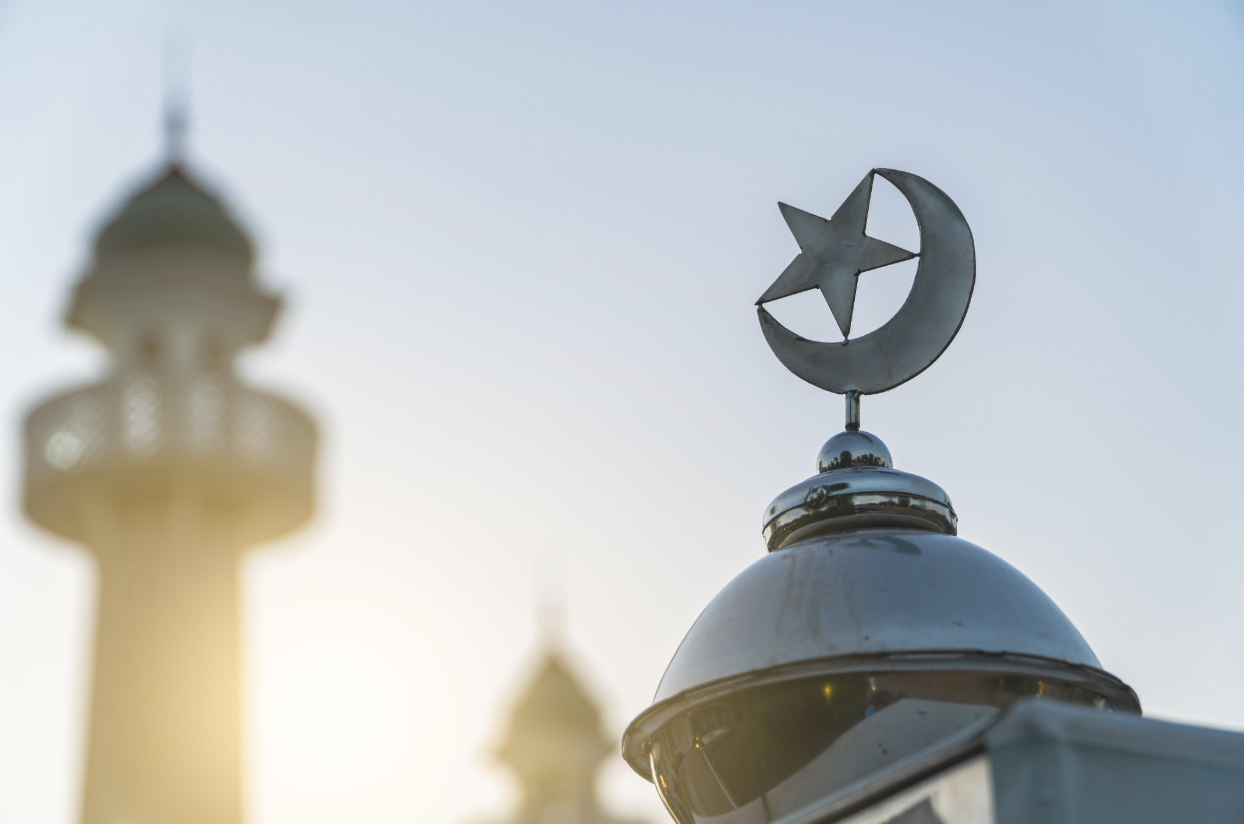
Image via UK Islamic Mission
***
It is no secret that the West’s view of the Muslim world is negative, partially due to hostile narratives in Western media. From the narratives pushed during the War on Terror to the way Islam as a religion has been painted as a whole in Western eyes, the Muslim world and its values have always been seen as opposition to the West. However, this narrative emerged long before 9/11. Western media and politics have spent decades molding a culture of distorted views where Islam and Muslim populations are seen as backwards, violent, and extremist. These ideas did not arise naturally but were rather propagandized and constructed through media, political rhetoric, and selective storytelling. These Islamophobic viewpoints not only shape opinions, but also deeply influence how human lives are valued, which crisis deserves political attention, and which dispute goes unnoticed.
Islam has been portrayed through an Orientalist lens in western cultures for centuries. The dynamic of Islam being painted as the West’s enemy can be traced back to the Crusades, a series of military campaigns spanning the 11th to13th centuries that was launched by the papacy against Muslim rulers to regain control over the Holy Land (Jerusalem). The Arab empire was one of the largest empires of its time. It began around 630 CE and reached its peak around 750 CE, with the empire spanning from Spain to the Indus River Valley. Throughout the centuries of the Crusades, Muslims were referred to by European Christians as “Saracens,” a negatively-charged catch-all term, and portrayed by those same medieval Christian powers as the direct enemy of their religion, and in some cases, even the Antichrist. These depictions and fearmongering tactics rooted themselves in all aspects of Christian life, circulating in sermons with “evidence” found in false interpretations of the New and Old Testaments, and later Christian literature. These narratives shaped European attitudes towards the Muslim world long before colonial acts like the Spanish Inquisition, and have been used to justify the domination of Muslim societies. These ideas have followed throughout society and intensified throughout the time of the Ottoman Empire. They manifested in the creation of an orientalist lens, which constantly minimized the complex intellectual heritage of the Islamic world and propagated the conception of Islamic society as primitive and exotic.
Even though the Crusades themselves were political conflicts, the rhetoric used continues to find itself embedded in European and Western culture, reflecting the popular narrative we see today: Muslims as aggressors. This history of stereotypes, rhetoric, fearmongering, and, fundamentally, a misunderstanding of Islam, is visible today everywhere from Hollywood and entertainment to news media and political rhetoric. Looking at entertainment, in many popular Hollywood movies that predate 9/11, there are clear anti-Muslim rhetoric. For example, the 1996 film Executive Decision features a plane hijacked by Palestinian terrorists. The film displays terrorists reciting prayers before and after murdering innocent passengers, essentially equating the idea that “terrorist acts are intrinsic to Islamic beliefs and practices.” This type of rhetoric can even be found in children’s movies such as Aladdin, where the opening theme of Arabian Nights contains the phrase, “It’s barbaric, but hey, it’s home.” These stereotypes find themselves embedded all over modern media and paint Arab culture in a negative and harmful light. It’s not that negative representations shouldn’t exist; the problem arises when the majority of the portrayals of Islam in Hollywood are negative.
These narratives have only intensified after 9/11, as the rate of Muslim hate crimes surged. News media coverage of Muslim-majority countries post-9/11 have almost always focused on wars, corruption, and terror, themes aimed at driving up fear amongst the public. This is not to say that these issues are not important, but the Western media’s focus on fearmongering and negative rhetorics equating Islam with Extremism have made it difficult for the public to differentiate the religion from the politics. Then political rhetorics utilize this misattributed fear, only further growing the anti-muslim narrative. For example, during the 2016 presidential election, Donald Trump espoused anti-Muslim rhetoric on the political stage, proposing Travel bans from Muslim-majority countries and constantly targeting and criticizing Islam during speeches and interviews. Experts have found rhetorics, like that of Donald Trump, have contributed to the subsequent rise in anti-Muslim hate crimes, which had been on a plateau in the following years after 9/11.
These rhetorics which contribute to the misconceptions are extremely important as they morally unjust, but also have extreme political consequences. When there is constant framing of Muslim countries as unstable and chaotic, it erases the shock of violence and categorizes it as normal or even inevitable. These tropes erase the history of these countries and ignore the important context in which these issues arose . Instead, the histories of these countries are labeled as complex or even ignored and, in turn, any conflicts are then viewed as almost “unsolvable” through a Western lens. This erases the humanity of the people living in these countries and has negative consequences for how these conflicts are addressed and solved.
The most obvious example of this is the treatment of the conflict in Gaza in the Western media versus the treatment of Ukraine. After Russia invaded Ukraine, immediate empathy was extended to this tragedy, with western-majority countries such as the United States, Poland, and Canada had very high disapproval rates of Russia’s unprovoked invasion (over 90%).This immediate empathy was extended for many different reasons. A key one being the fact that Western perspectives see themselves in Ukraine and its civilians. Ukraine is a European, majority-Christian country that is a strong Ally to the Western. Many people were shocked that a tragedy could strike in such a country. A CBS foreign correspondent reporting on the invasion in Ukraine even stated, “[Ukraine] isn’t a place, with all due respect, like Iraq or Afghanistan, that has seen conflict raging for decades. This is a relatively civilized, relatively European – I have to choose those words carefully, too – city, one where you wouldn’t expect that, or hope that it’s going to happen.” This demonstrates the implicit bias that is embedded in most western media. The idea that Violence isn’t normal in a western country like that and the idea thatThey are just like “us.” However, the approach Western media took when reporting on Ukraine was not shared when discussing the conflict in Gaza.
In the weeks following the October 7th attacks by Hamas, Israel responded with intense military operations in the Gaza Strip, most aimed at harming civilians. When Americans were polled on the country’s military actions more than half of the Americans polled approved of Israel’s military action in the Hamas-led Gaza Strip, while only 45% disapproved. This is important because the nature of the conflict between Israel and Palestine has framed Palestinians through a different lens, where the headlines focus on the governmental group Hamas and their corruption with the civilians, who were the ones most affected by the extreme reaction, being seen as an afterthought. This blurs the two where all Palestinians are equated to Hamas, resulting in a lack of empathy extended to Palestinian civilians who suffered the most from the Israeli extreme response. A popular rebuttal to many pro-Palestinian activists is, “Do you condemn Hamas,” which highlights this conflation. Feeling the need to ask if you condemn a terrorist organization displays the lack of distinction between the terrorist organization, Hamas and the civilians who are harmed. In western media eyes, civilians are the same as Hamas. Additionally, this conflict is one that has historically been painted as complex and religious in the Western media, which absolves the humanitarian issues of the conflict and reinforces distance from Western empathy. These differences between the two conflicts reveal how global outrage and attitudes are shaped by Islamophobia and shape the hierarchy of whose lives and conflicts get covered with more empathy.
These misconceptions about Islam are not just inaccurate, but also dangerous, and did not form overnight. They stem from a long history starting from the Crusades, when Muslims were first categorized as threats. Those early ideas were only reinforced through colonialism and heightened during the War on Terror. These narratives shape media, policy, and cultural attitudes we see today and create a framework where Muslims are seen as less than and less relatable to the Western viewer. This rhetoric helps explain why crises in Muslim-majority countries such as Gaza are met with less empathy and urgency. Challenging these false narratives is important not only to oppose a false history but to begin creating a political and social climate where all suffering is recognized and responded to equally.
***
This article was edited by Jacob Chen and Griffin Strauss.
 Glenmarie Rios Rodriguez
  Ayden Suber
  Isabella Villalobos