
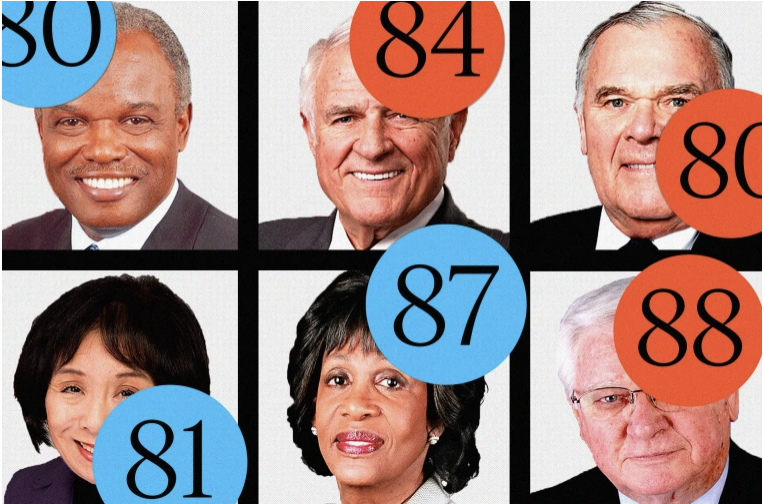
Photo via NBC News
***
25, 30, 35.
These numbers are not just multiples of 5. They are the minimum ages for holding government positions—25 for the House of Representatives, 30 for the Senate, and 35 for the presidency.
But who decided this and when?
239 years ago, the framers of the Constitution met at the Constitutional Convention and agreed on these requirements to serve in office. It was 1787. A lot has changed since then, and while the minimum ages could be debated, the real problem is the lack of a maximum age requirement.
In almost every job in the United States, there’s a social norm that dictates when adults retire from their professions. Between the ages of 65 and 67, teachers, doctors, lawyers, and workers in hundreds of fields transition out of their careers. This does not necessarily mean that once they reach this age, they become useless, but it does allow younger people to enter the workforce, creating a constant cycle. The work continues, and the people doing it rotate around it. However, politics is the only area where this has become an exception.
Republican Senator Charles Grassley is 92 years old and represents Iowa, a state that, over the past 44 years, has shifted from an agricultural to a more urban economy and has grown more diverse. This raises questions about how well one can keep up and accurately represent a state that has changed significantly since he was first sent to Congress. The longer the leadership, the more rooted it is in earlier eras, and the harder it becomes to regulate the present. Still, Charles Grassley is not the only one. This chart from the Pew Research Center shows the different generations and their standing in Congress.
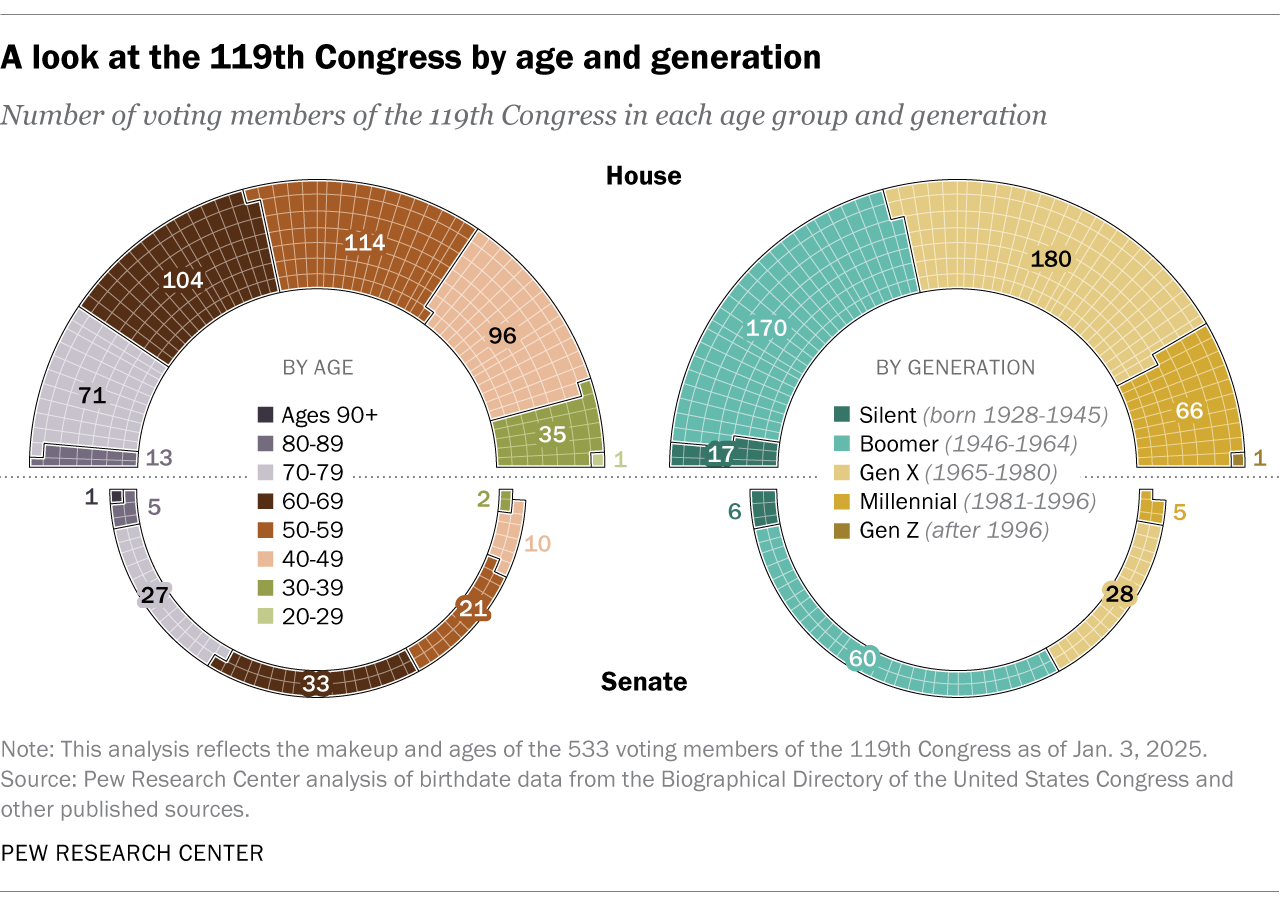
Image via Pew Research
***
In the Senate, 66 out of 100 senators are 60 years or older. In the House, 188 of 435 representatives are 60 years or older. The 119th Congress is the third-oldest since 1789. It’s clear that Congress is getting younger by the day, and American constituents should be concerned. These are the people responsible for how the country operates and for enacting laws. A 30-year-old representative will prioritize things an 80-year-old has not adapted to, and vice versa, solely based on experience. How are bills supposed to be passed when they can not even agree?
It’s also worth noting that capacity becomes a big question as age increases. Society has especially called out recent presidents for this same concern. President Joe Biden became the oldest person ever to serve as president, and his age became a constant topic of debate. On popular social media platforms, people mocked him for struggling to speak and move properly while addressing the nation. Although these memes brought humor in serious times, there was an underlying worry that the person who had one of the most demanding jobs in the world could not fulfill the responsibilities it entails. This led him to drop out of the 2024 presidential race. It did not stop with Biden either. Currently, President Donald Trump has been the subject of speculation about his health and lack of public appearances, with many wondering whether the same concerns apply to him. This is not a matter of party alignment, blue or red; it’s a matter of basic governance and public trust.
So why exactly do these politicians keep getting reelected?
The simple answer is incumbency advantage. Many people in districts like Iowa know of Grassley because he has been in office for so long. People know his name, and this familiarity translates to trust and votes. Simply recognizing a name on a ballot entices people to vote for that specific candidate. The visibility and experience that politicians like Grassley and Biden gained over more than 40 years in politics lent them a sense of legitimacy, making it easier for people to vote for someone they knew. It’s comfortable and low risk. The system has made it easier to stay than to be replaced, and that’s not even counting money and campaigning, but these consequences show up in how the government performs. Elections have become a constant cycle of the same routines, and it won’t be until there is a real urgency that people start asking why these imbalances have been accepted.
A democracy is not meant to be a lifetime appointment driven by the same campaign year after year. The entrance requirements have always been clear, but it’s time to consider when enough is enough.
***
This article was edited by Georgie Javier.
 Sarah Olivia Sullivan
  Luke Helmholz
  Gavin O'Sullivan