
Image via New York Post
***
New York City, the largest city in the United States and a major economic hub, generates more than 50% of its state’s revenue. Despite its economic strength, the city now faces a major issue: a projected $5.4 billion budget deficit following the administration of former mayor Eric Adams.
Zohran Mamdani, the city’s new mayor, aims to implement the key policies he vigorously campaigned for: fare-free public buses, city-owned affordable grocery stores, and universal childcare for families with children ages 6 weeks to 5 years. These policies factor into his $127 billion budget proposal (a $10 billion increase from the previous year). However, with NYC already operating under a multi-billion-dollar budget deficit, where would the money to fund these operations come from?
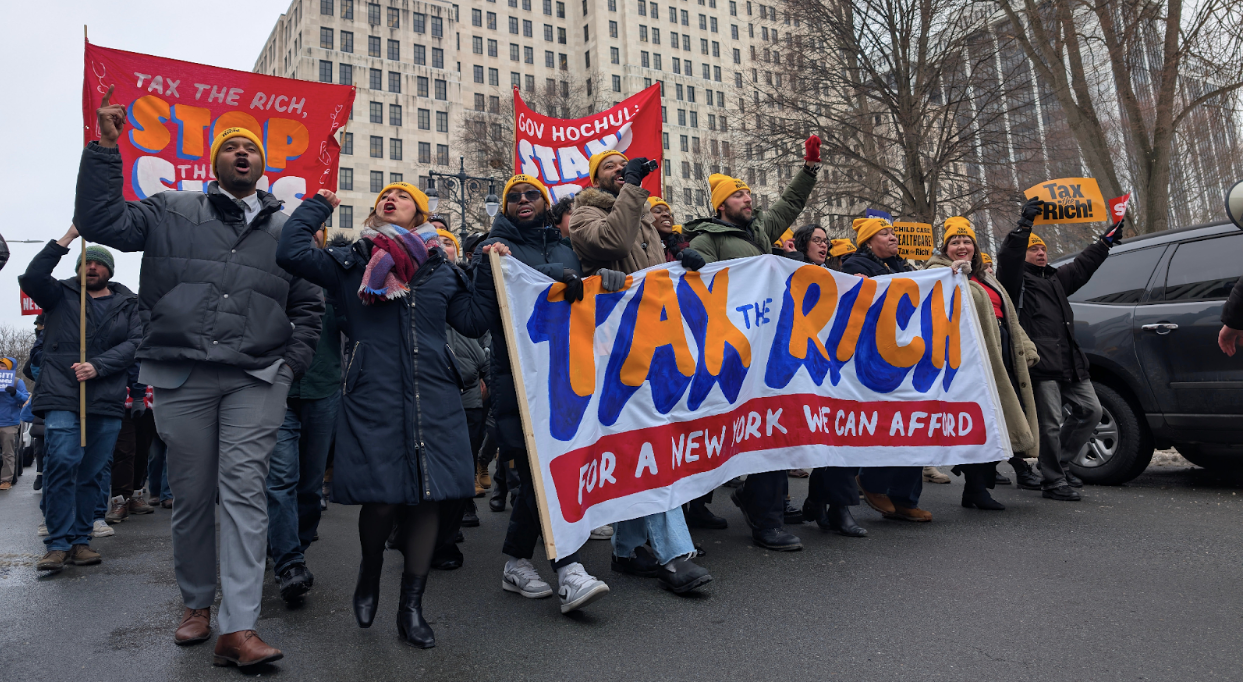
To fund his proposals and reduce the deficit, Mamdani has advocated for tax reforms targeting high-income earners by 2%, thereby imposing a 5.9% tax on income above $1 million, in addition to state and federal taxes. Currently, the top 1% of earners in NYC (around 33,000 individuals out of the population of 8.5 million) contribute nearly half of all city income tax revenue. This “rich tax” policy would, thus, allow the city to bring in more than it currently does, a potential step toward decreasing the deficit.
The process of enacting this policy has faced significant issues, such as requiring approval from New York State. Governor Kathy Hochul has opposed raising taxes on wealthy residents, arguing that doing so would undermine the city’s economic competitiveness and encourage high earners to relocate. Top-income households already face a combined city, state, and federal tax burden exceeding 50%, and further increases could incentivize both individuals and businesses to move elsewhere.
Recent migration trends suggest that this concern is not unfounded. Many high-income individuals have relocated to states such as Texas and Florida, which impose no estate, inheritance, or state income taxes and offer a lower overall cost of living. Major tech companies, such as Oracle and Tesla, along with CEO Elon Musk, have moved out of the innovative Silicon Valley in California and into the corporate-tax-free state of Texas. Specifically within NYC, finance giants Blackstone and Goldman Sachs have opened major offices in Miami, Florida. Although they have not entirely moved, this expansion in Florida, rather than their home city, shows a transition in sentiment as corporations are drawn to lower costs and greater tax benefits.
Some still question whether the rich would abandon New York City, which has been a global center of finance and commerce for more than a century. However, since the pandemic, remote work has become increasingly popular, as people realize they can work from farther away and still maintain the same levels of efficiency. Additionally, cities such as Miami and Austin have become major areas for growth and innovation, rapidly expanding and potentially taking some of New York’s economic activity with them. Over the last 15 years, New York’s share of the country’s millionaires has fallen from nearly 13% to 8.7%, suggesting that some of these high earners truly are packing up.
Despite the New York government’s refusal to raise income taxes, closing the budget gap remains an issue. In response, Mamdani has proposed an alternative approach, one that this time does not increase costs for the rich but instead carries costs to the lower and middle classes.
The Mayor’s new proposal suggests a 9.5% property tax increase, which would generate $3.7 billion in revenue for the city. Unlike income tax changes, which require state approval, property tax adjustments fall within the city’s authority, making it a more immediate option. The property tax increase would affect more than 3 million of the city’s residential units and 100,000 commercial buildings. Consequently, amid the ongoing housing crisis, these imposed taxes will likely place upward pressure on rents, as landlords may attempt to pass along a portion of the increased costs. This increase is unlikely to affect higher-income households, which can more easily absorb the cost. However, it will disproportionately hit low- to mid-income families, who already spend a larger share of their income on housing. Renters will not see their landlords’ property tax bills, but will still pay for them indirectly.
Ultimately, closing New York City’s budget gap will require difficult tradeoffs. Raising income taxes on the wealthy raises concerns about economic competition if some taxpayers or businesses relocate. Increasing property taxes, by contrast, could place additional financial pressure on homeowners and renters, leaving some households with rising rates they likely will not be able to afford. Each approach redistributes the fiscal burden differently, revealing an unpalatable reality: New York City has reached a standstill, and it remains unclear who will bear the costs of policy change.
***
This article was edited by Fatimah Waqas and Lauren Fattorusso
 Saad Sandhu
  Campbell Brown
  Christian Dziura