
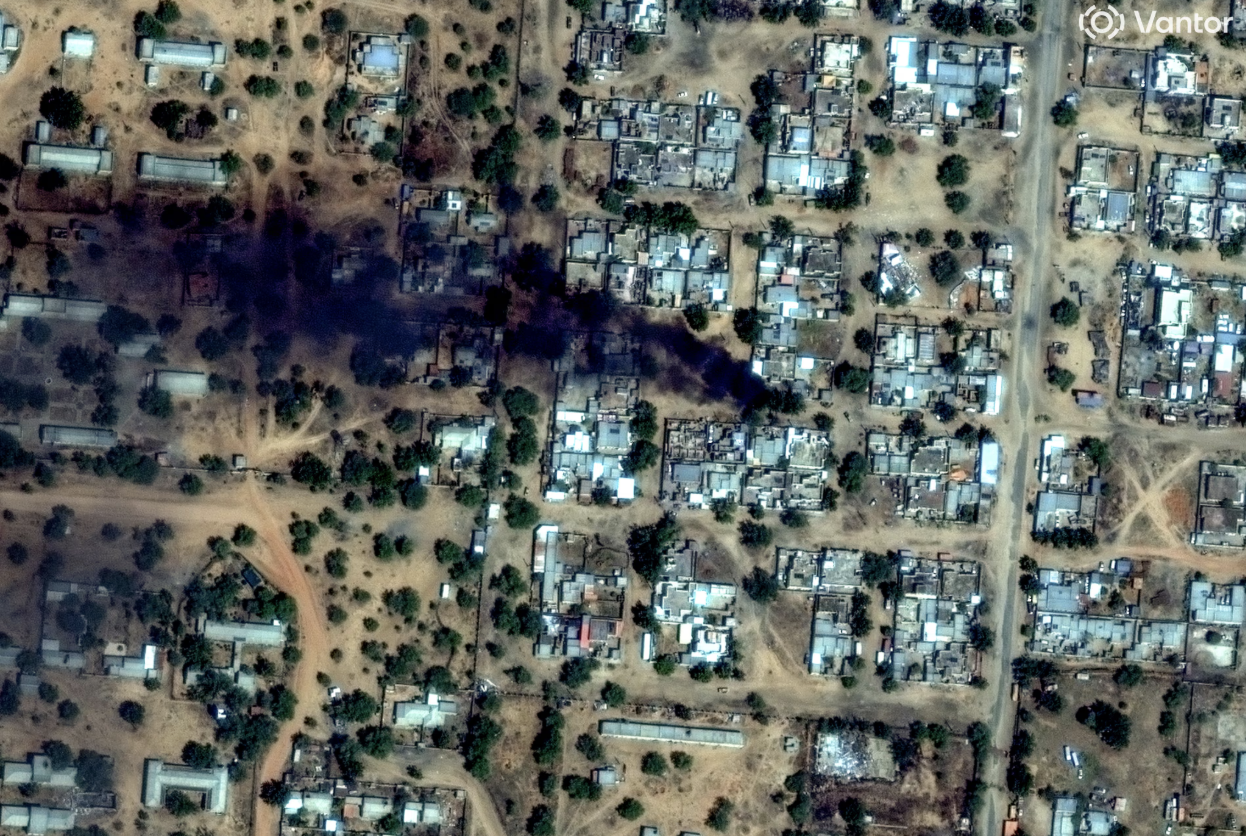
Smoke billowing over El-Fasher following an RSF attack. Photo via Getty Images
***
Over the course of the past three years over 12 million Sudanese have been displaced as a result of an ongoing civil war, with death toll estimates hovering around 150,000. Conflict emerged in early April 2023 following difficulties incorporating the Janjaweed previously used in the War in Darfur, restructured as the paramilitary Rapid Support Forces (RSF) into the Sudan military. Fighting between the RSF and Sudanese Armed Forces (SAF) accelerated in the months following this, culminating in the current worst humanitarian crisis. Constant airstrikes on civilian infrastructure, ongoing famine, widespread sexual violence and civilian massacre have left a country ruined. A horrific pattern of RSF humanitarian rights violations has occurred, with mass killing and rape of villages as their forces move through them. Sexual violence is used as a means of deliberately inciting terror within these communities alongside the blockade of food and aid into affected areas. Ethnic division underlines the conflict, with African Arab RSF forces attacking non-Arab so called “black” Africans. The displacement and damage done at this level are unimaginable, millions of individuals risk facing violence and famine within Sudan, and no effective Western response has been coordinated.
Fighting has continued to struggle for control over oil fields and gold deposits, both used by either military force to continue funding their actions. Petroleum exports serve as Sudan’s main source of GDP, with the majority of reserves along its border with South Sudan. The RSF currently hold control over many of these fields, relying on unstable cooperation with the SAF to access key pipelines for exportation. Gold deposits sit mainly along the Eastern border at the North and South, both the RSF and SAF control these caches, with an illegitimate black market driving their exportation. Almost all extracted gold is transported to the United Arab Emirates, relying on forced labor in mines across Sudan. The extractive processes of both of these resources result in significant damage to the surrounding ecosystem and threaten the health of nearby communities, exemplified by the unstable nature of artisanal mining.
The RSF draws the majority of its funding and arms from the UAE, underpinned by an illicit network of gold trade. The UAE seeks to strategically involve itself in this conflict for better access to gold despite ongoing RSF efforts being labeled genocide. Russian support composes a significant portion of RSF armaments, with Wagner Group missiles being used for airstrikes on civilians. Russia seeks to defend political and economic interests in the country, with the RSF allowing Wagner Group forces free aerial entry and access to gold deposits. Recently Ethiopia has covertly supported the RSF with supplies, as well as aiding the RSF in launching attacks into Sudan from Ethiopia. Following this, UAE-Ethiopia relations strengthened, with Ethiopia acting as the UAE’s central ally in the Horn of Africa. Turkey has funded the SAF, strengthening air capacities via direct supply of drones and extensive training in Egypt on their operation. Turkish military forces have expanded throughout Sudan as a result of this agreement, with Turkey seeking to bolster geopolitical influence in the region and strengthen soft power. Despite the extent of violence and foreign aid, an arms embargo has been in place in the Darfur region since 2004 following the War in Darfur. The arms and aid sent to the RSF have been illegitimately laundered through a variety of non-government organizations for the sole purpose of enriching a foreign power’s wealth and political capital. The UAE and Russia have been actively involved in funding a genocide for the sole reason of easier access to gold, and there has been no international response. The tragedy of Sudan has been met with silence from all Western powers, with no coordinated action taken despite the horrific abuses of human rights and no foreseeable path to recovery.
***
This article was edited by Abigail D’Angelo.
 Anne Eslick-Persyn
  Stan Refermat
  Samantha Kornsey