
Image via Roll Call
***
The populist flanks of each political party are becoming increasingly unified on one issue: corporate money in politics. Projects like Track AIPAC, the Political Integrity Project, and Open Secrets, all databases that catalog campaign finances, are skyrocketing in popularity. Commentators alike are encouraging viewers to be suspicious of politicians bankrolled by corporate interests, and it’s working. A Politico poll from last May found that 72% of Americans think there is too much money in politics, including 77% of respondents who voted for Trump in 2024 and 80% of Harris voters. Yet, more and more races are breaking spending records. In this cycle’s Texas Senate race, the primaries alone surpassed a whopping $122 million in spending, according to ADImpact, making them the most expensive Senate primaries in US history. What explains this growing paradox in US politics?
To understand the campaign finance landscape as it is, one has to start in the early 2000s with an exhaustive effort to get money out of politics. In 2002, Congress passed the Bipartisan Campaign Reform Act (BCRA), pushed by Senators John McCain (R) and Russ Feingold (D). This law was meant to limit the influence of money in federal elections by restricting “soft money” (money raised from corporations, unions, and the wealthy in general), which, up till then, had been largely unregulated. In January 2008, Citizens United, a conservative non-profit, produced a documentary criticizing then-candidate Hillary Clinton. The Federal Election Commission (FEC) stopped this documentary’s distribution because it violated a clause in the BCRA that prohibited corporations from using funds for independent political broadcasts so close to an election (within ten months). Citizens United sued, arguing that the limitation violated its free speech rights.
In 2010, the Supreme Court issued the landmark decision that defines campaign financing to this day. In Citizens United v. FEC, the Supreme Court ruled that BCRA could not constitutionally limit corporations and labor unions from making independent expenditures for political communications. The Supreme Court held that corporations, like people, are afforded free speech rights, and any attempt to limit their ability to exercise that right, even if monetary, is unconstitutional. While this did not mean that people could donate unlimited amounts of money directly to campaigns, it allowed private companies to spend as much as they wanted on so-called “independent expenditures.”
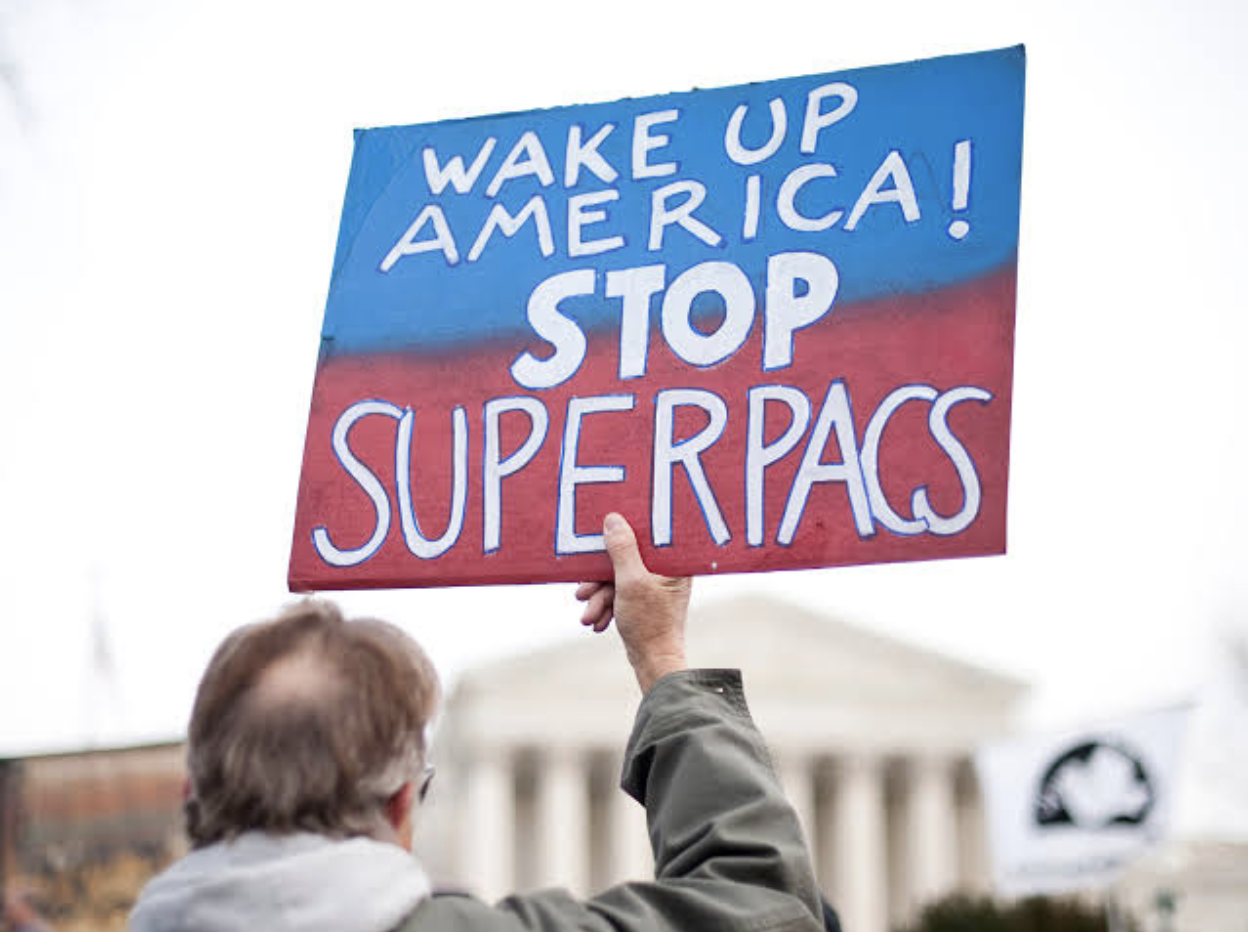
These opened the floodgates for Super Political Action Committees (PACs), through which donors can give unlimited amounts of money because the committees only engage in independent expenditures. Regular PACs can only donate $5,000 per election cycle but are allowed to directly coordinate with campaigns. But even these regular PACs can go far beyond these limits by simply contributing to a Super PAC, which will act in the former’s interests and can spend millions “independently” on their behalf. Often, independent only in name, they consist of ex-campaign employees and bypass enforcement of independence rules, resulting in campaigns relying on these super PACs as essential parts of their apparatus. This is how super PACs can spend over $2.6 billion in the 2024 election cycle.
Fundraising has a direct impact on Congress: The better the fundraiser you are, the better the positions you get, and, consequently, the more influential donor money becomes in shaping policy. People across the political spectrum, as noted above, are becoming increasingly aware of the influence of these large cash injections. There are a plethora of reasons why this is happening now, none more important than the American-Israel Public Affairs Committee (AIPAC) controversy. AIPAC is an organization with the stated purpose of supporting candidates who intend to strengthen the ties between the US and Israel. Many people, on both sides, if not driven by a moral apprehension of the genocide in Gaza, are simply frustrated that taxpayer money is being sent to fund the military operations of Israel. This distaste for foreign military aid was only further aggravated when the Trump administration began engaging in a war with Iran, a war that Israel had been pushing for on the premise that Iran had a nuclear weapon. For those attuned to campaign spending, politicians receiving money from AIPAC pushed this military aid through so that their AIPAC donations would keep coming in. Thus, activists and commentators from Bernie Sanders to Tucker Carlson are calling out this entrenched manipulation of policy. Their populist angles often run along these lines: your taxes, which could be spent on programs here at home that would directly benefit your community, are instead funding a foreign military because the system lets donors, not individual people, influence policy decisions with money.
Within American conservatism, this type of rhetoric aligns with the “America First” political agenda. Among liberals, this replicates the model in which the state serves the bourgeoisie. Nevertheless, there is a notable convergence. This distaste for corporate money influencing policy decisions is creating a rift within both parties, with “extremists” differentiating themselves from the increasingly unpopular establishment. The upcoming elections will be a litmus test for corporate money: Will Americans continue to elect politicians bankrolled by corporate America? Or will breakaway politicians rejecting that funding prevail?
***
This article was edited by Cristina Palmieri and Adam Sharqawe.
 Besalb Dema
  Sarah Olivia Sullivan
  Luke Helmholz