
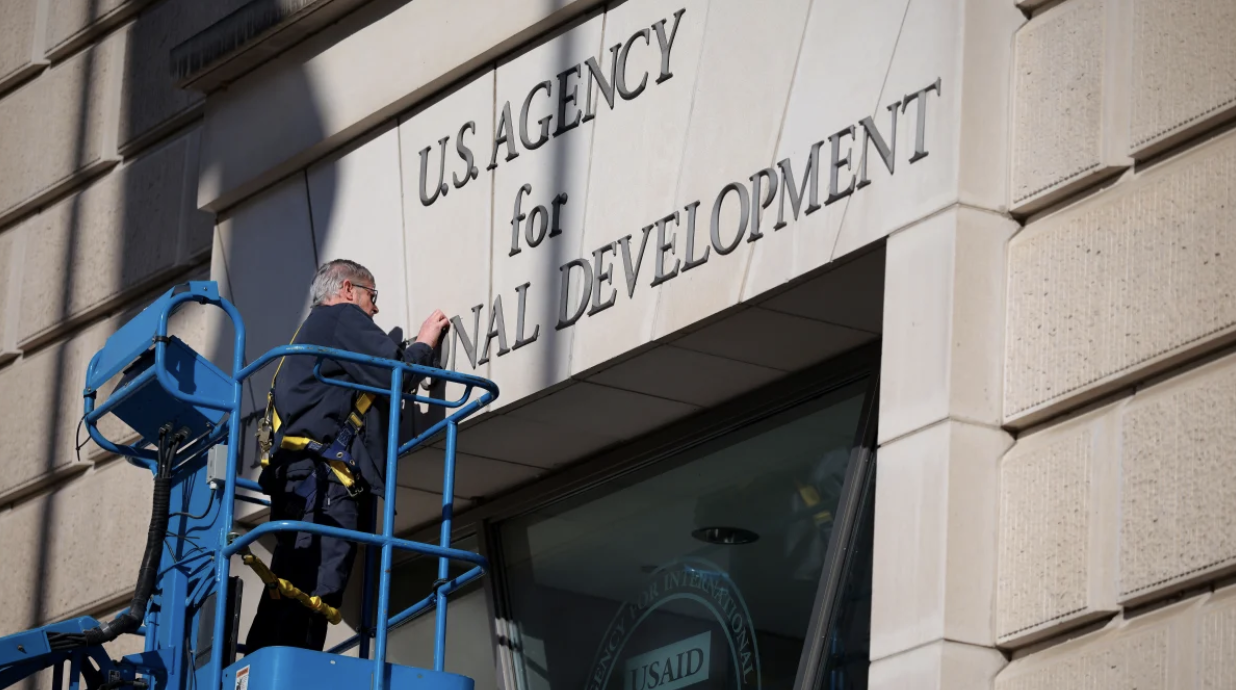
Image via NPR
***
In March 2025, a 7.7 magnitude earthquake devastated parts of Myanmar. Within days, Chinese rescue teams and relief supplies arrived on the spot. All the while, the United States, gutted by the dismantling of the United States Agency for International Development (USAID), struggled to deploy a three-person assessment team.
It looked like the confirmation of a fear that had been building for months: as the United States withdrew from foreign assistance, China would inherit the space it abandoned.
However, roughly a year after the abolition of the USAID, that fear appears to have come true only in part. China has not rebuilt the aid system that the United States tore down—it did not need to. Rather, it has cherry-picked specific projects abandoned by the U.S. that benefit them diplomatically.
The retreat happened fast. Trump’s January 20 executive order froze foreign aid for 90 days, but the freeze never truly ended. USAID stopped independently running its own programs by July 2025. Consequently, humanitarian spending fell 62 percent that fiscal year, opening the door for other global superpowers. China did not need all of that space; solely the parts that mattered to furthering its global agenda. They found those parts through three specific mechanisms: buying a seat inside institutions the U.S. walked away from, benefiting from the disappearance of external monitoring and oversight of China’s own conduct, and using targeted financing to insert Chinese banks, firms, and other institutions into foreign economies.
The clearest example of the first mechanism is the World Health Organization (WHO). In January 2026, the United States formally withdrew from the WHO entirely. Months earlier, China pledged $500 million to the WHO over the next five years, positioning itself as one of WHO’s most committed backers.
Opposingly, the U.S had provided the WHO with roughly $958 million in 2024 and 2025 combined. This is almost double what China pledged in a much smaller timeframe. China has been reluctant to close that gap, but full replacement was never the point. With the United States gone from the organization entirely, a fraction of its former contributions is enough to make China the loudest remaining voice with increased leverage over which health emergencies get prioritized.
The second mechanism did not require China to do anything at all. The USAID didn’t just build clinics and schools across the globe; it kept alive a network of organizations that monitored China’s own conduct. After the freeze, dozens of groups that monitored human and labor rights in China were forced to suspend their work and lay off staff. China itself did not have to silence them; the US did this on its own, and China reaped the benefits.
The third mechanism is a term scholars label economic statecraft. Essentially, this is the use of loans, foreign assistance, and investment in other countries’ infrastructure to secure strategic advancement. In China’s case, assistance rarely comes in the form of money alone. China brings in lenders, contractors, and legal arrangements. This gives the Chinese government an influential position inside the country it’s helping.
One example is the Bahamas, a country located less than sixty miles from Florida. It is important to note that the U.S. left its ambassadorship in this country vacant for almost 15 years. In 2025, the Bahamian government finalized plans for a new hospital, financed largely by a $195 million loan from a Chinese bank. China’s goal is not just to provide capital to a foreign entity; it is to insert Chinese institutions into Bahamian developments. The Tribune explains that “China said the hospital is a ‘livelihood project’ requested by the Bahamian government and financed through a highly preferential loan.” However, this arrangement means that, if a problem were ever to arise, China would have the leverage over the Bahamas in the courtroom. Most importantly, Bahamian officials said that they approached the U.S. first and received nothing that matched the Chinese-backed project. Only after the agreement was secured did the United States urge the Bahamas to reconsider the Chinese financing. This means that the U.S was willing to oppose China’s expanding economic position, but not willing to provide the Bahamas with a competitive alternative.
Make no mistake, all of these advancements from the Chinese government are both directly and indirectly caused by the shortcomings of America’s current administration. The United States did not just cut a foreign-aid budget; it handed China a shortcut. The USAID’s abolition has given China the freedom to pick and choose where they want to pursue diplomacy without expending as many resources as the U.S. ever did. China is now tilting the global balance of power, not by growing stronger on its own, but by letting other countries’ economies and political institutions weaken before stepping in. As a result, China is continuing to gain allies and strengthen its economic prosperity at America’s expense.
***
This article was edited by Maria Sofia De Abreu and Peter Leyba.
 Kennedy Walker
  Saad Sandhu
  Abby Coxe