
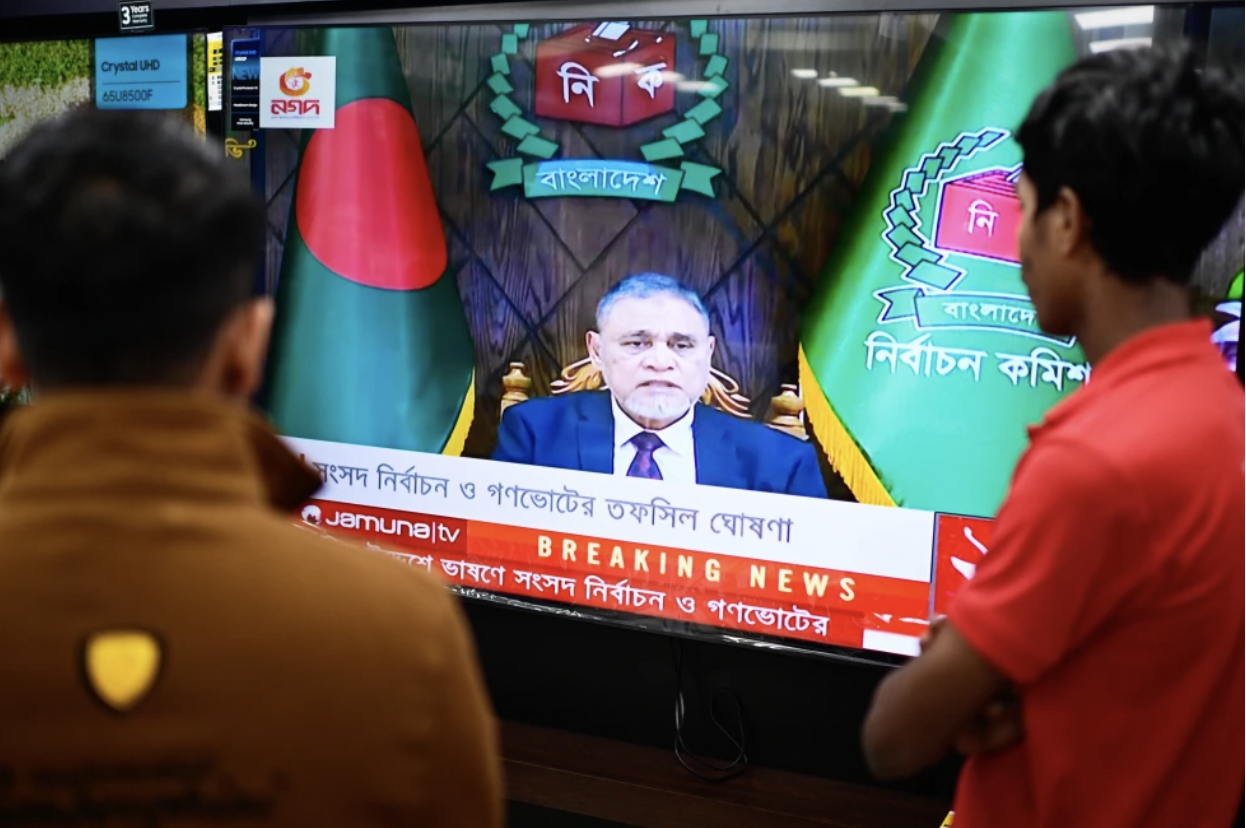
Photo via AP
***
On December 25, 2025, Bangladeshi politician Tarique Rahman returned to Dhaka after spending 17 years in self-imposed exile in London. As he set foot in Bangladesh, he was met with hundreds of thousands of supporters who had eagerly awaited his arrival. Despite his recent return to the country, Rahman and his Bangladeshi Nationalist Party (BNP) are likely to win parliamentary elections on February 12, though “analysts still contend it’s anybody’s game.”
Rahman’s return to the national stage signals a continuation of establishment Bangladeshi politics as the country holds its first major elections since the resignation of longtime PM Sheikh Hasina in the summer of 2024 following her government’s response to weeks of protests against her administration, leading to hundreds of deaths. After her exit, President Mohammad Shahabuddin Chuppu dissolved Parliament and appointed Nobel Prize-winning economist Muhammad Yunus to lead an interim government until the upcoming elections.
Bangladesh’s government has endured a rocky history since the country’s independence from Pakistan in 1971. Its formative years were defined by coup d’etats and the assassinations of several Presidents, including Ziaur Rahman (Tarique Rahman’s father). After the end of military rule by H. Mohammed Ershad, the nation transitioned to a parliamentary democracy in 1991. Two main parties emerged as the frontrunners in Bangladeshi politics: the BNP led by Khaleda Zia (the first female Prime Minister and Tarique Rahman’s mother), and the Awami League led by Sheikh Hasina, with both parties leading Parliament for several year-periods.
Sheikh Hasina would return to power in 2009 and remain in charge of the country for the next 15 years. Her tenure was marked by reports of corruption from figures linked to her administration, with the country being regarded as among the most corrupt in the world. Upon her resignation, Hasina would move to India in self-imposed exile; a Bangladeshi court would sentence her to death in absentia for her crackdown on protestors.
Descending from political royalty, Tarique Rahman has been involved in politics for most of his life, holding several positions in BNP leadership and working for his mother’s successful campaign in the 1991 elections. His party’s Vision 2030 plan includes provisions to fight corruption, increase development in rural areas, and improve internet infrastructure.
Throughout his long career, Tarique Rahman has also faced controversy; being accused of nepotism and corruption, with the then-US Ambassador to Bangladesh saying he represented “kleptocratic government and violent politics.” Rahman’s self-exile in London was prompted by corruption charges that courts would later acquit him of after the end of the Hasina regime.
The BNP’s main opposition is the Islamic party Jamaat E-Islami, which has promoted the implementation of Islamic law in Bangladesh. The party was historically in a coalition with the BNP but are now running against one another following a split of the alliance.
Jamaat has been historically controversial in Bangladeshi society due to its alignment with Pakistan during the fight for independence and its overtly religious ideology, though it has since moderated some of its stances. Its leader, Shafiqur Rahman (no relation to Tarique) has promised that individuals convicted of corruption will face “strict punishment,” offering a vision of a society based on “justice and merit.”
Though some analysts have noted that Jamaat does not have a high chance of winning the election, they acknowledge that the party has been steadily gaining influence in the country, especially among younger voters. The party’s student wing won several student union elections in major universities, though some elections were boycotted by other parties. While the BNP are seen as the favorites, the influence of the youth vote highlights a disparity between the political establishment and the electorate that could materialize in key races.
Regardless of the election’s outcome, Bangladesh’s election represents a bridge between its past and future, echoing the hope for change that many in the country hope to achieve. International observers have been sent to ensure free and fair elections. Importantly, the election highlights the importance of the youth; “Students were a crucial part of the independence movement for Bangladesh,” and now played an important role in the ouster of Sheikh Hasina. With the election approaching, the world waits to see how Bangladesh opens up a new chapter in its history.
[Editors Note: This article was originally written prior to the election.]
***
This article was edited by Brigid Byrnes and Dysen Morrell.
 Abby Coxe
  Campbell Brown
  Holmes Wormald