
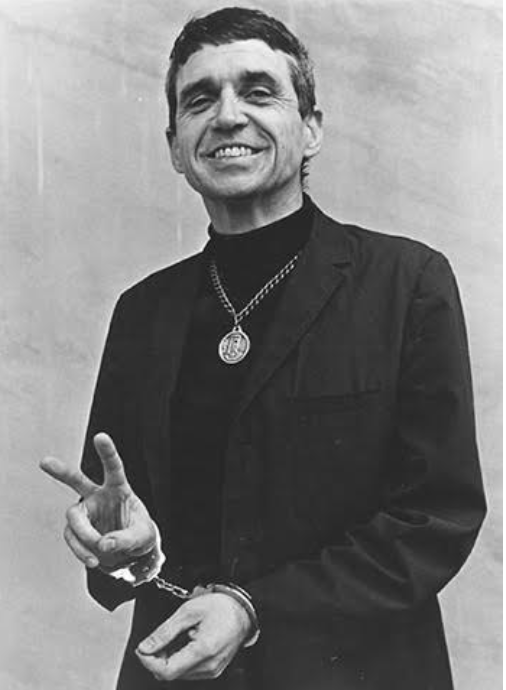
Photo via Fordham Now
***
In a critique of 1960’s American militarism and imperialism, Reverend Daniel Berrigan (1921-2016) wrote that “America fights a stupid and genocidal war in Indochina, mostly because we don’t know how to turn off the bloody spigot we have opened…we are powerless to inquire why it is easier to continue to slaughter than to stop.”
A political activist, ordained Jesuit priest, Fordham’s Poet-In-Residence, and fugitive on the FBI’s Most Wanted List, Berrigan’s 94 years were a story of relentless political activism and passionate praxis that truly embodied the spirit of going forth and setting the world on fire. He marched for civil rights, traveled to Vietnam during American bombing campaigns, burned draft cards with homemade napalm, broke into a nuclear warhead factory, and continued his fight for peace long into his old age. After all of that, he spent his final years at Fordham, where he passed away inside Murray-Weigel Hall in 2016. Fordham’s own obituary remembered him as its longtime Poet-in-Residence and a man devoted to “peace and justice.”
Walking by the houses of mild-mannered elderly priests on your way to class, the last thing you may expect is that one of their residents was once on the run from the FBI or investigated for conspiring to kidnap Henry Kissinger. Berrigan deserves to be remembered for more than being Fordham’s unusually rebellious old priest. His life was spent living a version of Jesuit views far more confrontational than the sanitized language of “service” and “social justice” implies. He believed that his faith created an obligation to resist militarism, racism, nationalism, and state violence, as well as breaking the law, embarrassing powerful institutions, or going to prison in order to do so. While he never identified with antifascism, I would argue that Father Berrigan’s vigilant pursuit of peace and his fight against systemic injustice and violence speak for themselves. These characteristics made him a clear antifascist in nature and a role model of what Jesuit values should look like at Fordham and beyond, in a world dominated by corrupt killing machines.
In 1965, after a young Catholic Worker set himself on fire outside the United Nations in protest of Vietnam, Berrigan’s public mourning got him shipped off to Latin America at the urging of New York’s cardinal. He came home four months later, more determined than ever. In February 1968, he flew to Hanoi with historian Howard Zinn to assist in the release of three captured American pilots in the middle of the Tet Offensive.
A few months later, on May 17, 1968, Berrigan, his brother Philip, and seven others walked into a Selective Service Office in Catonsville, Maryland, carried out hundreds of draft files, and burned them in the parking lot with homemade napalm. As the fire burned, they prayed for peace and waited to be arrested. In the statement he read at trial, Berrigan apologized for “the burning of paper instead of children.” He was convicted and sentenced to three years in federal prison. However, on the day he was meant to report to federal prison, he instead went into hiding. He made a series of speeches at underground church events before a national FBI manhunt culminated in his capture that August; he would end up serving time until his release in 1972.
Prison seemed to have no diminishing effect on his passion for activism. On September 9, 1980, he and seven others broke into a General Electric missile plant in King of Prussia, Pennsylvania, where they hammered on warhead nose cones and poured blood over the equipment meant for nuclear arms. It was the first action of the Plowshares movement, named for the prophet Isaiah’s call to beat swords into plowshares (peaceful, life-sustaining tools). He was arrested, tried, and imprisoned again, yet he kept showing up at protests well into his eighties.
Berrigan arrived at Fordham as its poet-in-residence in 2000, and by most accounts, he gave the university far more than it gave him. According to Fordham’s own obituary, he ran seminars on teaching peace for faculty, taught undergraduate courses on poetry and suffering, and, in 2007, spoke to new freshmen about his Vietnam-era activism. When he died, then-president Joseph McShane, S.J., called him “a giant among us.” Fordham University Press published a collection of essays on his challenge to Catholic social thought, and in its blog said he belonged to “a significant period in American history.” While this is all very complimentary to Berrigan’s legacy, it is imperative to look at how the praise is given. It is written entirely in the past tense, and is safely attached to a distant war, a distant decade, and a man too old and too dead to be a problem. The obituary calls his civil disobedience a “devotion to peace” and omits the fact that it was, by definition, criminal. Berrigan was not honored because the university embraced what he did, but because enough time had passed for Fordham to claim him without having to defend him. If you want to know what Fordham actually thinks of dissent, it is more insightful to consider what it does to the living activists. In December 2016, the university’s Dean of Students, Keith Eldredge, refused to recognize Students for Justice in Palestine (SJP) as a club, saying he could not support an organization whose goals ran “contrary to the mission and values of the university.” A New York judge initially found the ban “arbitrary and capricious,” but an appellate court reversed that decision in 2020, largely on a technical question of standing, and New York’s highest court declined to hear the students’ appeal.
Then came May 1, 2024, when members of (the unofficial) Fordham Student for Justice in Palestine (SJP) set up an encampment in the Lowenstein lobby at Lincoln Center, demanding that the university divest from Israeli war crimes via weapons manufacturers. The administration responded quickly and forcefully, with a letter released by police calling the encampment a “clear and present danger” to people and property. By evening, the NYPD, called in by President Tania Tetlow, had cleared the lobby and arrested 15 students and alumni on misdemeanor trespassing charges. In the university’s eyes, these students were dangerous threats to campus safety, while Berrigan was a gentle poet who loved peace. The difference between these activists is not the severity of what they did. It is that one of them is dead, while the others are an active, living force on campus. The Jesuit tradition that Fordham advertises is meant to combat this kind of administration. An institution that preaches the language of justice, but calls the police on students who protest to bring it about, has not honored Berrigan. It has used him.
This is the easiest way to celebrate radicals: to commemorate them after they have grown old, died, and become portraits in our halls. Their disobedience becomes anecdotes, their politics “service,” and their struggles can become a generic commitment to justice. Berrigan deserves something more respectful than that. What would Fordham think of Daniel Berrigan if he were doing these things now as a 19-year-old? A student who trespassed into a defense contractor, destroyed government property to disrupt a war, and accused institutions’ faculty of moral cowardice would certainly face immediate condemnation and expulsion from Fordham. Only once an elder has passed away, and their actions are no longer as controversial, can Fordham honor and endorse the activist and their resistance. Daniel Berrigan spent his life insisting that calls for peace without resistance would become little more than performative rhetoric. He refused to separate the Jesuit language of justice from the political systems producing injustice, even when that belief led him into handcuffs and prison cells. Fordham administration already remembers Father Daniel Berrigan, but students should remember specifically what made him dangerous enough to be worth remembering.
***
This article was edited by Emma Saliasi and Nola Coburn.
 Luke Helmholz
  Ayden Suber
  Saad Sandhu