
Image via Time Magazine
***
Hundreds of thousands of protesters have taken to the streets of France in the largest student-led demonstration the nation has seen in decades. These protesters comprise students, teachers, parents, and other interest groups united by the demand for educational reform. Their frustrations stem mainly from crumbling school infrastructure and massive class sizes, as a September 2026 survey found that more than half of all French schools are understaffed.
Widespread response to these issues came after an initial protest at Saint-Exupéry high school in a northern Parisian suburb, where students joined their striking teachers to protest understaffing and a lack of resources. Their cry was heard, and the French government sent additional staff to the school; however, this sparked a chain reaction. These protests spread throughout the nation, leading to the closure of hundreds of schools and more than 6,500 individuals being taken into police custody.
France has struggled to keep order, with roughly a quarter of a million people joining these demonstrations on Tuesday alone. French authorities have come under heavy criticism for the tactics they have used to maintain order during these protests. This backlash came to a head when a 15-year-old boy lost his hand in a protest due to the use of stun grenades by the French police force. Following the incident, Laurent Nuñez, the Minister of the Interior of France, called for a suspension of the use of stun grenades at high school protests. However, Nuñez continues to reject all accusations of police brutality.
This comes at an especially challenging time for France, as the nation is currently experiencing economic turmoil. According to the Wall Street Journal, France has one of the largest budget deficits in the eurozone, narrowly avoided a recession in the second quarter, and French business owners are stagnating amid uncertainty over changes in fiscal policy. Taken together, these factors suggest that France currently lacks sufficient capital to invest in educational reform.
The topic’s geography, the public outrage, and the economic factors at play have led people to draw parallels between what France is experiencing now and its history of civil disobedience. On the Morning Brew Daily Show’s October 7th episode, co-host Neal Freyman commented, “It’s literally Les Mis out there,” comparing these modern demonstrations to Les Misérables, a popular novel and adapted stage play about the French Revolution.
The French have a long legacy of resistance and demonstration. Every year on July 14th, the people of France celebrate Bastille Day, a holiday commemorating the storming of the Bastille, the event preceding the Reign of Terror, which ultimately led to the beheading of King Louis XVI and Marie Antoinette in 1793. Since then, the nation has experienced a second revolution in 1848 and numerous other demonstrations that have forced the French government to respond to the people’s demands.
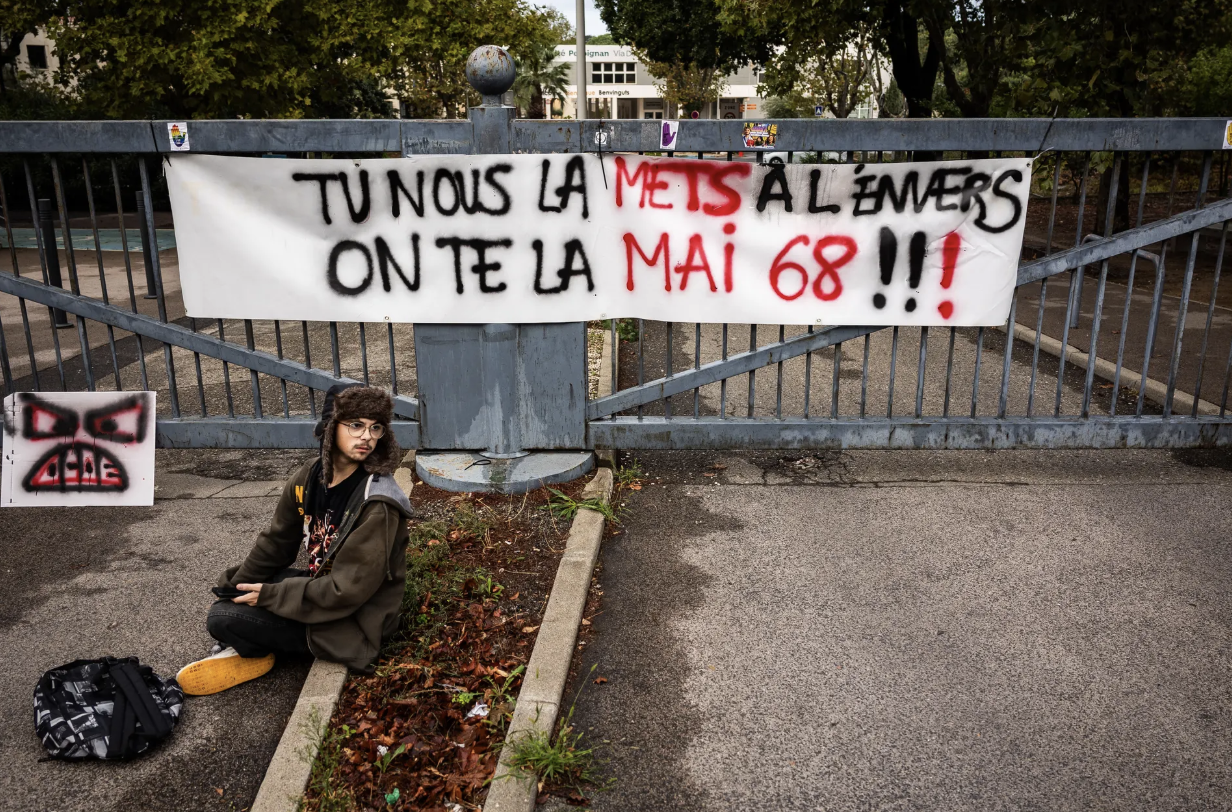
France is no stranger to student-led protests. In 1968, Parisian university students led the Cobblestone Protests, earning the title for the cobblestones they dug up from the streets and used as weapons against the French police. The similarities between what France is experiencing today and their history are not lost on the French demonstrators. In a protest in front of the University of Perpignan, Via Domitia, on Tuesday, one student’s banner translated to, “You’re trying to pull a fast one on us; we’ll give you May ’68.”
What France is experiencing today reinforces the nation’s legacy of resistance. The French public maintains the position that when the government turns its back on them, they will set the streets ablaze.
***
This article was edited by Cameron Ma and Lena Vanella-Martorana.
 Katie Mulhall
 Sophia Kiosses
 Samara Shelby-Nishita