
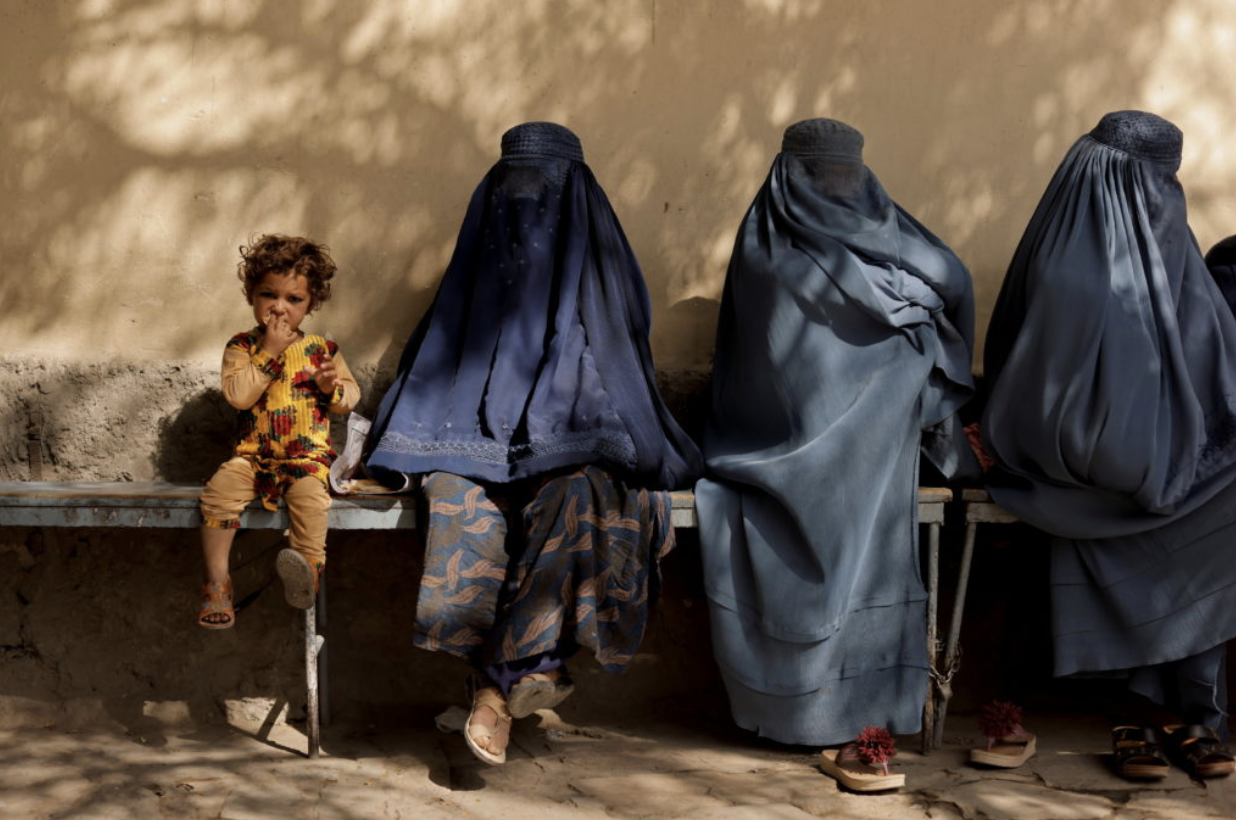
Photo via PBS News
***
Afghanistan has returned to its previous state of violent patriarchal misogyny since the United States military pulled out in 2021. This country has the worst repressive conditions for women in the world, with little to no employment or educational opportunities for any female living within its geographical boundaries under Taliban rule. This country, encapsulated with gender-based violence, is not unfamiliar with the harmful tactics necessary to oppress women, as seen during the years prior to the United States 2001 takeover, when almost no girls were legally enrolled in school.
However, upon the United States’ arrival in 2001, specific sectors such as education expanded considerably. By 2021, nearly one million girls were enrolled in secondary education, a significant increase from their 2001 numbers.
Women also had formal political representation in 2004, when the constitution reserved 68 of the lower house’s 250 parliamentary seats for women.
These gains were not perfect. Afghan women still faced poverty, insecurity, domestic violence, and unequal access to resources, especially in rural areas. Nevertheless, the period after 2001 created institutions and opportunities that allowed many women to imagine a future beyond the home. Women became teachers, doctors, journalists, judges, business owners, and government officials.
Girls attended school, and women entered universities in growing numbers. These changes did not erase patriarchy, but they gave women more choices and more visibility in public life.
The Taliban’s return to power in August 2021 reversed much of this progress. After the United States completed its withdrawal on August 30, 2021, the Taliban quickly imposed rules that restricted women’s freedom in nearly every aspect of life. The most significant change was visible within the education system.
In March 2022, the Taliban closed secondary schools to girls, and in December 2022, they banned women from attending universities.
Afghanistan became the only country in the world where girls and women are formally barred from secondary and higher education.
UNESCO reported that by 2026, an estimated 2.4 million girls had been excluded from secondary education since the Taliban returned to power. This reversal is especially damaging because education affects every other area of a woman’s life: her ability to work, earn money, access health care, participate in politics, and support her family.
Employment restrictions have followed the same pattern. The Taliban have banned women from many forms of paid work, including jobs with nongovernmental organizations and United Nations agencies.
These bans do not only affect wealthy or educated women in major cities. Many Afghan families depend on women’s wages to survive, particularly after decades of war and economic collapse.
When women are prevented from working, households lose income, and women become more dependent on male relatives. This dependence can make it harder for women to leave abusive situations or make independent decisions.
The Taliban have also restricted women’s movement and public presence. Women are expected to travel with a male guardian, known as a mahram, and rules require them to cover their bodies and faces in public.
The Taliban have banned women from parks, gyms, and other public spaces. In 2024, the Taliban’s “morality” law went even further by requiring women to conceal their voices in public.
These policies send a clear message: women are not viewed as equal members of society, but as people whose bodies, voices, and movements must be controlled.
The consequences extend beyond education and employment. Restrictions on travel make it more difficult for women to reach doctors, hospitals, and medical care. Due to the fact that male doctors cannot always treat female patients, the shortage of female medical workers creates serious health risks.
Women who experience domestic violence also face fewer protections. The Taliban have weakened the institutions that once helped women report abuse, seek shelter, or pursue legal justice.
In this sense, the restrictions are not separate problems; they work together to isolate women and reduce their power.
***
This article was edited by Emma Cate Martin and Eamonn Tucker.
 Joseph Gilardi
 Sophia Kiosses
 Samara Shelby-Nishita