
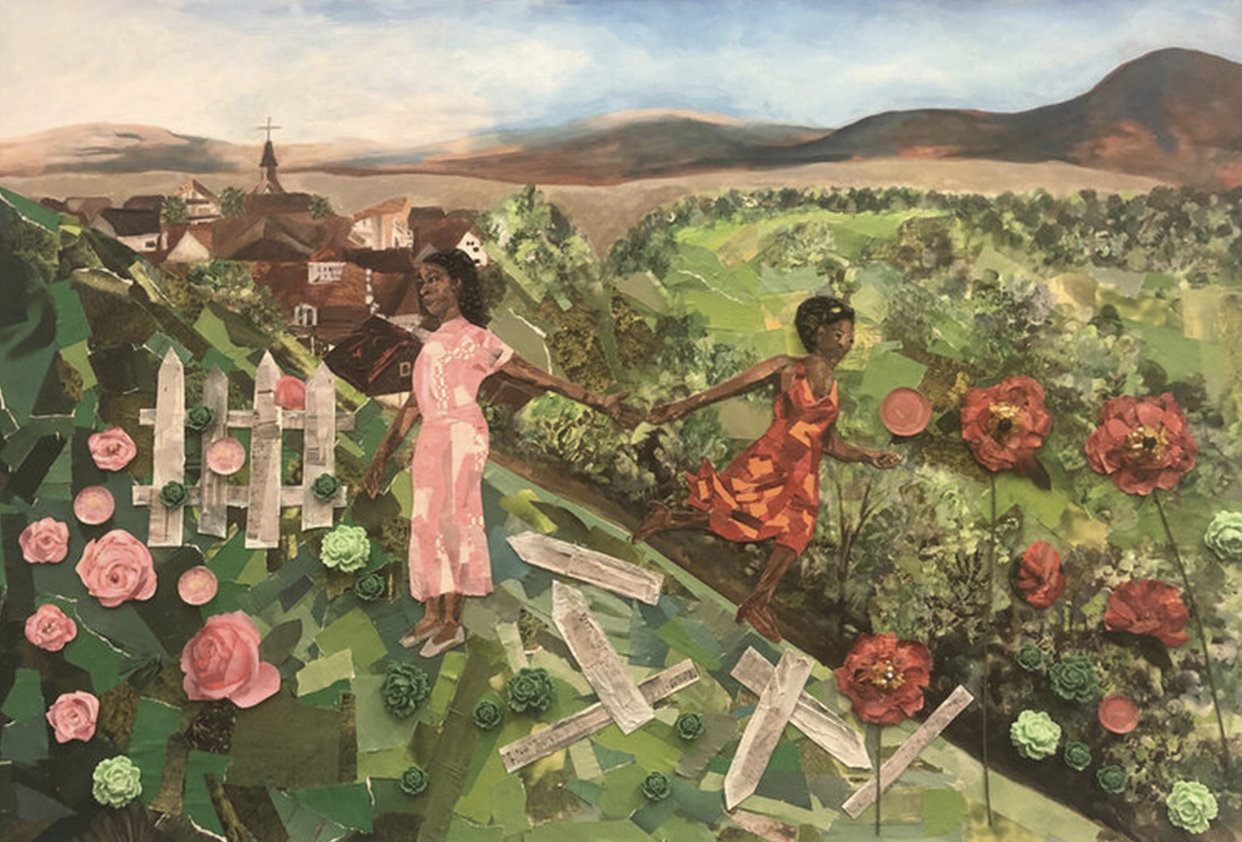
Image via Jordan Schnitzer Museum of Art WSU
***
February 1931, in Lorain, Ohio: an American novelist of singular linguistic talent was born. Toni Morrison’s work weaved elements of folklore into fragmented historical timelines impacted by shifting socio-systemic struggles and perspectives. She would go on to make her hometown the setting of her first masterclass in storytelling, The Bluest Eye (1971). The stunning spiral of events, told from the perspective of a little Black girl named Claudia, unfolds over 1940 and 1941, shortly following the Great Depression. In her own words, Morrison was writing the kind of book that she wanted to read, but could not find—a book that would capture the depth of the experience of Black girlhood in the midwestern United States. In the years since the novel’s publication, the themes she crafted within it have proven to be impactful for people from any cultural background.
Using everyday objects like a doll, a photograph, a storefront, and a piece of candy, Morrison makes questions of historical and philosophical significance into physical realities. In her world, an object is never just an object. Power is communicated through these material vessels, informing her characters of the nature of beauty, desirability, and, most devastatingly, what kinds of bodies are granted permission to be loved.
Nothing in The Bluest Eye is incidental. One scene in particular stands out upon an initial reading for its relationship to the objectification of Black identity. Claudia and her older sister meet Pecola Breedlove when her family is put “outside” by an act of Pecola’s father, leaving Pecola in need of a place to stay. In the Autumn chapter, the narrator describes Pecola’s consistent trips to the local grocery store. Pecola enters the store and purchases a Mary Jane candy from the store owner, who refuses to make physical contact with her Black hand in the process of exchanging money. The Mary Jane candy wrapper features the familiar image of a little White girl with golden blonde hair and bright blue eyes. Morrison spends time lingering over Pecola’s fascination with the image, writing, “She eats the candy, and its sweetness is good. To eat the candy is somehow to eat the eyes, eat Mary Jane. Love Mary Jane. Be Mary Jane. Three pennies had bought her nine lovely orgasms with Mary Jane. Lovely Mary Jane, for whom a candy is named.”
Morrison is making an incredible move here. In describing the child’s encounter with a piece of candy and its packaging as “orgasmic,” she is explicitly fetishizing the commodity. A commodity is an object that was created through labor and has the value of use and exchange. In attempting to reclaim her humanity through the consumption of candy, Pecola uses the candy to cross the boundary between herself and the image of the White girl. This grants the Mary Jane otherworldly powers of transformation that promises Pecola an escape from the unwanted body she inhabits. The mechanism offered to the little Black girl is self-erasure, and the supposedly liberating commodity simply reinforces the hierarchy that made liberation a necessity from the start.
At this point, the scene must be placed into a broader historical context: the objectification of the Black body. The Transatlantic Slave Trade maintained its foothold in the 16th century by transforming enslaved Africans from people into units of property—a commodity. As described in the autobiographies of Frederick Douglass and Harriet Jacobs, human beings were inspected for value, exchanged, transported, inherited, and separated from their families as if they were hogs. This was done according to the characteristics of race imposed upon their bodies. Historian Jennifer Lyle Morgan has shown how Black women in particular became entangled in hierarchical systems that reduced reproduction, kinship, and domestic labor to simple economic calculations. The word consumption acquires an especially disturbing resonance in this context. Chattel slavery did not stop at treating Black people as laborers; it constructed them as commodities whose bodies could be consumed economically. Their labor and reproductive capacity generated massive wealth for their owners.
The historical record contains an extraordinary case in which the language of consumption becomes literal. In 1837, the Portuguese schooner Arrogante was captured by a British warship off the coast of Cuba. More than 330 Africans were aboard, and many of them were children/adolescents. Survivors testified that crew members had killed one of the African men, cooked his flesh, and forcibly served it to other enslaved Africans aboard the vessel. Some testimony also included members of the crew cooking and eating the man’s heart and liver. The Arrogante story is not necessarily evidence of widespread cannibalism during the slave trade. Rather, its significance lies in the extreme endpoint of a system that had reduced those human beings to subhuman cargo. Enslaved people were most likely given what we consider today as Post-Traumatic Stress Disorder (PTSD), as well as other severe mental health issues, brought on by routine beatings, starvation, sexual assault, consistent overwork, and unceremonious disposal, all of which were described by survivors of the Arrogante.
This historical context matters to The Bluest Eye because Morrison’s novel is concerned with the ways children learn to understand themselves through preexisting systems that classify their bodies before they can. Pecola did not invent the belief that blue eyes are superior to her own; rather, she received it from the culture around her in advertisements, classrooms, toys, movies, adult attitudes, history books, and scientific language. Her desire for White features was manufactured before she was even old enough to recognize it as desire.
Within Morrison’s framework, Blackness shares an inherent quality with queerness as the Black body is artificially othered, or made to be queer. Whiteness establishes itself as universal, and therefore, Blackness becomes hyper-visible as a result. Black people are watched and contained so that they may be “corrected.” An instance that exemplifies this carcerality can be found in contemporary New York City in the Lincoln Square neighborhood. One resident described the caged nature of Black youth, saying, “…It’s a fact of life that it’s really happening right here, right across the street from Fordham, right across the street from Lincoln Center, right across the street from the Trump buildings, and it’s like, sometimes I say, it’s like we’re caged in. If you look at the neighborhood itself, when you go to the back, it’s the fences. So I’ve seen the kids like screaming at people, and I’m like, you guys look like little caged animals screaming at people on the other side.” It’s not accidental that the physical conditions of life for Black children like Pecola Breedlove are reproduced every day. Pecola is watched, her gendered and racialized body is judged, and her poverty is strung around her neck. Such children are not granted a space in which they can carefully construct themselves away from these systems of surveillance. They are symbolically cannibalized.
It should be noted that the Black body remains an object of commodification under the Prison-Industrial Complex, which disproportionately incarcerates people of color, Black people in particular. The 13th Amendment to the United States Constitution, which abolished slavery, still allows for slavery as punishment. Without meaningful representation, convicts are exploited and forced into labor in order to generate billions of dollars for free as dehumanized humans.
The issue of representation is integral to Toni Morrison’s religious imagery. Christianity is saturated with racial meaning in her novel. The White Jesus of Western visual culture becomes another image through which Black children learn to understand beauty and value. Morrison problematizes the historical production of a Christian invention in which holiness is repeatedly represented as Whiteness. A White Christ becomes another impossibly blue-eyed ideal.
When the ongoing history of Black objectification is placed in conversation with the biblical understanding of Christ as God’s son who was crucified for the sins of humanity, there is a powerful question to be asked: Was Christ lynched? And if Christ was lynched, then has the Black body been crucified every time one is found hanging from a tree? Christianity situates the crucified body of Jesus Christ at the center of sacred imagination, displayed solemnly to the world as the ultimate sacrifice. At the same time, when a Black person is found hanging from a tree, their life is turned into a spectacle. A community gathers to witness collective punishment, to mock and photograph and consume the Black body for entertainment. The evidence of racial power continues to mount. Across seven Southern states, there have been 70 modern-day lynchings identified since the year 2000, and they will continue.
Toni Morrison’s great achievement is forcing these systems of Black identity into comparison—the candy commodity, the blue eyes, the image of Jesus Christ, and the Black body all participate in a larger economy of racialization. People get to decide what is beautiful, normal, sacred, and consumed. Even as Blackness is desired in the form of style, music, language, and cultural capital, Black people remain subjected to exclusion, surveillance, and execution. The culture can eat Blackness alive while refusing personhood to people seen as Black. Morrison’s candy scene makes this contradiction intimate; Pecola doesn’t just want the candy, but the image that the world has told her will make her worthy of life.
“Life is complex, conceptually dominated by binaries but never wholly contained by them.”
– Zadie Smith, Introduction to Recitatif by Toni Morrison
***
This article was edited by Olivia Goodman and Sabrina Pala.
 Luke Helmholz
  Sidney Levitt
  Saad Sandhu