
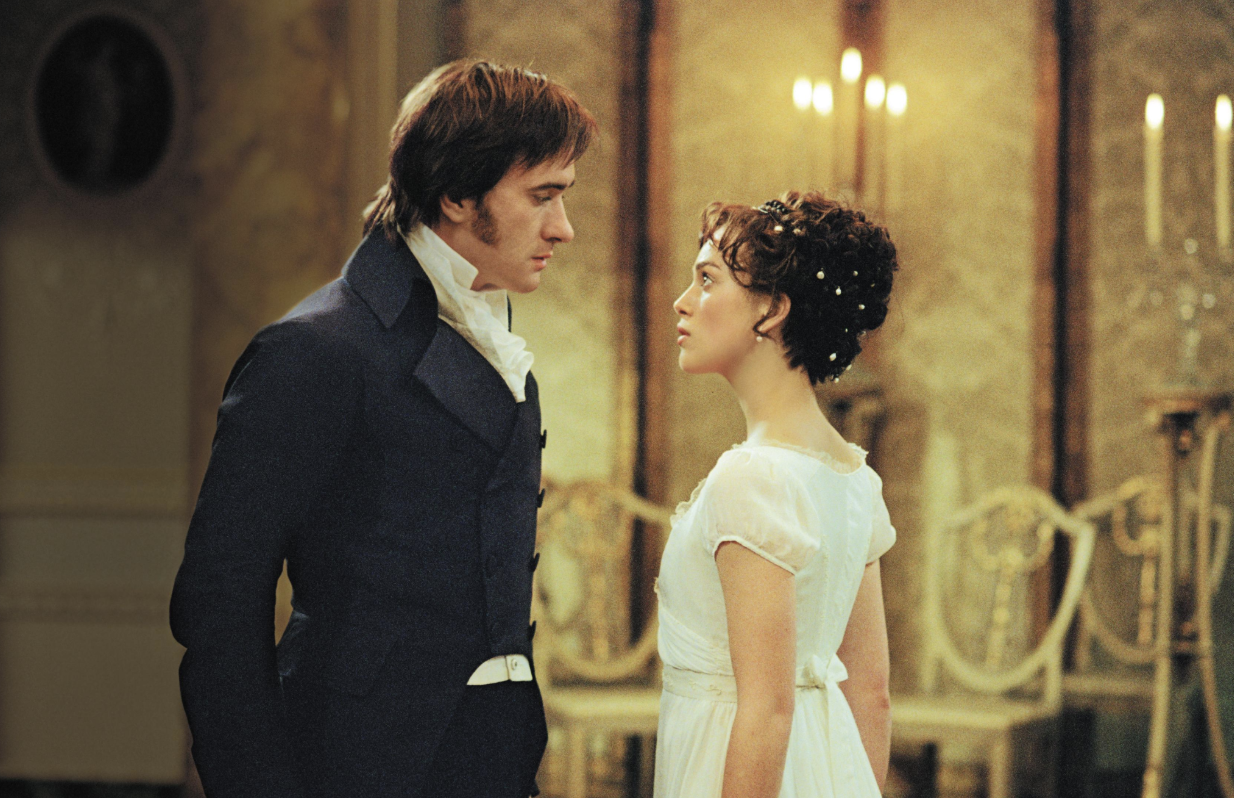
Image via IMDB
***
In Jane Austen’s Pride and Prejudice, a primary theme in her novels is the tension between filial obligation and personal liberty. Through Austen’s character-building, she extends external value to the inner lives of her characters. She is painting the portrait of a 19th-century world filled with the potential of love. However, that love at times must be transactional rather than for the sake of love itself.
The main characters focused on in the novel are Mr. Darcy and Miss Elizabeth Bennet. They are composed characters who consistently try to define how their hatred for one another is justified by the other’s actions. It is a classic story of miscommunication and the distrust that results from it.
Even more than it being a romance novel breaking ground for the tropes we all know so well, it engages in a larger conversation. How is it that love must be transactional for it to be worthy? What role do status and class play in the realm of desire and want? Moving back and forth between the formation of outward hatred and a confusing mix of inner emotions, each character grapples with what it means to be in love and to rid themselves of predispositions.
For the man, the motive is different. It is based purely on attraction and the likelihood that the match will bring good investment and a fruitful future for the family. For the woman, attraction is not a factor, or rather, it should not be lauded as the most important one. Instead, the main focus is to find a husband who will provide well into your old age. These provisions make the wealthy men the best suitors, despite their lack of tact, personality, or complexity. While women are not welcome anywhere near the field of business, it is their business to think of who they become once they marry whomever it is they choose.
Lizzy Bennet is an idealist. She rejects the social conventions of what it means to find love and instead searches for true love. She is complex, knowledgeable, and knows exactly what she does not want in a relationship. Her mother, Mrs. Bennet, and best friend, Charlotte Lucas, are, by contrast, primary followers of the social constructs of the Regency Era of matchmaking. They focus on social mobility and the ways in which the matches—for herself in Charlotte’s case and for her daughters in Mrs. Bennet’s case—will allow them to be of a higher status.
When these perspectives are taken into consideration, it makes sense that love is only acceptable in a form that is both productive and equitable. However, what happens when we translate this ideology into the ways we navigate relationships today? What does it mean to desire for the sake of yourself or others? Despite the obvious reasons—that we no longer live the antiquated lives of ‘yesterday’—and the fact that our social confines and spheres are much larger in today’s society compared to the past, how is it that we choose our matches? What are the socio-political implications?
Today, we emulate the complex human that is Lizzy Bennet. While society still impacts us, our obligations to ourselves are much greater than what we may owe to others, if anything at all. Even so, the counterargument is that many still live in a world where things such as marriage are considered a business transaction or an investment.
So, where exactly do we distinguish the differences between antiquated methods of finding the one and our modern ways? Has it been entirely disregarded, or is it just buried among a plethora of new factors that we have come to consider more important?
The politics of matchmaking is ever-changing and varies among the individuals involved in creating a blossoming relationship. Within the politics of today, one may say it’s best to combine both the pragmatic aspects of realism with the romantic endeavors of what it means to be an idealist. To find the true person you are meant to be with, it can be taken from Austen’s novel that one perspective does not have to preside over the other when it comes to your choice.
***
This article was edited by Mia Kirch and Whitney Woodrow.
 Samantha Kornsey
 Matthew Subramani
 Jackson Cutrone