
Image via Liberty Flagpoles
***
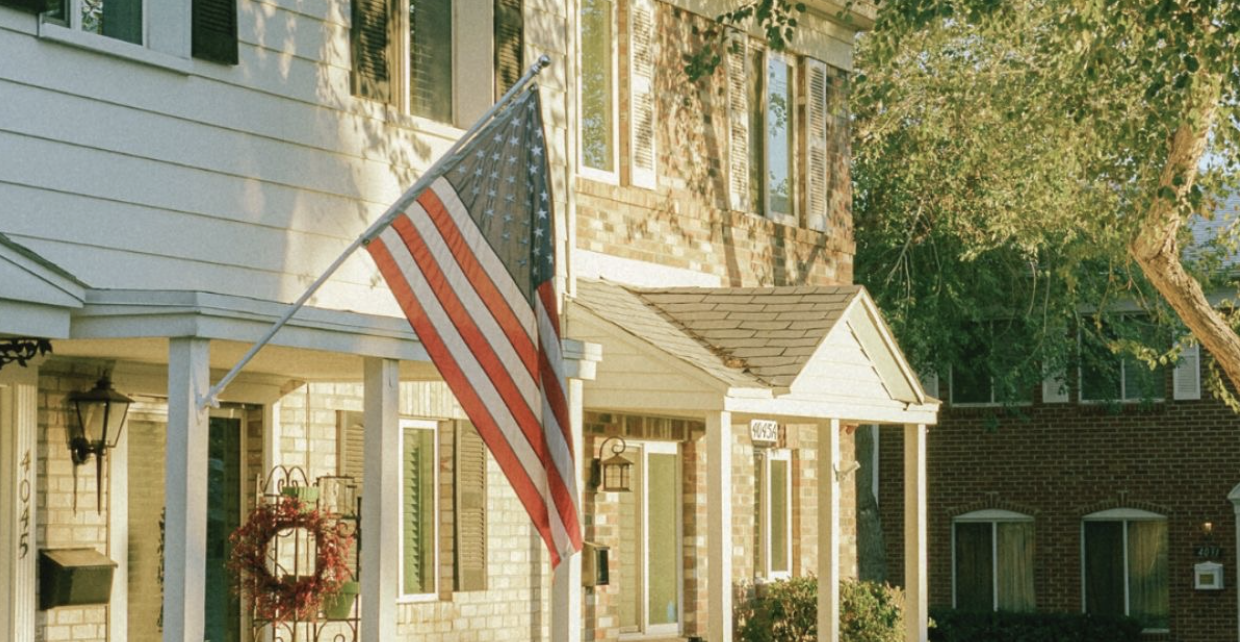
I spent most of this past summer in California’s Northern Valley, a sweltering, suburban region with notably one of the highest rates of diversity in the state. A few weeks after Independence Day, I was driving to a friend’s house along a busy avenue when I noticed what must have been hundreds of American flags lining the telephone poles and streetlights, looming over me as if I needed a constant reminder of where I was. They stretched along the entire avenue, and even after I turned onto her street, I couldn’t seem to escape the star-spangled banner. Some houses on her street went beyond the quaint, picturesque decoration of a single flag and decked out their yards with giant tapestries of the Constitution, “Don’t Tread on Me” flags, and red, white, and blue lights.
While I do not think that an American flag in one’s front yard is a distinct identifier of their political opinion, I think the tangible fear and doubt it can evoke speaks volumes. Particularly so in a region that is home to over one million Latinx individuals and has seen mass immigration raids and arrests from Immigration and Customs Enforcement (ICE) that are targeting agricultural workers, handymen, and innocent family members alike. When I looked out at the rows of these homes with American flags outside of them, the dissonance between the notions of freedom and liberty seemed to reverberate as the detention of a father with his four-year-old daughter in the car that occurred just a few miles south seemed astounding.
I tried to give these people the benefit of the doubt, but frankly, these residents were all white, American, and most hadn’t lived outside the Northern Valley their whole lives; it doesn’t seem far-fetched to assume that even if their hearts might have been in the right place, their minds clearly weren’t. They lacked the cultural cognizance and critical empathy to correlate their brash patriotism with supporting a persecutory and racist federal organization. Their insulation from the rampant and deadly ICE arrests and deportations makes it easier to celebrate an abstract idea of America without confronting the realities of the systems operating in its name. For those who have never had to question whether their appearance, surname, or accent might make them a target, the promise of American freedom can feel universal. This worsens the othering felt by those who are not afforded such privilege.
In semiotics, the American flag functions as a compelling sign; its physical composition of red and white stripes, a blue canton, and fifty stars serves as the signifier, which instantly conjures the signified concept of the United States as a nation. Through social agreement and convention, we interpret the idea of “The United States.” However, what happens when the sign that is supposed to represent our nation is transformed into fear, bigotry, and injustice? These facets may not be new in our history. Still, now more than ever, it is important to look beyond the nostalgia associated with idealized Americana culture and perhaps question the connotations of our flag. No longer an innocent display, the American flag serves to create a barrier between an unspoken “us and them.”
Those who were born and raised in a culture that historically afforded them a sense of security and belonging will struggle to recognize that the symbols they embrace can evoke entirely different feelings in people from other cultures and historical backgrounds. Patriotism itself is not inherently exclusionary, but blindly following its traditions and customs can unintentionally enforce a culture of intolerance. And when patriotism is a cardinal tenet of the flag itself, it is hard to empathically separate it from nationalism. Moreover, the manner in which Americans view their freedom and liberty as superior to other nations, yet remain ignorant to the foundational flaws of the nation, signals an estrangement from genuine pride.
I reflect on the fear and doubt I felt upon seeing the flag repeated, not to condemn those families or anyone who has the flag in their front yard, but rather because, in a culture of political division and cynicism across party lines, it is more important than ever to understand our neighbors. What the American flag means to me may be different from what it means to you, or even to the person sitting next to you. Still, we share a responsibility to check the volume of our patriotism and use our privilege to speak out against the injustices in our nation before they reach our front door.
***
This article was edited by Aayushi Kejriwal and Mia Kirch.
 Samantha Kornsey
 Matthew Subramani
 Jackson Cutrone