
Image via X
***
Before the rapid growth of prediction markets, there was a clear, easy-to-understand boundary between professional athletes and sports gambling companies. Athletes would play the games, and sportsbooks would accept and manage wagers on them. States and professional leagues established regulations intended to keep those capable of influencing games distant from those wagering on their outcomes. However, prediction markets are making that boundary harder to see.
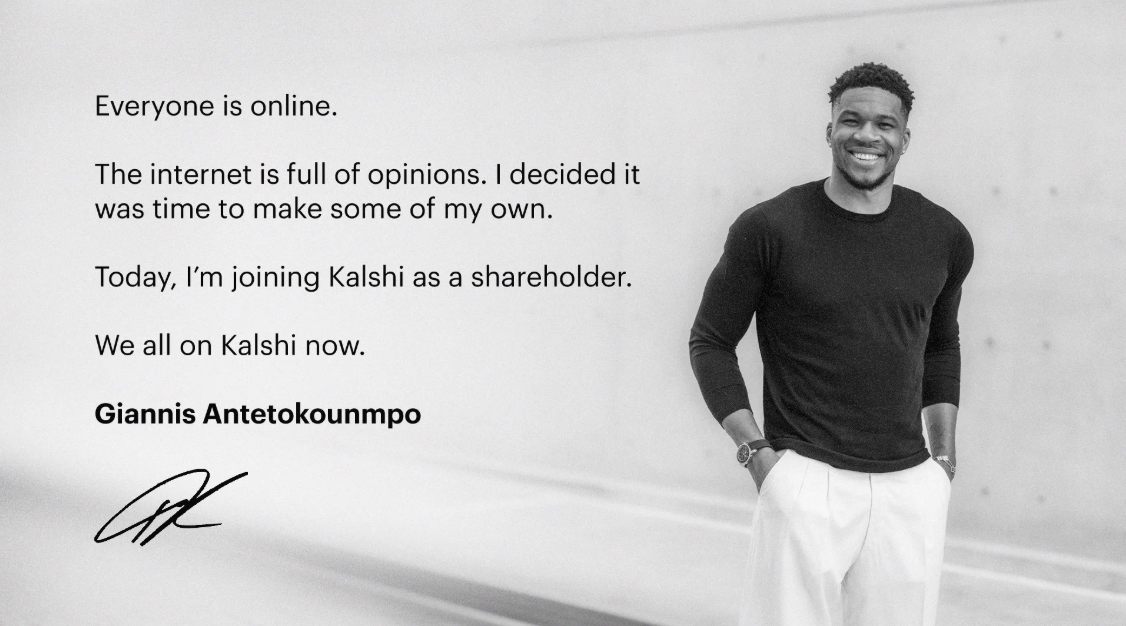
On February 6, 2026, NBA superstar Giannis Antetokounmpo announced that he had become a shareholder in Kalshi, one of the largest prediction markets in the United States. The announcement came after months of trade rumors regarding Antetokounmpo before the trade deadline. Kalshi hosted contracts on whether he would remain in Milwaukee or be traded. A Kalshi article published the day before Antetokounmpo’s announcement showed there was a 99% chance he would remain in Milwaukee rather than be traded, which increased from when the option was priced at 47 cents. would stay with the Bucks and be part of a blockbuster trade with the Miami Heat during the summer. Kalshi would clarify that he would be part of marketing and live events, but would be restricted from involvement in trading NBA-related markets. Seven months later, LeBron James entered the same industry from a different angle. On September 5, 2026, James announced an endorsement deal with the competitor to Kalshi, Polymarket, worth approximately $15 million per year. According to Front Office Sports, James is an endorser of the platform, and his engagement focuses on football rather than basketball.
Neither partnership shows criminal activity. There is no evidence that Antetokounmpo or James used private information to trade or influence market outcomes. The concern is more systemic. What happens when a person with access to private information about injuries, contract negotiations, or unannounced trades also has a relationship with a platform that commodifies sports events? That question matters because prediction markets are under vastly different regulations than traditional sportsbooks. The Commodities Futures Trading Commission (CFTC) explains that prediction market products are event contracts, typically structured as swaps whose value depends on the outcome of a future event. Kalshi operates a federally regulated contract market, placing much of its operations within the CFTC structure rather than the state gaming commission structure that oversees sports wagering.
However, to a regular user, that distinction could feel nonexistent. A person purchasing a contract on whether a football team will win and a person placing a wager on that same team to win are both risking money on the same outcome. That blurry distinction has raised legal questions about whether prediction markets should fall under federal commodities law or be regulated by states as gambling. In September 2026, the Sixth Circuit Court of Appeals ruled that Ohio and Tennessee could apply their gambling laws to Kalshi, reflecting a deep divide among federal courts that leaves prediction markets in an uncertain position. The relationships these prediction markets have with athletes make that uncertainty important to address. Giannis is not just an athlete speculated on by the market; he is the main figure determining its outcome. While with the Bucks, Giannis controlled whether he would demand a trade or stay with the team. Kalshi profited by charging transaction fees on trades tied to uncertainty about Giannis’s future.
Federal commodities law has some influence on this matter, as the CFTC released a prediction markets advisory that described cases in which a political candidate traded on his own candidacy and a YouTube editor traded on the content of a YouTube channel, with knowledge of the videos before their posting. The agency stated that the misuse of material nonpublic information violates federal commodities law. The CFTC has also taken direct action against this action in prediction markets. It ordered Gabriel Perez to pay $172,000 for misappropriation of material, nonpublic information, while working as a teleprompter for the White House to trade prediction contracts about words President Trump might say in his speeches. These cases are important because they show that prediction market insider trading is not just a concern. A person should not use confidential information to profit from trades, but it doesn’t answer the conflict of interest created by athletes and these markets. An ownership stake is not a trade, and an endorsement is not linked to the result of an event. As a result, the relationship between these athletes and prediction platforms can cause issues that may not constitute fraud but diminish public trust in sports outcomes.
The NBA has shown that it recognizes the integrity risks posed by these sports prediction markets. In a May 2025 letter to the CFTC, the league describes maintaining public confidence in basketball as its main priority, noting that sports prediction markets use similar mechanisms to those used in sports betting. The NBA argued that, although prediction markets are under federal oversight, they lack the sport protections found in regulated sports betting, including requirements for information sharing and cooperation with league investigations into suspicious activity. As these markets continue to grow, the league warned that poor oversight would make integrity risks more difficult to manage.
Supporters of prediction markets argue that they can do more than just amplify sports gambling. Economists Justin Wolfers and Eric Zitzewitz argue that prediction markets are a way for people to search for information, reveal information, and combine various opinions into a single market price. Their research found that these markets have often produced strong forecasts that outperform those of major polling organizations and internal corporate markets, predicting business outcomes more accurately than traditional forecasts. Attempts to manipulate prediction markets have only a short-term impact because other traders have a financial incentive to correct distorted prices.
The same advantage that makes prediction markets valuable can become complicated when the people with this knowledge have financial ties to the platforms that control those markets. The CFTC should require clear disclosure when an athlete holds equity in or receives compensation from prediction market platforms. Exchanges should also disclose if compensation is based on platform growth, sports trading volume, or activity in certain markets. These regulations would help consumers better understand the partnerships in the markets they trade.
Federal law should restrict athletes, coaches, team employees, and others with access to nonpublic sports information from trading relevant contracts. Exchanges should be required to implement systems to identify linked accounts, suspicious trading activity, and trading occurring shortly before major market events. When an athlete holds an ownership stake in the platform, the exchange should establish safeguards to prevent the athlete from participating in decisions about contracts directly related to their own league or career.
Antetokounmpo’s equity in Kalshi and James’s endorsement with Polymarket are not similar. A shareholder can benefit from growth in the exchange’s value, while an endorser is paid to draw attention to and lend credibility to a brand. Both relationships need to be transparent, but ownership creates deep financial ties that need stronger oversight.
Prediction markets have turned information about future outcomes into a financial product. Professional athletes sometimes have that information before the public knows. As athletes become investors and active participants of platforms that commodify their sports, the integrity of these markets depends on punishing illegal trades when they happen. The difference between a sportsbook and a prediction market may be legally important, but it should not be used as an excuse to put integrity aside.
***
This article was edited by Mia Kirch.
 Madelyn Marcisz
  Dominic Razzano
  Campbell Brown