
Photo via Deseret News
***
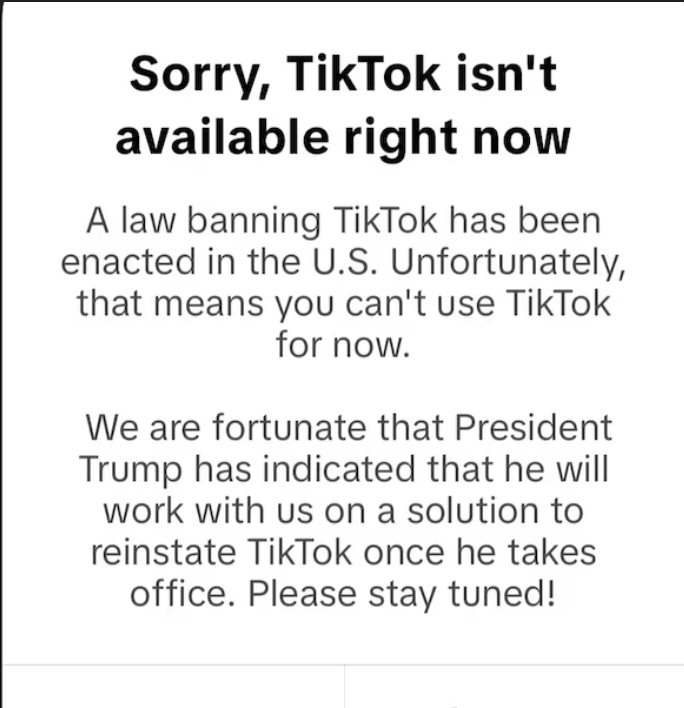
On January 19th, 2025, millions of TikTok users in the United States of America found that they could no longer access the highly popular app due to the Supreme Court’s upholding of its ban.
A day after, on January 20th, President Donald Trump held his inauguration in Washington D.C. Among the many CEOs and billionaires in the audience currying favor with the President-elect was the CEO of TikTok’s parent company, ByteDance.
Shou Zi Chew, a Singaporean resident and the CEO of TikTok, had previously been accused of being a Chinese spy at a March 23, 2023 Senate hearing held to decide the beloved app’s fate. American politicians argued for the ban due to security concerns, asserting that the Chinese Communist Party could use TikTok to manipulate content and gain access to American user data. Strangely quiet on the matter was the White House’s newest employee—Trump— who had, in his first term, expressed immense distaste for the application. He had made a massive pivot from advocating for TikTok’s ban to becoming its knight in shining armor.
The Supreme Court has a current Republican majority, with multiple justices being placed by Trump himself. It is important to question why he would oppose some of the very people he put in power. This starts a larger conversation about Trump’s motivations surrounding “saving” TikTok. Despite coming off as belligerent and ignorant, Trump is highly attuned to his power over people. He knows how to create a cult of personality, as well as how to gain new followers. Trump was aware of, and subsequently utilized, the conservative shift in young Americans— especially young men—to win the 2024 Presidential election.
According to NBC exit polling, Trump is the first Republican candidate since 2008 to have picked up a large portion of voters under 30, especially young white men. While he only gained 41% of the young male vote in 2020, he procured 56% of the vote from this demographic in the recent election. Trump has also appeared on multiple different podcasts catering to young men under 35, most notably The Joe Rogan Experience, one of the most popular podcasts on Spotify. He has befriended and employed the owner of the platform X (formerly known as Twitter), Elon Musk.
Donald Trump was marketing himself to young Americans in as many ways as possible. He recognized the power TikTok held over American youth and, as the crude businessman he is, wanted to harness that power for his own political gain.
What better way to appeal to millions of young people, some voting for the first time and who are too young to remember quite how bad things were in his first term, than by positioning himself as a hip 78-year-old out to save Gen Z’s favorite doom-scrolling app? Trump seems to believe that he would be able to expand his political empire through social media prowess. What he did not account for, however, was the unpredictable nature of Gen Z, as well as their tendency to rebel against authority.
With nowhere else to satisfy their hunger for goofs and gaffs, American youths flooded other apps, from Instagram to YouTube. The most peculiar out of all of these was the Chinese app 小红书 (Xiǎohóngshū). Internationally, this new app is called Rednote, Little Red Book, Chinese Instagram, or simply XHS.
Ironically, Americans were now being exposed to real Chinese propaganda and, for the first time, were experiencing Chinese censorship. Many long-time users of XHS noted how Chinese netizens welcomed their American counterparts with open arms, establishing “TikTok Refugee Boot Camps” to teach Americans Mandarin Chinese.
TikTok remained banned for a mere 12 hours before President Trump “unbanned” it. Of course, it is a common misconception among Americans that Trump had reversed the app’s ban; he actually only extended it for 75 days in an executive order upon entering office. He claims this allows him to consult experts about the application’s future. His good graces did not extend to allowing TikTok back on app stores, so be wary of deleting it in the future, you may not be able to get it back.
Although Trump’s plan to appeal to young Americans seemingly backfired, seeing as he did not predict that the youth would be driven to another Chinese app, he still largely benefited from the stunt. America thrives on its billionaires, as seen in the illustrious guest list that attended his swearing into office. It’s a symbiotic relationship; the billionaires get political protection from the federal government, and the federal government increases their nation’s wealth through a handful of exploitative CEOs.
American youth’s apparent resistance to the new administration’s dubious propaganda shows great hope for the nation’s future. A considerable number of people saw through Trump’s ploy to appeal to different demographics and rebelled against the exemplification of the growing ties between tech billionaires and governmental power. As long as Americans remain resilient against top-down manipulation, there is hope that we will be able to shape our own digital and ideological futures.
***
This article was edited by Emily Caro and Naomi Rea.
 Esme Carson
  Anne Eslick-Persyn
  Stan Refermat