
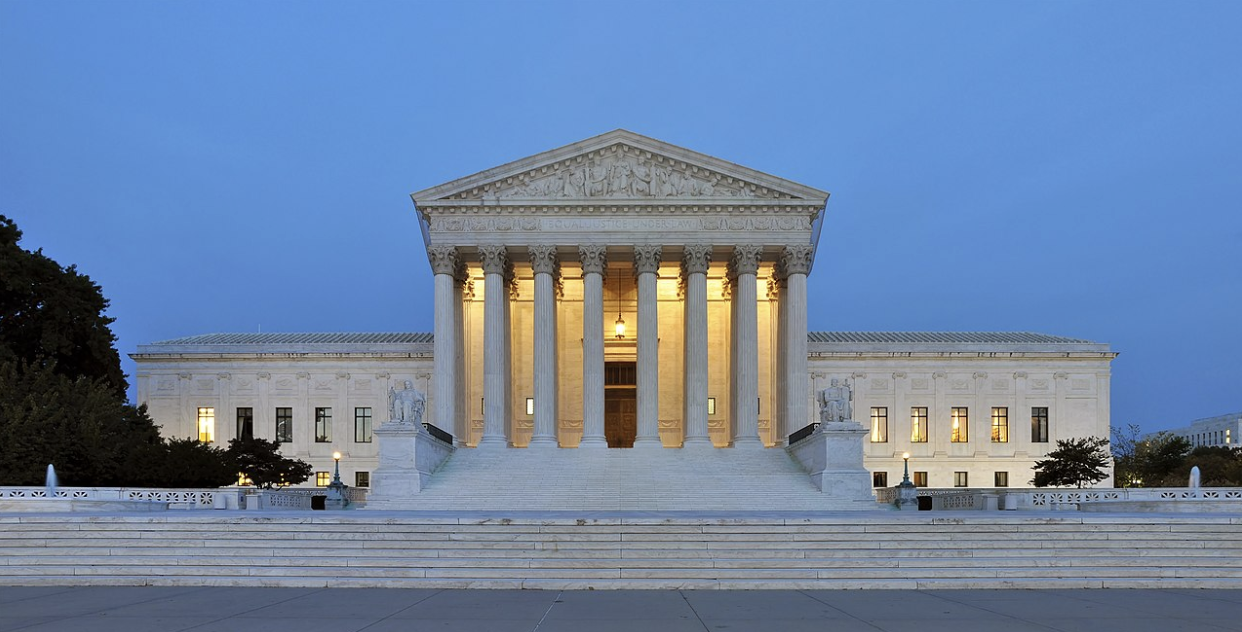
Photo via Wikipedia
***
When the Supreme Court ruled 6–3 in February 2026 that President Trump lacked authority to impose sweeping tariffs under the International Emergency Economic Powers Act (IEEPA), most observers called it a major defeat. The headline wrote itself: the Court had reined in overreaching executive powers. Legal commentators praised the decision as a reassertion of the separation of powers. Critics of the administration celebrated. However, that narrative is too simple and arguably wrong.
To understand why, it helps to understand what IEEPA actually is and how the administration chose to use it. Passed in 1977, the law was originally designed to give presidents the ability to freeze foreign assets and block financial transactions in response to an unusual or extraordinary threat to national security. It was invoked sparingly for decades, typically in response to specific geopolitical crises. It was used to issue sanctions against Iran after the hostage crisis and to freeze assets of foreign terrorist organizations after September 11th. It was never intended as a broad instrument of economic policy. But in his second term, Trump’s administration invoked it to justify sweeping tariffs on imports from nearly every country, arguing that chronic trade deficits amounted to a national economic emergency. It was an interpretation of the statute far broader than anything previous presidents had attempted.
The legal challenge to Trump’s tariffs came immediately. A coalition of small businesses, many reliant on imports, filed suit against the administration arguing that their costs had soared overnight with no congressional authorization behind the policy. A manufacturer dependent on foreign steel, a retailer sourcing goods from overseas, a small importer operating on thin margins. These were the kinds of businesses which brought the suit forward, in collaboration with several states. The plaintiffs were not making an argument against tariffs as a concept. They were making the claim that IEEPA was never meant to be a tariff statute, and that the president had no authority to use it as one. Two lower courts agreed, though both paused their rulings as the case worked its way up to the Supreme Court, allowing the tariffs to remain in effect throughout the appeals process.
By the time the case reached the high court, the stakes had grown considerably. The tariffs had generated more than $200 billion in revenue, according to estimates cited in the litigation. They had also reshaped global trade, contributing to agreements with China, the United Kingdom, and Japan worth trillions of dollars. The Court was not being asked to block a policy before it began. It was being asked to unwind one that had already remade the global economic landscape, disrupted supply chains, and formed the backdrop to some of the most consequential trade negotiations in recent memory.
Chief Justice Roberts, writing for the majority, grounded the decision in a straightforward reading of statutory text. IEEPA permits the president to “regulate” importation during a declared national emergency, but the statute makes no mention of tariffs or duties anywhere in its text. The majority held that such a significant taxing power, one capable of reshaping entire industries and international trade relationships, could not be conveyed inside the word “regulate.”
That conclusion drew on the Court’s increasingly influential major questions doctrine, a principle holding that when executive action carries vast economic or political consequences, Congress must authorize it explicitly rather than by implication. The doctrine has become one of the Roberts Court’s most important tools for checking executive overreach. Its application here sent a clear signal that ambiguous statutory language on trade was not enough to support transformative economic tariffs.
There is, however, a deeper constitutional question that the court’s recent ruling conspicuously sidestepped. Article I, Section 8 of the Constitution explicitly grants Congress, not the president, the power to lay and collect duties and to regulate commerce with foreign nations. The tariff power was never meant to belong to the executive branch at all. The farmers were deliberate about this. Having lived under a British monarchy that taxed them without representation, they placed the power to tax purposely in the hands of the legislature, the branch of the people. But over the course of the twentieth century, Congress voluntarily transferred much of that authority to the president through a series of trade statutes.
The Roberts Court had an opportunity to examine whether that transfer of power had gone too far, to ask whether decades of congressional delegation had stretched beyond what the Constitution’s design permits. It declined. By resolving the case on narrow statutory grounds rather than constitutional ones, the Court avoided the harder question of whether any of these tariff statutes, not just IEEPA, represent an unconstitutional shift of legislative power to the executive. That question remains open, and for a president willing to test its limits, that openness is an advantage for Trump.
More telling still is what the ruling left intact. Justice Kavanaugh, in dissent, noted that multiple other statutes already give the president broad authority to impose tariffs and that the majority’s decision did nothing to disturb them. Section 232 of the Trade Expansion Act of 1962 allows tariffs on imports that threaten national security. Trump used Section 232 during his first term to impose tariffs on steel and aluminum, and those tariffs survived legal challenges. Section 301 of the Trade Act of 1974 authorizes tariffs in response to unfair foreign trade practices, and has been used to justify hundreds of billions in duties on Chinese goods. Neither authority was touched by the ruling. Kavanaugh observed that they could potentially justify most of the same tariffs just struck down under IEEPA, requiring additional procedural steps but arriving at much the same destination. Trump has publicly said he intends to rely on both going forward, and there is little reason to doubt him.
The ruling’s silence on remedies is an additional win for the Trump administration. Having declared the tariffs unlawful, the Court said nothing about what should happen to the more than $200 billion already collected. Plaintiffs argued they were owed refunds. But as Kavanaugh pointed out, the businesses that paid those tariffs had largely passed the costs downstream to manufacturers, retailers, and consumers. Untangling those financial relationships to determine who deserves what repayment would be an extraordinary undertaking, one that could take years of litigation and produce deeply uneven results. Unwinding the trade agreements with other nations negotiated because of the tariffs would create its own diplomatic complications, potentially destabilizing arrangements that both sides had come to rely on. Faced with that complexity, the Court chose not to intervene. The practical effects of the tariffs were left largely in place even as their legal basis was struck down.
This restraint fits a recognizable pattern in the Roberts Court’s approach to executive power. Rather than issue broad constitutional rulings, the Court has consistently preferred narrow statutory interpretations that resolve the immediate case without setting sweeping precedent. From one perspective, this reflects judicial modesty, an unwillingness to insert the Court into complex disputes over economic policy and international trade that are better resolved through the political process. But the approach has a consequence that is easy to overlook: ambiguity tends to favor the branch most willing to act. The Trump administration is inclined to test the limits of what executive authority will allow. Congress, meanwhile, has shown little interest in reclaiming the trade powers it has delegated over decades. Unless lawmakers act to narrow statutes like Section 232 and Section 301, an unlikely prospect in the current political environment, the courts have limited tools to constrain presidential tariff policy. The ruling returned the question to the political branches, and in doing so, effectively handed the advantage back to the executive.
For critics of Trump’s trade agenda, the ruling offers something genuine. The court rejected the administration’s most expansive reading of emergency economic powers and reaffirmed the principle that power delegation requires clear congressional authorization. But it is not a check on tariffs. Trump lost the argument that IEEPA is a blank check for trade policy. He did not lose the argument to pursue aggressive tariffs. The ruling told him where he cannot go, which, in practice, means he now knows exactly where he can. The Roberts Court delivered a decision that looks dramatic from a distance and is far more modest up close. The headline said Trump lost. The fine print tells a different story.
***
This article was edited by Abigail D’Angelo
 Sahir Sadat
  Amelia Felice
  Nathan Wellman