
Image via City Life Org
***
New York City (NYC) is in the midst of a public health crisis, and has been since the 19th century. The culprit? Air pollution. The air pollution crisis is most prevalent in environmental justice (EJ) areas, characterized by low per-capita incomes and high rates of minorities. EJ areas house a disproportionate number of polluting infrastructure such as arterial highways, freight distribution routes, waste management facilities, and 13 of NYC’s 19 “peaker” power plants. Furthermore, the existence of EJ communities is often attributable to past discriminatory policy decisions and systemic racial injustice. While recent and current policies have greatly reduced total emissions, the vast human and economic cost of persistent and disproportionate pollution in EJ areas justifies increased, targeted investment in lasting solutions like the New York Economic Development Corporation’s (NYCEDC) ‘Blue Highways” initiative.
High concentrations of particulate matter, CO, NO2, and other chemicals, together with a lack of access to protections like indoor filtration, have led to high asthma rates in EJ areas, as well as other health effects. At 14%, New York City’s adult asthma rates are higher than the national average. But in the Bronx, the borough with the highest concentration of EJ areas, the adult asthma rate is 20%. Furthermore, East Harlem’s asthma rate is 4 times that of Park Slope, Greenpoint, and Bay Ridge respectively. Air pollution exposure is also linked to cancer, cardiovascular disease, diabetes, and other reproductive, neurological, and immune system conditions.
In places like the South Bronx and Harlem, pollution often interacts with poor public transportation and lack of access to necessities like hospitals, grocery stores, and green spaces. These compounding disadvantages burden historically marginalized communities and contribute to systemic racism and oppression. Consider Mott Haven, a neighborhood in the South Bronx labelled “Asthma Alley.” The 97% nonwhite neighborhood is straddled by two “peaker” power plants. It houses a confluence of arterial highways and the Major Deegan Expressway. The highways attract shipping, exposing residents to black carbon emissions from diesel freight vehicles. Mott Haven Community High School has a graduation rate of just 26%, but 86% of the student body qualifies for the school’s free lunch program. Both low household income and high air pollution have been linked to negative educational outcomes.
Observable in the racial demographics of EJ communities today, environmental injustice is part of the long shadow cast by racial discrimination in NYC’s urban development. From NYC’s first zoning ordinances in 1916 to the preferential implementation of the Home Owners’ Loan Act of 1933, a process now known as redlining, discriminatory historical policies contributed to segregation and unequal urban development. After WWII, planners like Robert Moses exploited biased urban redevelopment laws targeting ‘urban blight’ to build vehicle infrastructure in minority communities. The “slum clearance” policies Moses utilized were famously called “N*gro removal” by Harlem native James Baldwin. These laws, alongside discriminatory zoning and permitting practices, led to the overdevelopment of public and private polluting infrastructure in marginalized neighborhoods. Today, low-income and minority New Yorkers are still more likely to live near environmental hazards, underscoring the continued relationship between racism and environmental injustice.
Recently, a collection of federal, state, and local laws has greatly improved NYC’s air quality. Locally, the Clean Fuel Bus Program, Clean Air Taxi Law, Clean Heat Program, and Local Law 38 (regulating emissions from city vehicle fleets and commercial stoves), are credited for the significant citywide decline of particulate matter and NO2 between 2007 and 2021.
The city has also provided targeted relief to EJ communities with the 2018 Waste Equity Law, reducing waste management operations in overburdened communities, and the 2022 Cumulative Impacts Law, embedding EJ considerations into environmental permitting processes. At the state level, the Build Public Renewables Act directs the New York Power Authority to decommission all natural gas peaker power plants in the New York City area by 2030, while the Green Amendment ostensibly protects New Yorkers’ right to a “healthful environment,” though early litigation attempts under this provision have been largely unsuccessful.
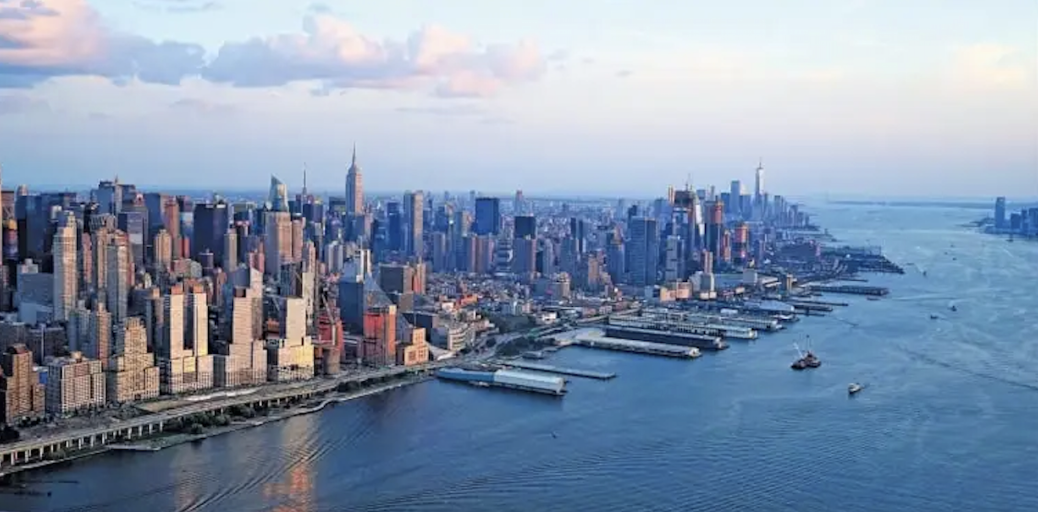
NYC should look to build on these policies by expanding NYCEDC’s “Blue Highways” freight infrastructure initiative. 90% of NYC’s supply chains use trucking, burdening EJ communities with diesel exhaust emissions, where distribution centers and routes are concentrated. Moreover, freight volumes are projected to increase by 67% in NYC through 2045. “Blue highways” provide a direct substitution to middle and last-mile trucking by leveraging NYC’s 520 miles of navigable waterways, including the Hudson and East rivers, and its mostly publicly-owned waterfront to expand maritime shipping. Implementation requires constructing/activating cargo ports and coordinating with distribution firms, vessel traffic services, and other stakeholders.
The Hunts Point Marine Terminal pilot project illustrates the potential EJ benefits of blue highways. Many middle-mile trucking shipments arrive at Hunts Point, home to the largest food distribution center in the country, via the George Washington Bridge & Cross-Bronx Expressway, bisecting several EJ zones. The marine terminal will activate routes between Hunts Point and New Jersey ports like Port Newark, removing an expected 9,000 truck trips per month. NYC should look to rapidly expand this initiative to other sites and routes that reduce trucking through EJ areas. NYCEDC has already identified several waterfront sites for port construction/activation that would do so. To compensate for the high upfront cost of the proposed projects, NYCEDC has already received $200 million in federal funding. Moreover, when executed efficiently, community-oriented infrastructure projects often pay for themselves in urban development. The Hunts Point Marine Terminal alone is projected to generate $3.9 billion in economic impact over the next 30 years, including temporary and permanent jobs. Likewise, a 2017 highway removal project in Rochester has already generated economic development worth 10x the upfront cost.
The economic and human costs associated with the health impacts of air pollution warrant large, immediate investments from the city, especially since past mistakes have led vulnerable populations to suffer the most. Strategically expanding blue highways to eliminate trucking in EJ communities will help secure what should be a universal right: a healthy built environment for ALL New Yorkers.
***
This article was edited by Abigail D’Angelo.
 Saad Sandhu
  Campbell Brown
  Nadia Garriga