
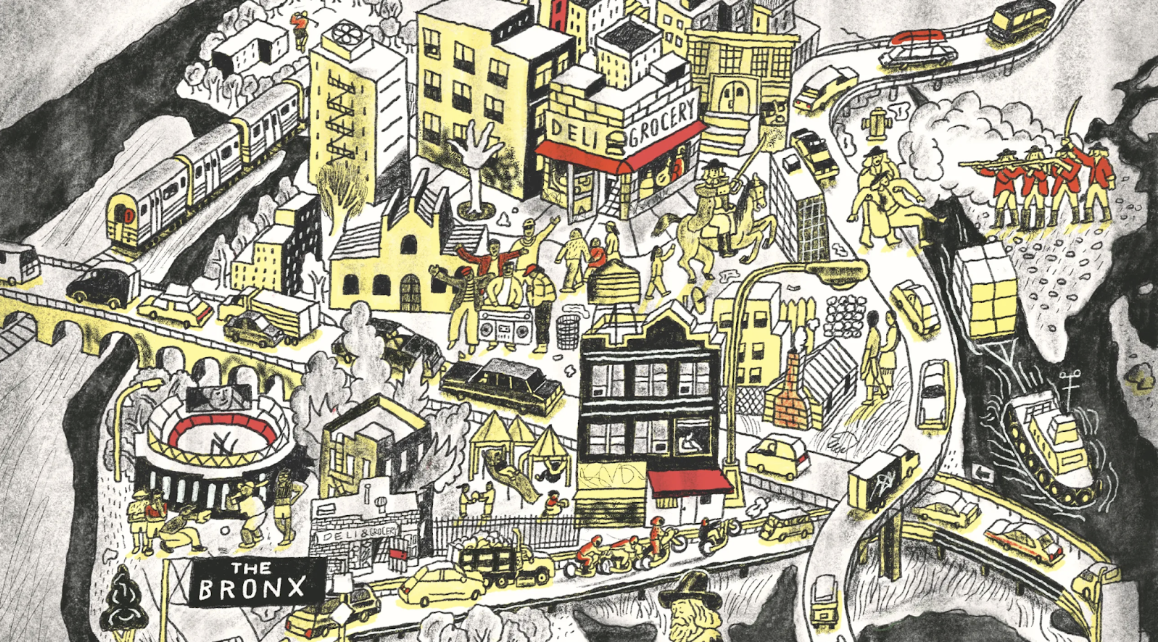
Drawing of the Bronx, Image via The New Yorker
***
Fordham University prides itself on many things. One of which is their motto, “New York is my campus. Fordham is my school.” Fordham, like other New York City universities, harbors a deep adoration for its location, being in one of the world’s most significant cultural hubs. The artistic, educational, and social opportunities for college students in New York City are unparalleled to those of any other location in the nation. Fordham recognizes this and makes it paramount that their students explore all the city has to offer.
What makes Fordham University unique in comparison to other New York City colleges is its two NYC campuses. In the 1950s, Fordham University was invited to be part of the Lincoln Square Renewal Project, a new performing arts complex on the West Side of Manhattan, which led to the genesis of its Lincoln Center Campus. Fordham’s Lincoln Center Campus spans 8 acres and features a landscaped plaza. It is home to over 7,000 undergraduate and graduate students across seven of Fordham’s different schools. Fordham’s Lincoln Center is perfect for students who want to stray away from the idea of a traditional college campus and want to experience life in the heart of Manhattan. Oppositely, Fordham’s Rose Hill, located in the north Bronx, provides students with a more orthodox campus experience, with “85 acres featuring Gothic architecture and tree-lined walkways.” Established in 1841, Fordham’s Rose Hill Campus is one of the oldest universities in New York State.
Fordham’s Rose Hill Campus is located in the heart of a bustling Bronx neighborhood and is just minutes away from the New York Botanical Garden, Edgar Allen Poe Cottage, and Bronx Zoo. Despite its surrounding cultural richness and historical landmarks, the Rose Hill Campus often receives significant criticism for its location. Just a few months ago, a Fordham University at Rose Hill freshman, under the username @am.randle, posted a video about the pros and cons of attending Fordham for prospective students. She begins the video by prompting prospective students to ask themselves what draws them to Fordham, and if it’s the idea of New York City, they should consider other schools. The creator describes the Rose Hill Campus, where she attended her first semester, as in a “not so great area” and “nothing like Times Square.” She goes on to say that if you’ve only ever been to Times Square and associate New York City with that picture, “this is not the New York you’re expecting.”
The TikTok was met with almost immediate criticism from New York City residents and Fordham Rose Hill Students. The comments of the video included discourse regarding the Bronx as being labeled an “unsafe” borough, along with critiques of NYC “transplant culture.” Despite the students’ video being met almost immediately with disagreement, distaste for the location of Fordham’s Rose Hill Campus is widespread in conversations about New York City colleges, with people raising concerns about safety surrounding the campus. In 2019, the violent crime rate in the Bronx was 6.81 per 1,000 residents, just ~2 higher than that of Manhattan. Despite the slight disparity in crime rates between these two boroughs, New York City transplants have deemed the Bronx a place of danger, chaos, and low-income.
The violent crime rate of the Bronx can be attributed to its poverty rate. The poverty rate in the Bronx is higher than that of other New York City boroughs, sitting at 27.9% compared to the citywide rate of 18.2%, according to a 2023 survey by the NYU Furman Center. High levels of poverty, such as these, contribute to higher crime rates, as many residents are forced to resort to crime to meet a standard quality of life.
The Bronx is also currently the least gentrified of the 5 New York City boroughs, which is crucial to note in its criticism. As of 2023, the Bronx population is ethnically composed of 55% Hispanic residents, 31% Black residents, and just 15% white residents. While New York City is known as a melting pot of culture, the Bronx remains the only borough still primarily made up of Native Immigrants. With the growth of gentrification in Brooklyn, Manhattan, and Queens over the past 10 years, many native New York City residents have been displaced and forced to move from their homes due to rapidly rising living costs. In 2019, it was reported that there were 314 gentrified, exclusive neighborhoods in the city, and this number has only increased since then. While gentrification has begun to hit the Bronx in the past few years, taking the number 1 spot for development among the 5 boroughs just two years ago, it has yet to completely reap the unjust displacement and cultural cleansing caused by gentrification.
To label the only remaining culturally diverse, affordable, and predominantly native New York City borough “dangerous” and “incomparable” to Manhattan is effectively erasing the area’s cultural significance and erasing New York City’s history as a place where anyone, regardless of background, can make a living. Being the only borough not overrun by aesthetic pop-ups and overpriced matcha, yet still home to immigrant-owned fruit stands and discount stores, the Bronx scares aspiring New York transplants. It is paramount that we, as New Yorkers, abandon the ideology that the Bronx is a dangerous, soulless area and instead appreciate the cultural and social enrichment it offers before it becomes another tourist-catered, unaffordable borough. We, as Fordham students, must abandon the harmful rhetoric of the Bronx and instead work to bolster the borough’s image.
***
This article was edited by Samantha Poillucci.
 Saad Sandhu
  Campbell Brown
  Christian Dziura