
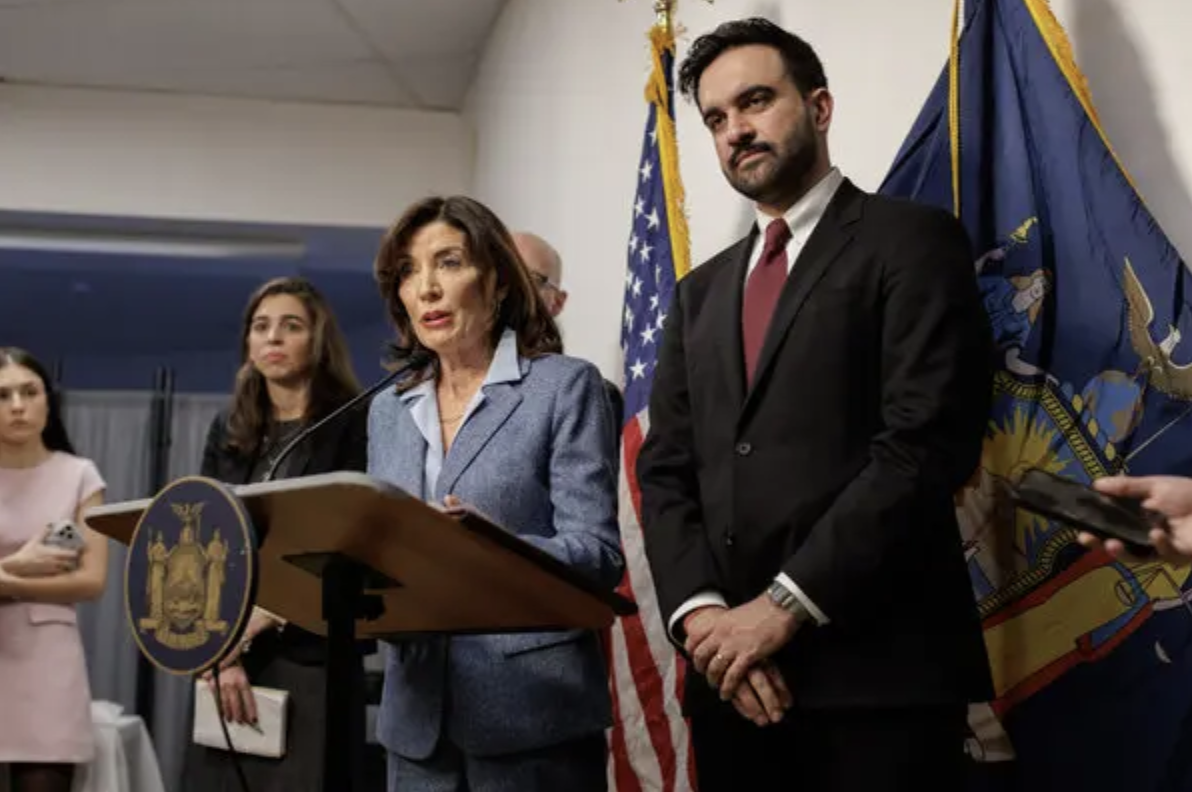
Image via New York Times
***
On April 15, 2026, New York City Mayor Zohran Mamdani and Governor Kathy Hochul unveiled a historic proposal: a pied-a-terre tax on ultra-luxury second homes, the first in the city’s history. Under the plan, any single-family home, condo, or co-op in NYC worth over $5 million would face an extra annual surcharge if its owner’s primary residence is elsewhere. The city estimates roughly 13,000 properties would be affected, generating about $500 million in new revenue each year. Mamdani called it a levy on the “richest of the rich,” even citing billionaire Ken Griffin’s $238 million Central Park penthouse as an example of “wealth […] stored in the city” without being taxed properly. The measure is pitched as a way to have ultra-wealthy non-residents help close New York’s budget gap, which Mamdani has estimated at roughly $5-12 billion.
A pied-a-terre, translating to “foot on the ground” in French, refers to a secondary city dwelling; a luxurious Manhattan loft or townhouse that someone keeps but does not occupy full time. The new tax would apply only to those non-resident owners of homes over $5 million—locals who own multiple houses are exempt. In practice, this means, for example, a Connecticut banker or an overseas investor would pay it on their idle NYC condo, but a full-time city resident living in a $6 million apartment would not. Media reports say that the surcharge will likely be graduated: on the order of ~0.5% of value on the lowest end, just over $5 million, up to perhaps ~4% on ultra-high values above $25 million. There’s even an incentive to keep a unit rented: if the property is leased to a year-round tenant, the owner would not owe the surcharge.
The tax comes against a backdrop of NYC’s long running budget woes. Mamdani inherited a multi-billion-dollar deficit, which he initially estimated at approximately $12 billion, before cuts and one-time state aid whittled it down to approximately $5 billion. The city can raise property taxes only so much, and it has no power to hike income or sales taxes without state approval. Over the past year, progressive city officials had been demanding higher levies on the rich, from corporate taxes to millionaire surcharges, to fill the gap. Until now Gov. Hochul had resisted those calls, warning that too many taxes might drive businesses away, but by Tax Day she struck a compromise with Mamdani.
Hochul explained that taxing only out-of-city homeowners would “stabilize the city’s finances” without overburdening ordinary New Yorkers. She states, “If you can afford a $5 million second home that sits empty most of the year, you can afford to contribute like every other New Yorker.” She also noted that other cities—Paris, Toronto, etc—already impose similar taxes on vacant luxury units for “fairness.” The pied-a-terre tax is only one piece of the puzzle; even supporters acknowledge it won’t close the entire budget gap, but it marks a notable shift toward taxing wealth as a way to fund subways, housing, and city services.
Unsurprisingly, reactions split along familiar lines. On one hand, many Democrats and progressive groups applaud at the plan as a win for fairness. Advocacy organizations like the Fiscal Policy Institute called it a “significant advancement towards implementing progressive taxation,” noting that it taps into the city’s immense wealth to fund critical needs. City Council Speaker Julie Menin praised the tax as “smart, sensible,” a way for the global superrich to repay the city for its safety, perks, and amenities. Manhattan Borough President Brad Hoylman-Sigal likewise argued that this is about equity. If billionaires park their money in NYC real estate, “they should appropriately contribute to the subways, schools, and public services that protect and sustain” that investment. At a public forum on Tax Day, Nobel laureate economist Joseph Stiglitz pointed out that over the past 25 years, the top 1% captured about 41% of all wealth gains, underscoring for him the need to tax idle luxury assets. Mamdani stressed that this is recognition of the growing inequality in New York, and that the real exodus is of working-class New Yorkers priced out of the city—not billionaires fleeing to lower taxes.
On the other hand, business and conservative voices expressed alarm. Prominent investors immediately warned the surcharge could drive money out of the city. Hedge-fund titan Bill Ackman tweeted that Mamadani’s “tax the rich” policies would “harm the constituencies he is supposedly trying to help,” while fellow investors Carl Icahn and Daniel Loeb hinted they might relocate businesses if the tax proceeds. Silicon Valley entrepreneur Jason Calacanis blared on social media that “NYC is cooked” once the news broke. Real estate leaders warned of unintended side effects: Bess Freedman, CEO of luxury brokerage Brown Harris Stevens, pointed out in an internal memo that a surcharge on the ultra-wealthy would “ripple” through prices at all levels. As she put it, when the top end of the market cools, it “compresses pricing throughout the entire market, impacting homeowners at all levels.” Skeptics also noted practical loopholes, for example, wealthy buyers might designate a normal resident or rent out the unit to avoid the tax. Conservative commentators went further, comparing the idea to “taxation without representation” since the owners being taxed often have their primary vote in states like Florida or abroad, not in New York. Even the most ardent advocates concede the levy could spur legal and economic pushback if not crafted carefully.
Looking ahead, the tax’s fate and fallout will be telling. If approved in Albany’s 2026-27 budget, the pied-a-terre surcharge would add significant revenue, but probably only scratch the surface of New York’s fiscal needs. Some analysts warn that unless paired with broader reforms—like higher corporate or income taxes—the city may still face tough deficits. Indeed, just before the tax was announced, a coalition of 20 City Council members urged the state to raise the city’s corporate tax rate on Big Business. Meanwhile, landlords and lobbyists will surely pressure for carve-outs or gradual phase-in. Mamdani counters that targeting residences over $5 million is not discouraging jobs or growth, given that those buyers have already invested in the city, and again points out that working families, not billionaires, are in crisis. He argues the question is who will “pay back into the city” for all the wealth it generates, and in his view the idle rich should chip in more.
In sum, New York’s pied-a-terre tax is as much a political statement as a policy fix. It crystallizes the city’s debate over fairness in hard times: should the hidden wealth of empty mansions help fund subways and schools? Or will such taxes chill the investment climate? The answer will come only after Albany acts and the law takes effect. However, one thing is clear, New York has truly begun to experiment with taxing the ultra-rich in this novel way. How that experiment fares will influence not just this budget season, but the long-term question of who really pays to keep New York City running.
***
This article was edited by Peter Leyba and Madison Boyd.
 Saad Sandhu
  Campbell Brown
  Christian Dziura