
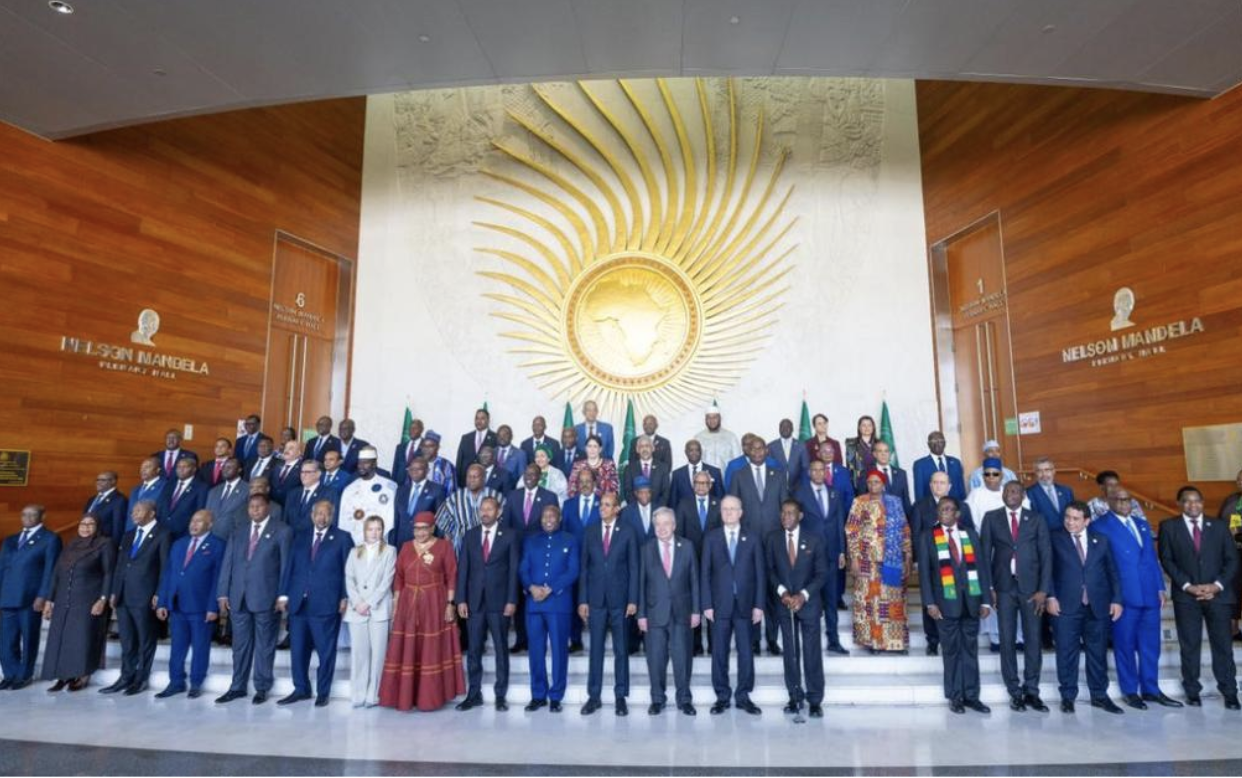
Photo via the African Union
***
Buried beneath hundreds of pages of domestic policy, the Heritage Foundation’s Project 2025 includes a peculiar proposition: “the recognition of Somali statehood as a hedge against the US’ deteriorating position in Djibouti.” While overlooked, it represents a transformative shift in American foreign policy. Somaliland, at that point, had been regarded as a breakaway state of Somalia, unrecognized by the international stage. In December 2024, Representative Scott Perry introduced the Republic of Somaliland Independence Act, which aimed to establish federal recognition of the nation. In December 2025, Israel would become the first and so far only country to recognize the nation, a move that could indicate that the US plans to do the same.
The status of Somaliland represents a larger battle in the continent between global powers—namely the United States (and the West more broadly) and China—vying for regional hegemony and how these actions both represent important developments and continuities of foreign intervention in Africa.
The Cold War in Africa
African decolonization took place during the height of the Cold War between the United States and Soviet Union. While international attention tended to focus on proxies in Asia and Europe, the Soviet Union considered African countries as a vital battleground in the fight against Western powers and supported independence movements in the aftermath of World War II.
The United States—under its policy of containment against communism—initially supported other NATO members such as France and Portugal in quelling independence movements in their African colonies due to fears of Soviet influence in these new nations. However, it later shifted its support to anti-communist governments in the continent, often choosing to overlook issues of corruption and economic mismanagement by these leaders.
Though some African countries leaned towards Western or Soviet spheres of influence, many followed a policy of neutrality—refusing to take an official stance in the Cold War and instead encouraging cooperation. In 1961, the Non-Aligned Movement met for the first time in Belgrade, Serbia, with some of the founding delegates coming from African countries, including Egyptian President Gamal Abel Nasser and Ethiopia’s Hallie Selassie. Today, the organization includes over 120 members, including every African nation, reflecting the continued commitment of many developing countries to work outside the hegemony of global powers.
Western vs. Non-Western influence in the Modern Era
In the past few decades, China has increased its influence in African countries through economic support. In 2009, it surpassed the United States as the continent’s main trading partner and has continued to invest billions of dollars into the continent.
However, the country’s most ambitious tool has been its Belt and Road Initiative, an infrastructure project that has since received some form of support from a large portion of the globe, including many African countries. While the program has the potential to massively develop infrastructure to meet the demands of a growing population, it has also been accused of serving as a ‘debt trap’ for developing countries who often struggle to pay back Chinese loans. A recent example was Kenya converting billions of dollars in loans into yuan to cut interest payments in an attempt to cut their debt.
Though it has been in effect since the Cold War, the policy of Francafrique has also defined Western power in Africa. This term has often been used to refer to French influence on many of its former African colonies; this has manifested in the form of military bases and most notably the CFA franc, a currency used by many of these countries which is tied to the French currency (the euro, the franc prior to 2002). While defenders of the currency argue that its use offers countries financial stability, critics point out that this system harms their development using a system intended for wealthier countries. This debate highlights a broader concern that France utilizes a system of neocolonialism in the continent that exploits these nations and the people who live in them.
The backlash against Francafrique materialized when military juntas in Mali, Burkina Faso, and Niger overthrew French-aligned governments between 2020 and 2023, in a wave of broader instability across the Sahel region. The African Union suspended the trio of nations for their coups; amidst unsuccessful negotiations with Economic Community of West African States (ECOWAS), they left the organization and instead formed the Alliance of Sahel States, feeling that the previous group had been inefficient in combatting the issue of extremist violence plaguing their nations.
Ibrahim Traore, the head of this group and the current leader of Burkina Faso, took power in a 2022 coup (his predecessor had taken power in a different coup earlier that year) has particularly taken a hardline stance against France, which included the three AES members expelling French troops. This position has led him to be considered by some as an anti-imperialist icon, even with his regime being considered to be increasingly autocratic and ineffective in dealing with terrorism.
In lieu of France, Traore has increasingly looked towards a new ally: Russia. He has welcomed the Wagner Group, a paramilitary group backed by the Russian government which has operated in several African countries, and worked with the country in the planned construction of nuclear energy plants in Burkina Faso.
Returning to Somaliland, the United States has aimed to establish a stronger foothold in Africa. Rep. Perry’s press release during his bill’s reintroduction stresses the importance of allying with Somaliland, including access to the Gulf of Aden and combatting regional piracy and extremism. More significantly, it mentions the threat of China and other hostile actors, emphasizing this move as part of a global initiative to maintain authority.
Another key reason for this push is the “deteriorating position in [neighboring] Djibouti,” mentioned in Project 2025. A small nation in the Horn of Africa, has maintained an outsized influence on the global stage due to its location at the Bab-el Mandeb, a narrow strait where nearly 12 percent of maritime trade passes through on a daily basis. Many nations including the United States have military bases in the country, and it has been seen as a key Western ally in an unstable region. Recently, the nation has established closer ties with China, especially with its own military base, which has raised concern with the United States and other Western powers.
The United States has also responded to Chinese influence in other ways. It recently increased its investments in Africa to outpace China, and declared Kenya as a Major Non-NATO Ally (MNNA)—the first nation in Sub-Saharan Africa to receive this designation.
The Future
China and Russia’s growing focus on the African continent highlight their position as being an alternative to Western powers that have long been associated with imperialism, just as the Soviet Union before them. The United States has responded in kind, increasing its own presence to counter them.
The most underlooked part of this conflict is its impact on native Africans. Of the 44 nations that the UN has classified as “Least Developed” based on scores in health, income, education, 32—almost three quarters—are in Africa, with over half of the continent’s countries being on this list. In the decades since independence, these nations have continued to battle issues including poverty, instability, and inequality. Amidst the involvement by global powers, it remains to be seen whether all the aid and investment translates to genuine improvements in the lives of ordinary people who find themselves in the crossfire of this geopolitical battle.
***
This article was edited by Abigail D’Angelo.
 Sidney Levitt
  Saad Sandhu
  Abby Coxe