
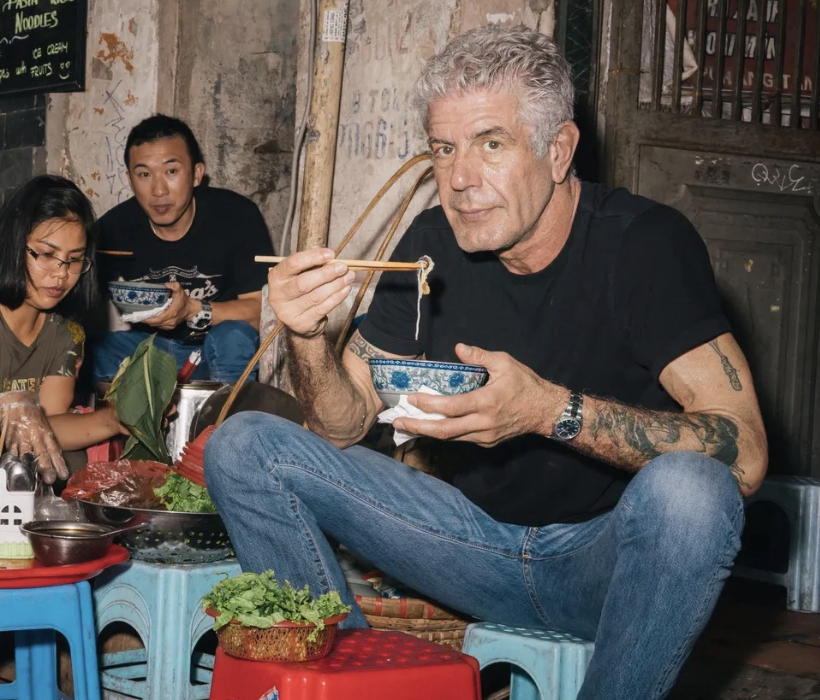
Photo via William Meban/The New Yorker
***
In a world filled with prejudice and division, I often wonder if, as a species, humanity will survive the violence and otherization we perpetuate based on fear of people who appear different from us. Whether this variation is visible through the color of your skin, or if the discrepancy between you and someone else lies in the languages you speak, the religions you follow, or the political identities you adhere to, truly, how different are we from one another? Is there a way to discover these differences while simultaneously recognizing a communal sense of humanity? To answer these questions, I point to (what I refer to as) the “Bourdainian Method.” Traveling and experiencing diversity through food, whether it be by sharing a meal with a stranger or simply trying a new dish, we may begin to focus on the connections and the pleasure food (something essential to our survival) brings to humanity as a whole.
Anthony Bourdain, from whom I coined the “Bourdainian Method,” was a chef-turned-television personality and author who devoted his career to exploring culture through cuisine. He advocated for movement, “as far as you can, as much as you can, across the ocean, or simply across the river. The extent to which you can walk in someone else’s shoes or at least eat their food, it’s a plus for everybody. Open your mind, get up off the couch, move.” Bourdain showed many parts of the world, unpretentiously, through the lens of empathy and humility; teaching the world that “it’s a privilege to sit at someone’s table,” try their food (an extension of their culture and history), and hear their story.
However, this mindset is easier said than done.
In a technical age where algorithms dictate much of the content we consume, even in an era of online diversity and globalization, many in “smart societies” (characterized by extensive use of technology and data-driven algorithms) find themselves stuck in echo chambers. “Where users are isolated from diverse viewpoints,” and algorithmic biases consistently reinforce preexisting opinions and perspectives rather than challenging them—an execution of confirmation bias and reinforcement theory. Along with the troubles of exposure, broadening one’s perspective and admitting ignorance is uncomfortable. Questioning the lens through which we see the world can often leave our foundation of morality, knowledge, and understanding bare. Therefore, although ignorance is detrimental to us as a whole, it is often comforting and stable.
Which is why I propose the following “Bourdainian Method” to simplify and make Bourdain’s approach to exploring culture more accessible:
- Take advantage of the diversity around you. International travel can be very daunting and expensive; however, you do not have to fly across an ocean to taste a different cuisine. You can move “simply across the river” or into another neighborhood and feast upon new delicacies—broadening your palate.
- Open your mind to the possibility that “the world is filled with people doing the best they can,” just as you are. And in that, we may find common ground. The “extent to which you can see how other people live seems useful at worst and incredibly pleasurable and interesting at best…it confirms the basic truth that people everywhere are pretty much the same.”
- Most importantly, “be humble [and] be grateful.” A mindset of ignorance is typically a mindset of superiority. Breaking down the walls that separate you from others, while simultaneously being grateful for the intimate experience of connection, allows for a genuine bond that may bridge the gap to understanding.
The violence and otherization we inflict upon one another seem never-ending. It may be a human condition. Even after watching Bourdain bridge the gap between himself and the rest of the world, I am still aware that it takes more than one person to undo what is perpetually dividing humanity. So will we survive this? I am not sure. However idealistic, I wish for people to begin cultivating an environment where we can make an effort to understand one another and recognize what we collectively share, rather than what we may disagree upon.
***
This article was edited by Abigail D’Angelo.
 Sidney Levitt
  Ayden Suber
  Saad Sandhu