
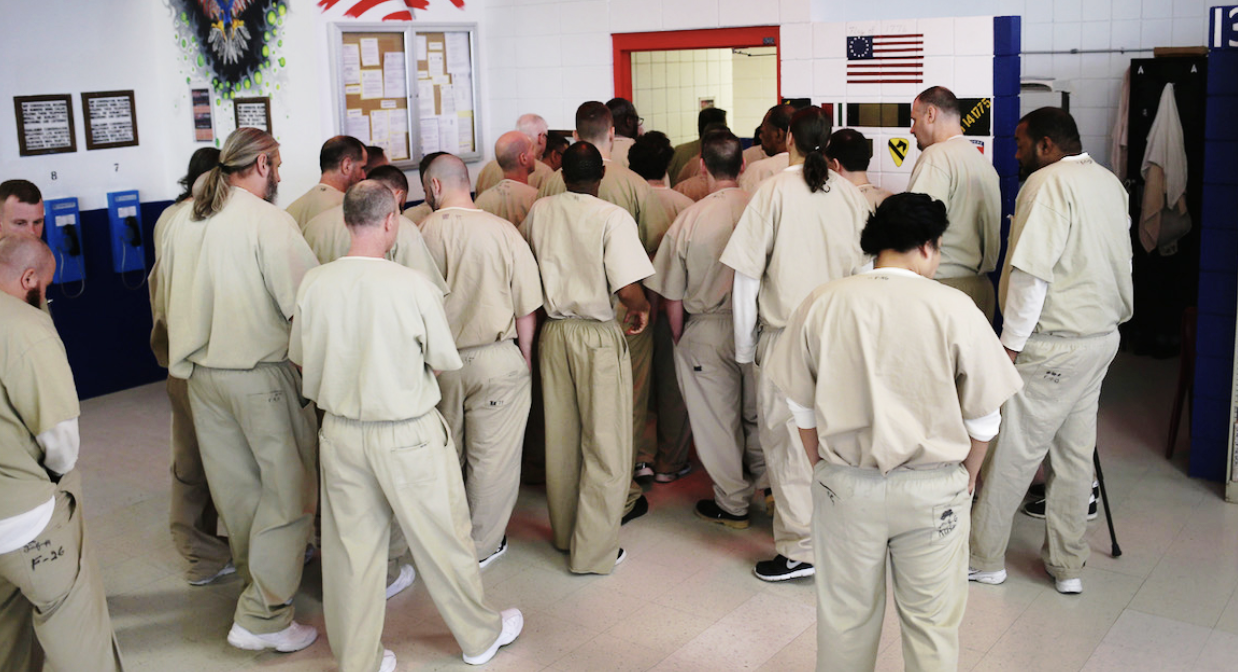
Photo via Politico
***
In the United States, debates over voting rights for incarcerated individuals frequently return to a familiar clause in the Fourteenth Amendment: its allowance for disenfranchising those who are involved in “rebellion or other crime.” Some policymakers argue that the Amendment grants states a vast authority to deny incarcerated people the vote, while others contend that the Constitution itself demands inclusion. In legislative hearings and editorials, the same refrain appears: this is what the framers intended; this is how democracy protects itself. After all, the Amendment was written at a time when the nation was still recovering from the Civil War, and its authors had reason to fear that former Confederates might attempt to regain political power through the ballot box. The provision was created for a country struggling to reunite, wary that those who had fought to destroy the Union might use electoral power to finish what they had started. In that historical context, the logic was understandable. Even today, many Americans share the same sentiment that individuals in jail could unfairly influence election outcomes. One poll by the Heritage Foundation found that seventy-five percent of Americans disagree with the argument that voting rights should never be taken away from felons under any circumstances.
However, the people incarcerated today are not remnants of a defeated rebellion; they are our neighbors, family members, and community members living entirely under the state’s authority. They are counted in our districts, governed by our laws and affected by every policy elected officials enact, yet they are stripped of any political voice in choosing those officials. Relying on a 19th-century interpretation of the Fourteenth Amendment to silence contemporary prisoners’ transforms a narrowly constructed provision into a mechanism for mass exclusion. The hard truth is that a consistent democratic system would extend the right to vote to all incarcerated individuals, regardless of the nature of their offense. Still, if that seems too harsh, even a more limited reform would move the country toward greater fairness. Allowing individuals nearing release, or those on probation, to participate in elections would reconnect them to the civic world they will soon reenter. This more modest step would strengthen political equality without requiring sweeping constitutional change.
The modern expansion of felony disenfranchisement under the Fourteenth Amendment rests on a small provision originally intended to address rebellion, yet it has become a convenient justification for restricting the franchise. This authority was established in the Supreme Court ruling in Richardson v. Ramirez (1974), 418 U.S. 24, which affirmed states’ authority to revoke voting rights from citizens with felony convictions because the Amendment explicitly referenced “participation in rebellion, or other crime” as grounds for denying suffrage. Legislators and courts have repeatedly relied on this case as precedent to defend expansive disenfranchisement statutes. Richardson thus became the legal document for mass voting exclusion, despite the Amendment’s original purpose.
However, the expansive power and limits to interpretation of this case were later acknowledged by the Supreme Court in another case: Hunter v. Underwood (1985), 471 U.S. 222. The Court unanimously struck down an Alabama constitutional provision that disenfranchised individuals convicted of so-called “crimes of moral turpitude,” a category created in 1901 to target Black citizens for political exclusion. The Court found clear evidence that delegates had designed the law to “establish white supremacy” by selectively criminalizing behaviors more likely to be attributed to Black residents. At the time of the lawsuit, Black Alabamians were disenfranchised at nearly ten times the rate of white residents for the same offenses. Hunter therefore established that Richardson does not fully shield disenfranchisement laws from constitutional investigation when they come from racially discriminatory intent. This limitation reflected the Court’s own recognition that a broad disenfranchisement interpretation can violate fundamental constitutional principles. Contemporary incarceration patterns further demonstrate how the phrase “other crime” in the Fourteenth Amendment has been weaponized beyond its intended power of addressing rebellion.
As illustrated by the reasoning in Hunter V. Underwood, preventing incarcerated individuals with felonies from voting would disproportionately affect minorities. In the 1800s, state laws and constitutions specifying disqualifying crimes often focused on offenses associated with the formerly enslaved people, while excluding serious crimes such as murder, which were considered “white crimes.” Today, states with larger non white populations are more likely to ban convicted people from voting than states with proportionally fewer nonwhites in their criminal justice system. According to the Sentencing Project, approximately 7.7% of Black adults in America are unable to vote due to disenfranchisement. In some states,including Virginia, Kentucky, and Tennessee, the rate rises to 20%. Nationwide, voting rights have been revoked for 2.2 million Black citizens, who represent 38% of all disenfranchised Americans. Only Vermont and Maine, the nation’s two states with the highest white populations, allow incarcerated individuals to vote. Meanwhile, many other states deny voting rights to prisoners while still counting them toward the population totals of their prison locations, which are frequently rural areas with predominantly white residents. This practice increases those districts’ political representation. Senator Bernie Sanders even published an opinion piece in USA Today arguing that prison voting could serve as an antidote to what he characterized as a systemically racist criminal justice system that enables “mass incarceration” as a “tool for voter suppression.” Due to aggressive policing in specific neighborhoods, socioeconomic precarity, and systemic biases, the disenfranchisement of marginalized individuals guarantees that the populations most damaged by inequitable policies possess the least political leverage to contest them.
Some argue that incarcerated individuals lack the literacy and civic knowledge necessary for meaningful electoral participation, framing disenfranchisement as practical rather than punitive. This perspective draws support from barriers including: assistance with legal documents shows that many incarcerated individuals struggle with reading and writing, potentially making ballot completion difficult without support. Mobilizing volunteers to work with incarcerated populations presents logistical obstacles, particularly when inmates themselves may lack motivation for civic engagement. These realities agree with the notion that prisoners cannot participate effectively in democratic processes. However, low literacy rates and limited access to information do not justify removing the right to vote altogether. Many incarcerated individuals may not exercise the right even if granted it, but the possibility of low turnout is not grounds for exclusion. States already provide ballot assistance to non-incarcerated citizens who require support, regardless of literacy level or disability, as enforced by the Voting Rights Act. Accommodations are considered standard practice in ensuring electoral accessibility. Furthermore, opportunities for incarcerated individuals to pursue education remain limited as college and high school degree programs are largely inaccessible within correctional facilities. If illiteracy presents a barrier to prison voting, then educational programming should become mandatory and universally available rather than used as a justification for exclusion. So, while many incarcerated individuals do lack civic knowledge, the fundamental challenge is not inmates’ capabilities, but rather systemic failures to create accessible information and support.
A key point to highlight is that part of becoming an incarcerated individual means temporarily losing freedom. Felons lose many freedoms that law-abiding citizens enjoy. Personal liberty, the freedom of speech and expression, the right to privacy, and numerous other constitutional guarantees are either nonexistent or severely curtailed in prison. Many Americans instinctively believe that individuals who violate society’s rules should temporarily surrender certain privileges, including the right to shape those rules through voting. From this perspective, voting is viewed as a privilege earned through lawful conduct, embodying a principle of accountability that seems intuitively just. After all, citizenship carries responsibilities constructed on mutual trust, and violent crimes such as murder, assault, and robbery represent a massive breach of both legal and moral obligations, causing lasting trauma to victims and communities. Protecting society and maintaining accountability for grave offenses appears to be a legitimate governmental function, making disenfranchisement seem like a reasonable consequence of serious wrongdoing.
However, this accountability collapses when confronted with the reality of who is actually being silenced. According to the Jail Data Initiative, nearly 70% of the U.S. jail population consists of individuals awaiting trial, people whose guilt remains legally unestablished and many of whom may ultimately be acquitted or released without a felony conviction. Many behind bars, even those who have not been convicted, feel like they are no longer citizens of the country. For example, in an article by NPR, one formerly incarcerated individual told the reporter after voting for the first time that, “It was the first time I did not feel like property of the state in almost 10 years.” Having the right to vote in prison can serve as a reminder to inmates that they are still human. They are not part of a different world, and at the end of the day, they are citizens with constitutional rights like the rest of us.
Denying someone in prison the right to vote does more than punish them. It makes them powerless over systems that hold their life in their hands. For those preparing to return to our communities, their ability to find a home, a job, and a second chance relies on opinions decided at the ballot box. So, while good behavior was not examined prior to incarceration, taking away their vote removes a tool for rebuilding their lives and becoming the accountable citizens we say they should be. After all, trust once broken needs to be rebuilt in some way, and proving responsibility and citizenship through voting is a good start. A truly democratic system recognizes that citizenship is not conditional, that political voice should not be treated as a reward for good behavior and that governance without consent is fundamentally unjust, especially when the burden of disenfranchisement is unequally placed on marginalized communities. The Constitution, at its heart, is a document that promises belonging. That promise is not fulfilled through exclusion from democratic participation but through the recognition that even those behind bars remain part of “We the people.” Whether through comprehensive reform restoring voting rights to all incarcerated individuals or incremental steps that begin with non-violent offenders and those nearing release, the path forward requires us to acknowledge a simple truth: the incarcerated deserve a voice.
***
This article was edited by Karol Quinde.
 Sahir Sadat
  Amelia Felice
  Nathan Wellman